
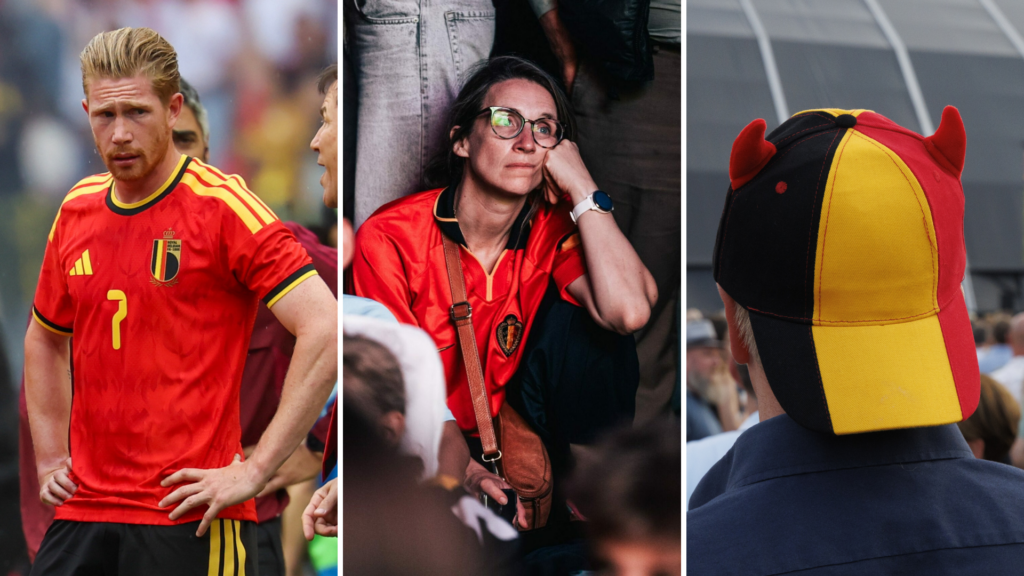
We all know the feeling the morning after a sporting elimination.
For a few weeks, knowing that at 2am you were going to wake up, plod to the living room and watch your country play and win was keeping you buoyant. Not only buoyant, but also hopeful that they might actually lift the cup.
Then that’s it. The battling Red Devils, mighty Norway, valiant Morocco. Gone. No more.
You feel the air gasp out of you like a deflated balloon; you wake up like someone has run you over with a truck. You’re somewhat off-balance, cheerless, melancholic even. You spend the day ruminating on the possibility of turning back the clock to a nano-second before that wrong pass, or before the ball hit the crossbar. If only, if only…
The science behind your feeling of deflation
As it happens, there is a reason you feel, as you say, emotionally drained. For the brain, World Cup games are not ‘just’ games. Sport taps into our ancient survival wiring. As humans, we evolved in tight-knit groups where teamwork shaped survival.
It took a good number of people to catch an antelope for dinner, or to fend off a clan of ravenous hyenas. Collective identity meant strength, and strength meant survival and plenty of food, whoops and cheers.
In contrast, group failure signalled that a threat might be looming, such as, becoming the hyenas’ dinner. So, when ‘your group’ loses, your evolutionary-shaped nervous system does not say: “Oh ça va, it’s just a game.” Instead, it reacts as if something more fundamental is at stake: “Put***! C’est la défaite! Au secours!”
It does not matter that, logically, you know this is mere symbolic play. Your body is responding not to the football per se, but to the sense of belonging it triggers. This sense of belonging is why, while watching your country play, your heart rate goes up, cortisol rises, adrenaline is released and topped up by a good dose of feel-good dopamine. It mimics real-life stress responses. For the nervous system, it’s fight or flight even if you are at home, nice and cosy, watching it all play out from the comfort of your sofa.
The 'great belonging'
By way of example, when I am watching my home country team play (alas, so far only in World Cup qualifiers), I am not Kristina; I am the Malta Football Team. My identity and that of my team fuse into one. The sense of ‘we’ becomes temporarily stronger than usual. That symbolic group membership becomes a kind of Great Belonging, with a strong sense of emotional contagion.
When a Maltese player scores a goal and runs towards the camera to celebrate (keep in mind, in my case this is a rare occurrence), I feel as if he is directly addressing me. There is an outpouring of affection from me to him, this player whose name I do not even know, and to the people around me.
The belonging is why we are moved to tears at the sight of the team singing the national anthem, or when the fans in the stadium sing to the players to encourage them to keep going. You may not even know who the coach is, who the players are, and yet, you do not merely admire them, you feel them in your very heart.
Then boom. They lose, and they’re out. And you’re swamped over by an emotional aftershock. But you are not feeling low because of the match per se; it is because you were the team. It is not a “they lost”, it is a “we lost”. And it feels like a threat to your sense of belonging, to your identity.
If you are watching in a crowd, there is at least a shared sense of shock and a collective mood drop. You talk and vent with others, socially processing what has just happened; someone cracks a joke and you might even let out a chuckle. And then you somehow make your way back home, which at least means you will be moving.
But if you are watching on screen at home, you just stay sitting on the sofa. You skip the natural ‘cooling-down’ phase that normally comes with movement and social interaction – the phase that helps the body process and clear stress hormones. So, the nervous system does not fully settle after being totally switched on, and it struggles to return to its normal rhythms. The result is a low-grade stress hangover that carries into the next day. Which is where the fatigue and flat mood come from: it is emotional residue.
In brief, when your team loses, your brain is not reacting to a scoreboard – it is briefly reacting as if your social tribe has been weakened. Therefore, you have to respect that and act to restore the balance. How? Here are some tactics:
Post-exit-match toolkit
- Walk, shower, stretch, pretend you are Shakira or Burna Boy and jump up and down to ‘Dai Dai’. Stick up a picture of FIFA’s Gianni Infantino and throw darts at it – whatever works, as long as you do something physical
- Avoid doom-scrolling after losses. Why relive the painful moments? If you must look at a screen, watch funny reels of dogs playing football
- When you feel bleh, acknowledge it and tell yourself, calmly, that this is just post-match grief and not real-life distress
- Watch Early Man, the hilarious animated cartoon about a tribe of Stone Age dwellers who have to defend their land from bronze-tooled invaders in a football match
- Find your tribe and go and perform the post-match autopsy together.
Kristina Chetcuti is a Brussels-based registered health coach (UKIHCA) specialising in behaviour change and lifestyle medicine (ELMO).
