
One hundred years ago, Belgians were introduced to the belga by King Albert I. A short lived currency abolished in 1946, it was created with the aim of stabilising the Belgian franc – itself introduced in 1832 – in international currency markets.
The belga was worth five Belgian francs and its introduction created an oddity: bank notes in circulation now came with two values listed – one for Belgian francs and another for belgas. Despite their short history, belgas can still be exchanged if found.
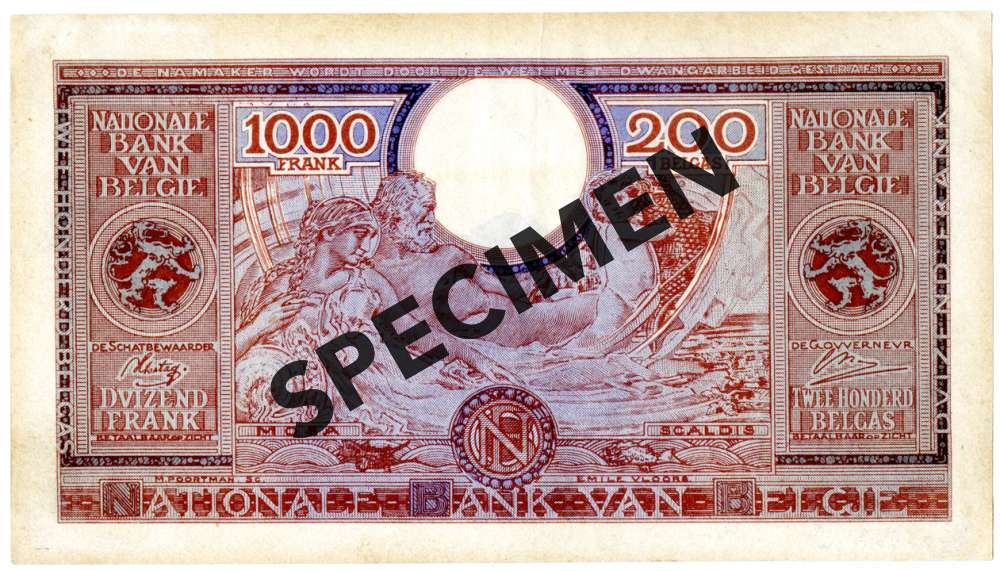
1,000 francs, 200 belgas. Credit: National Bank of Belgium
The belga is just one of a long list of currencies that have been used within the borders of present day Belgium. This includes the Dutch guilder, the French franc, the Austrian Netherlands kronenthaler, and – until 2002 – the Belgian franc.
Now, of course, Belgium uses the euro, but a sizeable share of Belgian francs are still in circulation.
According to the National Bank of Belgium, only 84% of the Belgian franc notes in circulation at the time of the euro changeover in 2002 have been exchanged. Around 50 million Belgian franc notes worth €419,283,285 were still in circulation as of 1 January 2026.
The least exchanged in terms of value are 5,000 F notes, with over 70% of these still floating around – worth over €80 million. This high number is partly explained by the fact that the 5,000 F bank note was discontinued in 1994 and was not replaced.
You are more likely to come across the 100 F bill as there are still around 30.7 million of these bank notes in circulation. According to the National Bank, their total value is worth just over €76m.
Can you still exchange Belgian franc coins and notes?
All banknotes issued by the National Bank since 1944 can still be exchanged without any time limit. The same applies to certain banknotes with a value of more than 100 F denominated in both franc and belga, and for a few rare denominations issued before 1944.
€1.1m worth of Belgian francs were exchanged last year. The currency is permanently pegged to the euro at €1 to 40.3399 Belgian francs, a value which has not changed since it was set in 1999.
Over 11,683 Beyeart-type 100 F notes were returned in 2025. This highlights the historic nature of Belgian francs still in circulation, since the Beyeart-type notes were first issued in 1978 and withdrawn from circulation in 1996.
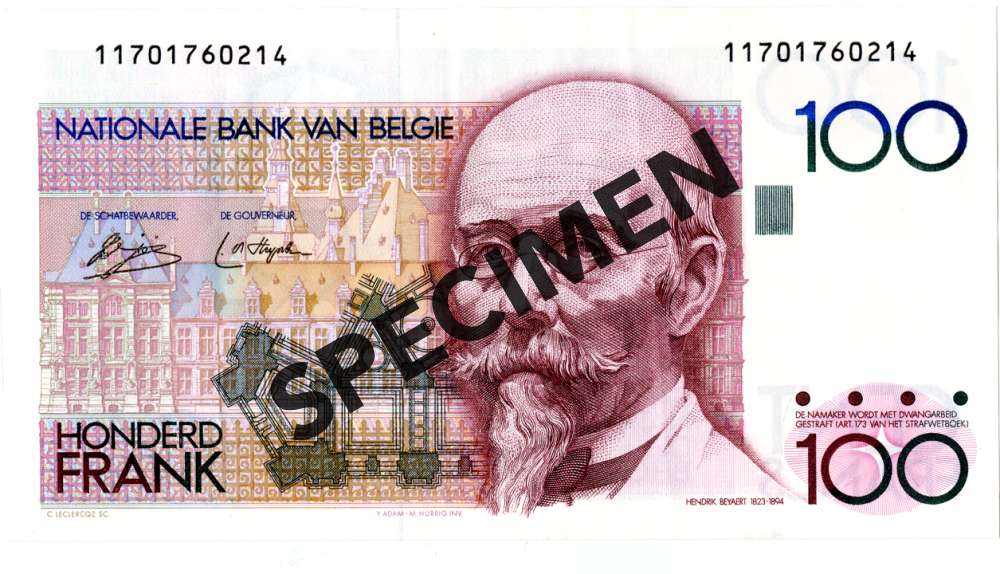
100 Belgian franc note. Credit: National Bank of Belgium
There are also €188m worth of historic coins still in circulation. However, while most notes can be exchanged (with the exception of the 20 and 50 F notes), the deadline for returning coins passed in 2004.
The National Bank told The Brussels Times that "the easiest way to recognise a Belgian franc is simply to look for the words “Banque nationale de Belgique” or “Nationale Bank van België” printed on it."
A helpful list of bank notes, and whether they can be converted, is available on the National Bank website.
Notes can be exchanged at the National Bank in person and under certain conditions by international post, although they stress that sending bank notes by bpost is no longer permitted.
What other bank notes might you see in Brussels?
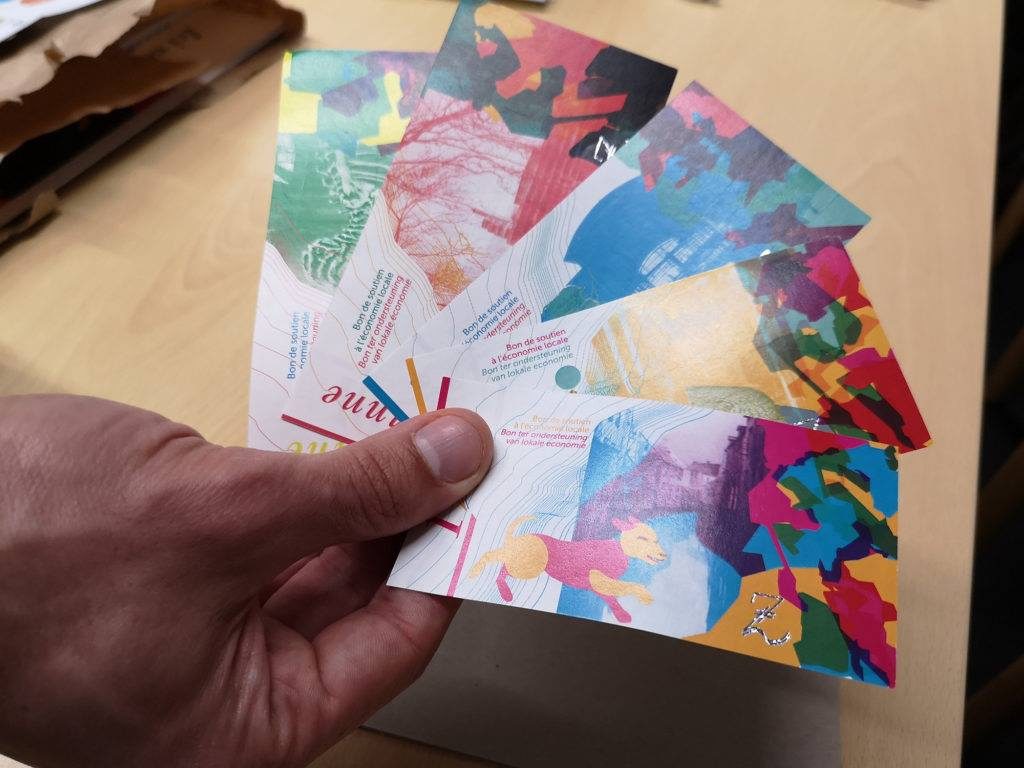
Aside from the euro, people living in Brussels may also come across another local currency called the Zinne.
Launched in 2019, there are 127,610 Zinnes in circulation, each backed by a euro in a reserve savings account. These are accepted at over 220 businesses in Brussels, a figure that has grown from 90 at its launch.
The Zinne is pegged to the euro at a rate of one to one, and can be exchanged in person or through an app.
Miriam Dean, a spokesperson for the currency, set out the aims to The Brussels Times. "The currency moves through a short circuit, and stays there: you buy your bread in Zinnes, the baker orders flour in Zinnes, their supplier pays rent in Zinnes, and so on – all within a distance no longer than between Berchem and Auderghem."
In addition, the euros in the savings account are used to provide loans to local businesses. Businesses can apply to join the network as long as they accept Zinnes as a form of payment and make commitments to support the local economy. This support includes using shorter supply chains and adopting ethical trading principles.
The Zinne website maps participating merchants in the network, this includes major businesses in Brussels like Palace Cinema and Brussels Beer Project.
