
The situation in the Gaza Strip and the transition to the second phase of President Trump’s peace plan have fallen under the radar with global attention focused on the current tension between the US and Iran around the Strait of Hormuz and uncertainty if it will escalate to full-scale war.
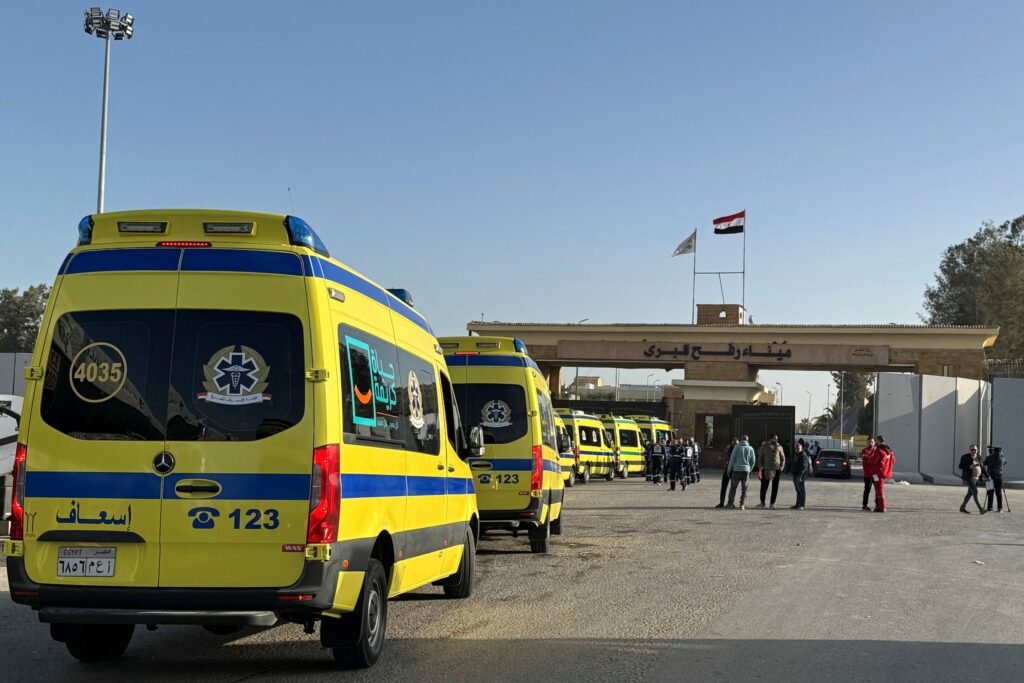
The opening of the Rafah border crossing in February, with staff from the EU Border Assistance Mission (EUBAM) supervising the crossing, was greeted as a positive step in the implementation of the peace plan.
However, the traffic is still limited. The opening was agreed between Israel and Egypt and limited to between 150 and 200 people in both directions. Sick and wounded people with their escorts are allowed to leave, and people who left Gaza during the war are allowed to return. EUBAM deploys 30 experts in border management and security from 11 EU Member States.
The total number of people who have crossed the border in both directions since its opening on 2 February until last week was 9244 (4485 entries and 4759 exits). This would make an average of slightly over 50 people per day, assuming that the crossing has been open every day. It is about the same daily number as during the first week of its opening.
EUBAM says that it has no influence on the number of people allowed to cross, but is ready to support any increase in traffic should Egypt and Israel agree. A Commission spokesperson told The Brussels Times that the EU mission on the ground is performing in line with its mandate. “It shows that the EU is playing an active role in the implementation of phase 2 in the peace plan”.
In fact, the transition to the second phase has arrived at a deadlock over the disarmament of Hamas, Israel’s withdrawal, the deployment of an international stabilization force and the entry to Gaza of the National Committee for the Administration of Gaza.
Students cannot leave Gaza
It appears that the only people who can leave Gaza without a visa are patients who need medical treatment. The Brussels Times reported last week about a Palestinian doctor in Gaza who has been granted a scholarship to study at the Institute of Tropical Medicine in Antwerp (ITM) but due to Belgian restrictions was unable to apply for a visa. At least six other Gazan students are in the same situation.
Asked if the Commission could facilitate the visa application process and coordinate their evacuation from Gaza, the spokesperson referred to the EU Member States who handle consular affairs.
While the immediate Belgian response was negative, there are signs of hope. The ITM institute said that their scholarship offer to the students remains open, should they be able to travel to Belgium at a later date.
The Belgian foreign minister, Maxime Prévot, called it "problematic" that students who have been awarded a scholarship to study in Belgium are unable to take it up because they cannot leave Gaza. "I therefore hope to be able to find a solution for them too."
The article also highlighted the problems in leaving Gaza even with a valid visa. The minister said that he is actively working towards a "realistic and workable solution for people currently in Gaza who have been granted permission to come to Belgium", including researchers and students who hold a scholarship.
According to a recent Belgian court ruling, a judge ruled that Belgium must allow visa applications to be submitted remotely but the Belgian government has so far ignored his decision. Alternatively, Israel might allow students with a scholarship to leave Gaza to apply for visa at the European consulate concerned in Jerusalem.
Early recovery projects delayed
Another issue concerns the European Commission’s announcement at the recent Palestine Donor Group Meeting (PDG) in Brussels of the launch of two major early recovery project in the areas of waste management and water security in Gaza. The Commissioner for the Mediterranean, Dubravka Šuica, referred to her “agreement” about their implementation with the Israeli authorities.
Her meeting with the Israeli foreign minister, Gideon Sa’ar, was described as positive but it is more likely that they reached an understanding without a signed agreement. A spokesperson of the Israeli ministry of foreign affairs did not respond to a request for clarification.
Asked if the two projects had already started – two weeks after the announcement – a Commission spokesperson replied that Commissioner Šuica during her recent mission to Israel stressed that the EU is ready to support Palestinians via early recovery initiatives, such as the improvement of access to essential services in Gaza (health, water, waste management).
“In this context, two major projects in the areas of waste and water management received provisional clearance after discussion with the Israeli Foreign Minister. The next step in the implementation is the technical coordination between the Commission and the Israeli unit which coordinates logistical and aid operations with the Gaza Strip (COGAT).”
“We know that conditions are not met for a full recovery, but conditions could be met for early recovery,” the spokesperson added. “We are focused on the first steps and hope that more can be done shortly. We stand ready to step up our support.”
At the meeting with the Palestine Donor Group, the Commission and its partners launched the “Team Gaza Initiative” bringing together close to 900 million euros of financial contribution to support early recovery actions in various sectors, to the benefit of civilians in Gaza.
Update: For comparison, the UK allows Gaza students to apply for visa to UK remotely. They apply for a visa while in Gaza. Once they have a full scholarship confirmed by their university, the university passes their name on to a dedicated departures team operated by the UK government.
The UK gives an initial clearance to exit, then coordinates with COGAT and the Jordanian government to secure exit permissions. They are then transported through Israel to Jordan, where they provide biometrics. After that, they are transported to the UK to take up their university places.
