
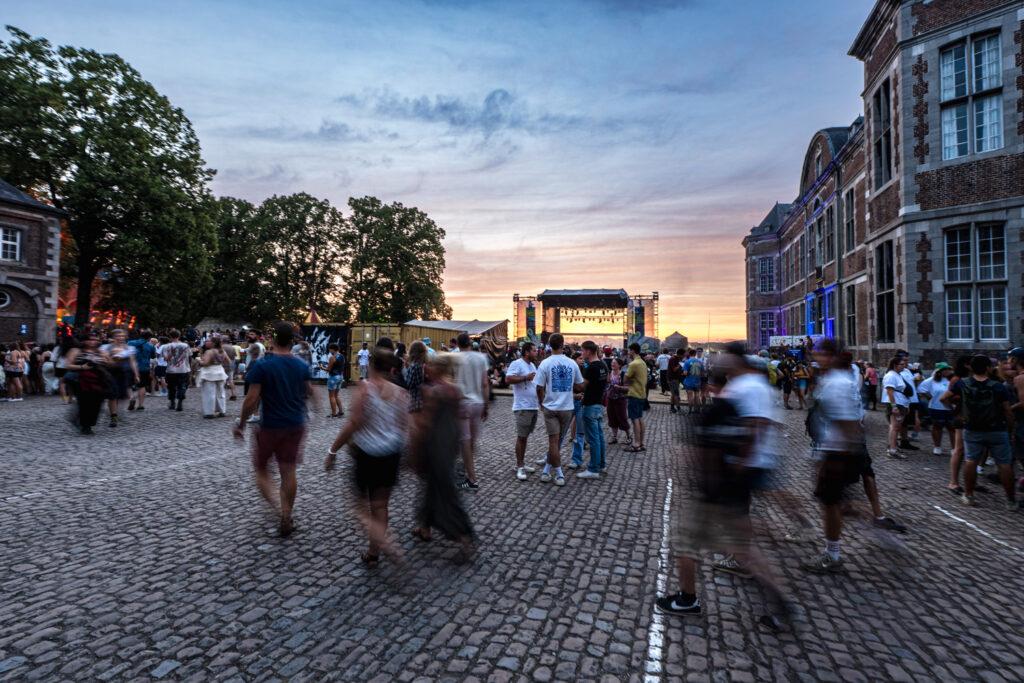
The Esperanzah! festival is set to move to a new venue in 2027 due to tensions with the managers of the historic site and the municipality of Namur.
Whilst this year’s festival has been described as a “total success” by organisers, it is “highly likely” that it will be the last to be held at Floreffe Abbey.
The desire to move elsewhere is primarily due to strained relations with the Bouvier family, who bought the abbey in May 2025.
“Organising a festival at a site like this is already very complicated: it’s a real game of Tetris where every centimetre counts,” explained co-organiser Arnaud de Brye. “When we find out a week before the event that we will no longer have access to certain strategic locations, it prevents us from moving forward with confidence, especially without any opportunity for dialogue.”
Disputes with local authorities
Added to these tensions is a dispute with the local council, which has terminated its logistical partnership with the festival due to Rokia Traoré’s inclusion on the line-up.
The Franco-Malian artist was convicted by the Brussels Criminal Court for failing to present her child for paternity testing, the child’s father being the Belgian playwright Jan Goossens.
The organisers, however, deemed the singer’s appearance “legitimate”, pointing out that this was a private legal dispute and that the Malian courts had ruled in the singer’s favour by granting her sole custody of the child. They therefore confirmed Rokia Traoré’s appearance despite the pressure.
Shortly before the event, the local authorities also informed the organisers that parking would no longer be permitted on the RN90, citing safety reasons. Although this is a regional road, de Brye claims that it was the mayor of Floreffe, Philippe Vautard, who persuaded the Wallonia Public Service to take this decision.
Whilst the co-organiser understands the rationale behind the decision, he regrets that the announcement came so late. The organisers were therefore forced to rent additional land to make up for the 900 lost parking spaces, double the number of shuttle buses and put new logistics in place, at a cost of around ten thousand euros.
Calls for a new location
The organisers issued a call on Sunday for other local authorities and venues to put themselves forward to host the event from 2027 onwards.
"Esperanzah! raises the profile of a local community and its heritage, and contributes to the local economy. Rather than recognition, we are met with mistrust from those who should be our partners," lamented de Brye.
“We love the abbey; we’ve been there for over a quarter of a century. But we need to feel welcome there for everything to run smoothly. Staying here would ultimately put the festival at risk and take it away from its core values," said de Brye, adding that the decision to leave has not yet been finalised.
According to the organisers, two local authorities are already prepared to host the event. “The important thing for us is that there is a railway station nearby and that the site is located along the E411 – so not necessarily in the immediate vicinity of the current site,” concluded de Brye.
Over 26,000 people at Floreffe Abbey
This year's edition of the music festival attracted more than 26,000 people, according to the organisers.
Dozens of artists performed on the festival’s various stages over the three days, showcasing a mix of world music, reggae, dub, hip-hop, rap, electronic and pop.
Among them were well-known names such as Scylla and Furax Barbarossa, Lia Kali, Luiza, La Niña, Rokia Traoré, 2L and Yoa, not to mention the pioneers of French hip-hop, Nèg’ Marrons, with special guests Lynssha, Passi and Pit Baccardi.
Driven by a new vision, Esperanzah! nevertheless placed a strong emphasis on emerging artists such as the French rapper Ino Casablanca, the leading figure of the Brazilian new wave Ana Frango Elecrico, and the punk-influenced cumbia of the Mexican band Son Rompe Pera.
Street arts also retained a prominent place, as did the “Village des possibles” and its thirty or so collectives and associations.
