
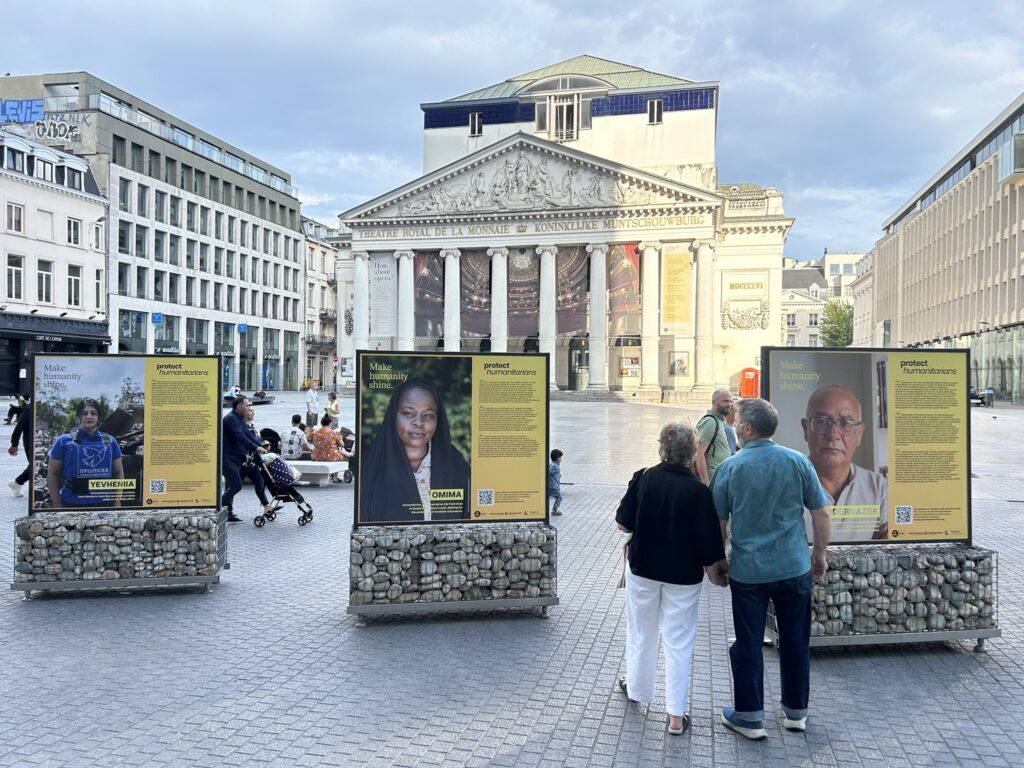
If you've passed through the city centre of Brussels in the last few days, you may have noticed a series of portraits and panels perched on Place de la Monnaie. Here's why you should take a moment to read what's on them.
From 15 August to 15 September, the non-profit Protect Humanitarians is running a campaign called 'Make Humanity Shine' in the heart of the Belgian capital, coinciding with World Humanitarian Day (19 August). The exhibition shines a spotlight on the lives of aid workers globally at a time when record numbers of humanitarians are being killed, with 2024 being their deadliest year in history.
The NGO organising the campaign, Protect Humanitarians, was founded in 2024 by Olivier Vandecasteele, a Belgian activist who was unlawfully detained in Iran on 24 February 2022, and survived 456 days as a hostage before eventually being released.
Now, Vandecasteele is using his own experience to help others in similar situations and protect the work of humanitarian aid workers worldwide through his NGO.
Protect Humanitarians provides psychological support and legal assistance to those affected by kidnapping, torture, arbitrary detention and other serious incidents, as well as to their families.
The organisation also raises awareness and campaigns for the release of those unjustly detained and focuses on academic research through an International Research Chair hosted by the University of Liège to strengthen the effective protection of humanitarian workers worldwide.
Faces behind the stats
This month, the non-profit has launched a new campaign, 'Make Humanity Shine', featuring humanitarian workers from all over the world and, where they remain detained, their family members.
Through almost a dozen portraits and first-hand testimonies, written in English, French and Dutch, passers-by can read about the plight of humanitarian workers and their stories of resilience and recovery.
From Sudan and the Democratic Republic of the Congo (DRC) to Ukraine and Tunisia, the stories come from across the globe and show the faces behind the abstract statistics often seen in the media.

Credit: Protect Humanitarians
Imad Abuhasira, for instance, is a humanitarian worker from Gaza, who was himself displaced after dedicating 22 years of his life to protecting civilians and supporting communities affected by conflict.
"Humanitarian comes from the fact that we are human. If we do not hold to our human principles, we go back to the Stone Age," he said in his testimony.
Christian Aganze, meanwhile, coordinates humanitarian access and response in eastern DRC. "I do not want other people to experience what I experienced more than 30 years ago," he said in his statement. "When I get up each morning, I tell myself I am going to contribute again to relieving the suffering of one person."
Ukrainian humanitarians Mykola Obelchak and Yevheniia Zhukova survived Russian strikes, but continue their work while advocating for stronger protection for their colleagues in conflict zones.
There are also testimonies from family members, such as that of Yusra Djemali, the daughter of a humanitarian who was wrongfully imprisoned in Tunisia for 19 months, convicted for helping refugees.
Deadliest year on record
In just three years, violence against humanitarian workers has more than doubled, reaching 1,187 humanitarians killed, wounded, kidnapped or detained in 2025, according to the Aid Worker Security Report 2026. This is the highest number ever recorded. More than 96% are humanitarian workers serving their own communities.
2024 marked the deadliest year on record for humanitarian workers. 383 were killed worldwide. Nearly half of those deaths were in Gaza, with Sudan the next most affected. A further 308 humanitarians were wounded, 125 were kidnapped, and 45 were detained. Provisional figures for 2025 show no reversal of the trend.
The 'Make Humanity Shine' campaign shines a spotlight on the courage, commitment and humanity of aid workers, who continue to help those in crisis contexts despite growing risks, including attacks, detention and intimidation.
The portraits and testimonies can be viewed at Place de la Monnaie until 15 September. The exhibition will also be shown on the ULB campus. Anyone wishing to donate to the campaign can do so here.
