
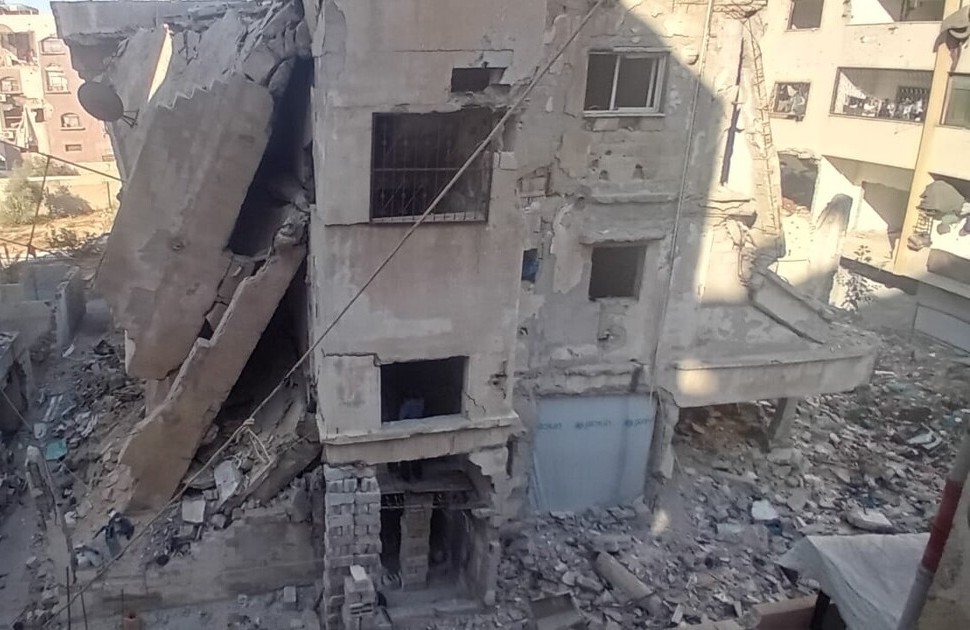
An estimated 2 million Palestinians in Gaza or 94 per cent of the population need shelter and basic household assistance, according to a new report by the Norwegian Refugee Council (NRC) published last week.
In a previous report in June, NRC reported that the destruction of homes in Gaza during the war and restrictions on shelter materials have trapped displaced families in dangerously hot tents and makeshift shelters during the summer heat waves. The war against Hamas left Gaza devastated, destroyed most of the buildings there and displaced families several times.
The new report reveals a shelter crisis which runs far deeper than just physical damage. According to the report's severity classification, more than four in five households face Critical or Catastrophic living conditions in their current shelter. This reflects severe gaps in the conditions and resources families need to live safely and with dignity, including fuel, energy and essential household items.
These constraints affect basic daily activities such as sleeping, cooking, washing, storing food and water, having adequate lighting, and coping with heat and cold.
The assessment draws on close to 2,000 household interviews conducted between 14 and 28 June 2026 in accessible areas of North Gaza, Gaza, Deir al-Balah, and Khan Younis. Rafah and other inaccessible or unsafe areas were excluded.
“A shelter is not adequate simply because it has four walls or a roof,” said Jehan Salim, National Shelter Cluster Coordinator. "Families need to be able to sleep, cook, wash and keep their children safe inside it. Ten months after the October 2025 ceasefire, most families have lived more than a year in shelters that were never designed for long-term accommodation."
The materials needed to repair homes, restore basic services and provide improved shelters are still not entering Gaza at anything close to the scale required, he added.
Only one in ten households received shelter or basic household assistance in the month before data collection in June 2026. By then, stocks of tents, blankets and mattresses inside Gaza had nearly run out. Restrictions on the entry of shelter materials and equipment, combined with funding shortfalls, have kept assistance far below the level of need.
Nearly two-thirds of households lived in tents or makeshift shelters, structures that are not designed for long-term accommodation. More than half of households in tents had already used the same tent for over a year, while more than half of tents and makeshift shelters assessed were in poor or very poor condition.
Major deterioration to flooring, walls and frames left more than 100,000 households living in shelters that posed serious risks to their health, safety or dignity. The dangers extend beyond the shelter itself. Almost all households reported at least one environmental hazard within 10 metres of where they lived, including rodents, stray dogs, solid waste, rubble or sewage.
COGAT, the Israeli body which is coordinating government activities in the occupied territories, declined to comment. In June, a spokesperson admitted that Israel has limited the supply of some equipment which it claims can be used by Hamas to produce weapons. Its public aid statistics shows figures until October 2025. Aid deliveries peaked during the first months after the ceasefire in 2024.
Journalist reports from Gaza
Gaza is closed to foreign journalists. Israeli military correspondent Amos Harel, author of a recent book on Hamas attack on 7 October 2023 (‘Anatomy of a Failure’), is one of the few journalists who have been allowed to report from Gaza.
“Every time you enter the Gaza Strip, you are struck anew by the scale of the destruction caused there by Israeli planes, bulldozers, artillery, and tanks in the war that broke out following the massacre on October 7,” he reported last Friday in Haaretz. “The ruins stretch almost to the horizon in every possible direction.” Almost no building left is livable, says the text under his picture illustrating the article.
“The response that was imposed on the Palestinians as a result (of the attack) caused a kind of deadly natural disaster in the Strip. It seems that this was a conscious Israeli decision, although it is doubtful that detailed documentation of it will ever be found. The policy of destruction has been systematically implemented in the years that have passed since.”
The humanitarian organisations in the Shelter Cluster led by NRC calls on donor states to press Israel to lift restrictions on the entry of tents, repair and construction materials, fuel, solar equipment, water-storage items and machinery needed for debris clearance, and to provide funding that reflects the scale and severity of the crisis.
The EU continues to call on Israel to increase the influx of aid into Gaza and to start early recovery actions but until now these calls have fallen on deaf ears. The Israeli government says that Hamas must first be totally disarmed. There is a plan for this. The recent 15-points Roadmap announced by the Board of Peace outlines a plan for the verified disarmament of Hamas but the talks on how to implement it have stalled.
In her latest statement yesterday, Kaja Kallas, High Representative for EU Foreign Affairs and Security Policy, focused on the worrying development in the West Bank, where settler violence has reached record levels.
In another statement, her spokesperson condemned recent statements concerning Gaza by the Israeli Minister for National Security. “The use of such egregious and inciteful language is unacceptable and should not be left unchecked. The Israeli government has a responsibility to reign in such rhetoric.” The only person who can do it is Prime Minister Netanyahu.
