
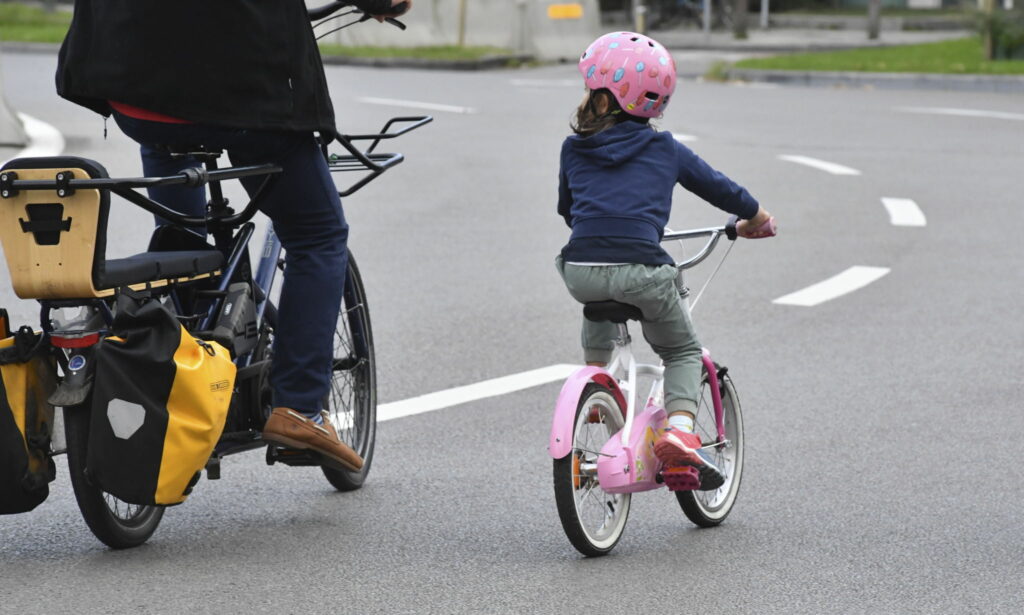
As 275,000 pupils travel to and from their schools in Brussels every day, Brussels Mobility is continuing its efforts to improve safety in school environments across the Capital Region.
The start of every new school year usually reminds the people of Brussels just how much safety in school surroundings is a key challenge for pupils, their parents, teaching staff and all road users.
"Making school surroundings safer is a priority to ensure every child can travel to school safely and independently," said Brussels Mobility Minister Elke Van den Brandt (Groen).
"We are taking concrete steps to address the infrastructure, speed limits and organisation of journeys, while at the same time guiding schools and families towards more sustainable mobility," she said. "The progress made over the past 20 years shows that habits can change: today, seven in ten pupils walk, cycle or use public transport to get to school."
School streets
These schemes (ten school environments since 2024) may focus on improving the school's visibility, reducing speeds when approaching the school, crossing points or junctions, or shortening the distance pupils have to cross to minimise their exposure to risks.
In some cases, the traffic organisation around the school is also reviewed, for example to adapt the drop-off and pick-up arrangements.
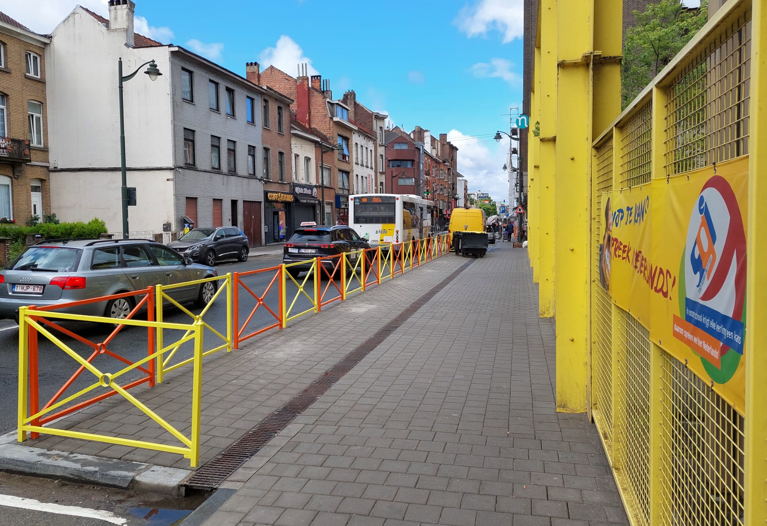
Brussels Mobility is also installing specific street furniture to increase the visibility of schools on regional roads. This furniture has already been installed in the vicinity of around 15 schools. Further installations are planned for 2026.
The Capital Region also supports local authorities with improvements on local roads: every year, Brussels Mobility subsidises around 20 projects aimed at improving safety in school environments.
The scope of these projects varies depending on the situation: the construction of a forecourt, the creation of a raised platform, the installation of fences as part of a 'school street' scheme, the fitting of speed cameras or pedestrian silhouettes.
In addition to infrastructure improvements, speed management is another key measure.
Credit: Brussels Mobility
Brussels Mobility combines a preventative and enforcement-based approach in school zones. When selecting a location for a new speed camera, the presence of a school zone is one of the criteria.
Currently, 36 speed cameras are located near schools, and two new ones are planned for the Chaussée de Ninove in Anderlecht.
Lidar cameras and mobile speed cameras are also regularly used by police districts, particularly at the start of the school year. Additionally, there are 125 preventative speed cameras installed across the Brussels Region, 100 of which are situated within a 300-metre radius of a school.
Numerous awareness-raising and educational initiatives are also undertaken every year. For schoolchildren, this includes the ‘Safe To School’ challenge and website, as well as support for educational projects such as the Pedestrian, Cycling and Multimodal certificates.
All these road safety initiatives are funded by the Regional Road Safety Fund, which is financed by regional traffic fines.
These initiatives in school environments form part of a broader evolution in school mobility in Brussels. In the late 1990s, 60% of pupils still travelled to school by car. Today, 70% travel on foot, by bicycle or by public transport.
For 20 years now, the School Transport Plans have been supporting this transition by working with 513 schools on awareness-raising, infrastructure, mobility education and the organisation of journeys.
