
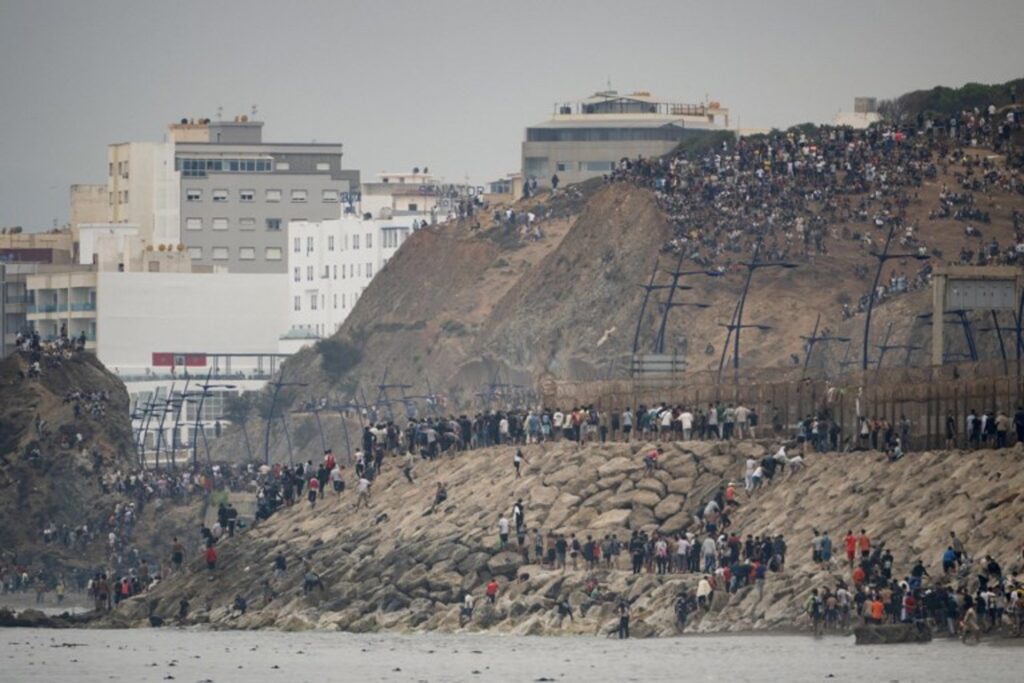
The Ceuta migration crisis has largely been brought under control but the battle of narratives continues after the Spanish Prime Minister Pedro Sanchez on Monday put the blame on social networks linked to Russia and Israel.
“After July 30 and 31, rumours and disinformation spread on social networks linked to Russia and Israel, and to an ultra-right international that always uses migration to attack both Spain and Europe and divide it,” he told Spain’s Cadena Ser radio. He was referring to undocumented research by the European External Action Service (EEAS).
Asked to comment on the allegations, the Commission’s chief spokesperson replied that the Commission had no information about them and referred any questions to the informal foreign affairs meeting (Gymnich) on Wednesday in Ireland. The issue, however, was not raised at the following press conference there.
The Commissioner for the Mediterranean, Dubravka Šuica, who joined the Gymnich meeting, said in her doorsteps that one of the main lessons learned from the Ceuta crisis was that the EU has to invest in narratives. As regards the thousands of unaccompanied minors still in Ceuta, she said that they would not be brought to shelters in Spanish mainland.
According to Sanchez, it was “evident” that Russia and Israel had used the crisis to criticize Spain to deflect its criticism against their wars in Ukraine and the Middle East. Both countries have rejected the accusations. Sanchez’s office reportedly said that his accusations were based on remarks of a European Commission spokesperson in beginning of August.
This, however, was inaccurate. The spokesperson confirmed that the crisis had been instrumentalized by human traffickers and smugglers and explained that the Spanish authorities were investigating the disinformation on social media using the instruments of the Digital Service Act.
Inside the Spanish government, there are conflicting information as to whether the government was prewarned about the influx of illegal migrants from Morocco to Ceuta. The defence minister, Margarita Robles, has told the Spanish parliament that the Spanish intelligence services had shared information about a possible border crossing before it happened but the information was ignored.
The Commissioner for Internal Affairs and Migration, Magnus Brunner, was also cautious at a briefing for journalists after the outbreak of the crisis. “We saw that there was instrumentalisation by human traffickers,” he said but cautioned that more clarity was needed before he could elaborate on what exactly had happened.
“Migration is a sensitive issue across Europe, and we have seen significant disinformation activity on social media seeking to exploit it, fuel divisions and increase polarisation,” a Commission spokesperson told The Brussels Times on Wednesday.
“In the case of Ceuta, we saw attempts by Russia to exploit the crisis online,” he admitted. “However, we have no conclusive evidence to suggest that the crisis itself was triggered by disinformation from foreign state actors.”
As regards the role of EEAS, he explained that it provides regular assessments of the information environment surrounding particular crisis or political events of relevance to the EU’s collective interests and policy objectives. “We also share, as an established practice, information with individual Member States when their interests are affected.”
