

In Belgium you can either be a worker or self-employed – but what if you want to make the jump from one to the other?
Intermediaries exist to allow employee-entrepreneurship, where you can be an employee of the intermediary but exercise your own independent activity to the external world.
This blended approach allows workers to build up social protection rights, as they still pay taxes and social contributions as an employee. Alongside building up these rights, they can focus on developing their business while having their administrative and tax requirements are taken care of.
In countries like France, this approach has a defined legal form. But in Belgium, where the system has been in operation for much longer, a fudge is needed to keep things legal.
Now a new organisation, Cooperis, wants to change this to make it more attractive for would be entrepreneurs to have the ability to test out a business idea with lower risks.
But what would be the benefits of giving the approach legal recognition? And how likely is that to happen in Belgium?
Employee-entrepreneurship as a test bed for new ideas
"We see with the upcoming digitalisation of the labour market, people want more autonomy," Thomas Blondeel, board member of Cooperis and head of international relations at SmartCoop, explained to The Brussels Times.
"With this desire for control and autonomy, some people still want to combine it with stability and social security, and this is the main reason why initiatives like Smart and DiES are that successful, because you can work in different sectors, develop your own career and be really in control of what you do."
According to Cooperis, over 22,000 workers, with over €207 million of combined turnover each year, operate through either SmartCoop or one of the six cooperatives of the DiES group in Belgium.
Credit: Luke Peters
Blondeel argued that many of these workers use the system to test out an activity and "to see how the market responds," before spinning out to start their own self-employed activity, using the employee-entrepreneurship route as a stepping stone.
The model is also seen as a way to support some people back into an economic activity, people who may otherwise not want, or be suitable, for traditional employment. As Blondeel explained, "you allow people who have some disadvantage on the labour market, and on the entrepreneurial market, to develop an economic activity, to gather an income, and thus to get out of the social statuses of unemployment."
"We have seen in France that the creation of a specific legislative framework allows this model to be really developed which allows more people to to get into it."
The entrepreneur salarié definition in France
In 2014, France passed a new law that established a hybrid work status called 'entrepreneur salarié' ("salaried entrepreneur"), with the aim of removing the grey area of whether or not these types of workers had access to social rights.
The French law also established a progression for workers, who have to pitch their idea to an Activity and Employment Cooperative (CAE), and have a prescribed window to test their idea on the market (with business support from the cooperative). If they are successful, entrepreneurs can then sign a permanent contract to become a co-owner or associate of the cooperative.
In that way, the French model seeks to balance the benefits of employee status, with the expectations of taking on the risk of running a business. The model seems to have worked, with French government figures showing France had approximately 100 CAEs hosting 5,000 entrepreneurs in 2014, growing to over 160 CAEs hosting at least 11,700 entrepreneurs by 2022.
In Belgium, the employee-entrepreneurship model operates as a general social-purpose cooperative, as if it was any other social purpose cooperative. This leaves the model in a grey zone. Cooperis wants the same legal status as France to avoid future legal uncertainty for employees and to grow the model.
But not everyone agrees with the need for change.
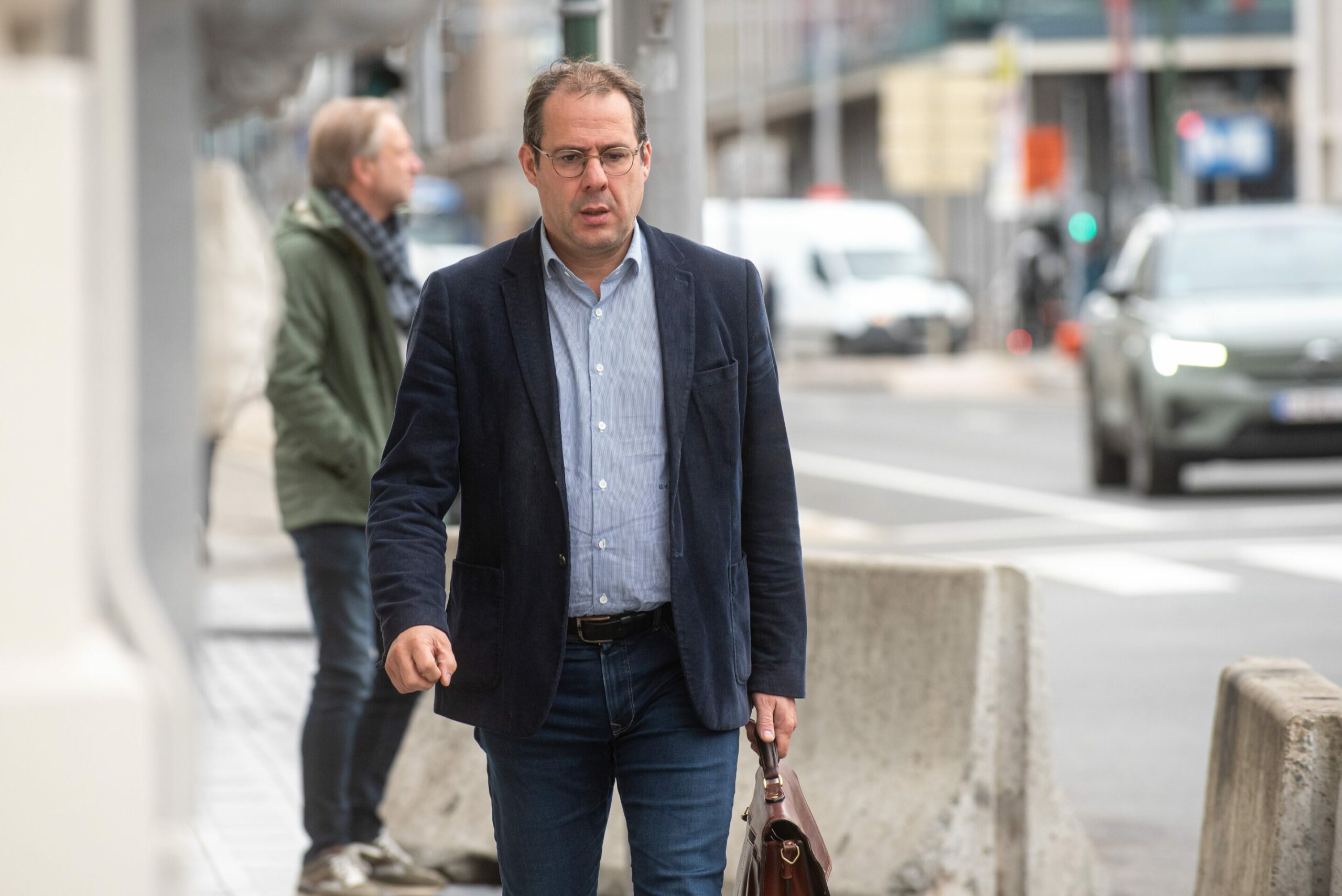
Vice-prime Minister and minister of Economy and Work David Clarinval. Credit: Belga/Jonas Roosens
Resistance to a new legal status in Belgium
Jenny Björklöf, community leader of Freelancers in Belgium, told The Brussels Times, that she welcomed any new initiative that encourages more people to start an independent professional activity, especially ones that support employees to transition.
However, she argued that a new legal status is not automatically the right answer. "We should first identify where the existing systems fail solo entrepreneurs and assess whether those problems could be addressed through simpler rules, fair access to economic support and better social protection across the different ways of working."
Meanwhile, understanding where responsibility sits between Federal and regional governments also requires some unpicking.
"The proposals put forward by Cooperis raise several legal and economic questions that may concern different levels of power and different areas of competence," a spokesperson for Deputy Prime Minister and Minister of Labour and Economy, David Clarinval (MR), told The Brussels Times.
"At this stage, the minister believes that these proposals, including the comparison with the French framework, require further legal and technical analysis before concluding on the necessity or advisability of modifying the existing Belgian framework."
"Some of the issues raised may fall under federal jurisdiction, while others, particularly those concerning certain forms of economic support and aid to businesses, may fall under the jurisdiction of the Regions," the spokesperson said.
His office stressed that Clarinval is "attentive" to the evolution of new forms of entrepreneurship and work organisation. "However, any potential changes to the framework must be examined carefully, taking into account legal certainty, fair competition, applicable social and labour laws, as well as the current distribution of powers in Belgium."
A push for better recognition of EU rules
Along with advocates in France, Cooperis are also pushing for the EU definition of "economic operator" to be adopted and used in public procurement and access to grants and subsidies.
The EU includes "natural persons", not just registered legal entities as being economic operators. However in practice, all EU countries require a registered business number.
For anyone operating as an employee-entrepreneur, this is impossible as they are not a registered business, despite meeting the definition of natural persons.
Blondeel noted the limitations this brings, he gave the example of an entrepreneur looking to apply for research and development funding to develop a new type of mixing deck but could not access Brussels Economy funding as he didn't have a registered business number. Another Smart member wanted to apply for subsidies to take their art to a European art fair but was unable to for the same reasons.
"If we apply this European definition, where we can really disconnect the economic activity that we want to support, from the legal status of the entrepreneur, then we can take it a step forward," he said.
Cooperis and advocates in other countries see employee-entrepreneurship as a key part of the future. Blondeel argued the "models are following reality more than the existing legislation" given the share of people who want to undertake a more flexible working arrangement.
However in Belgium, there is a long road ahead before formal recognition of the model becomes a reality.
