
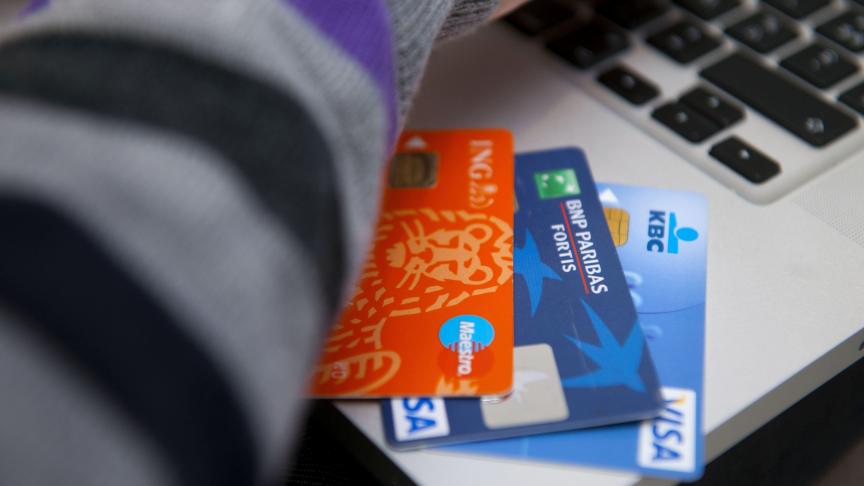
The European payment processing market, long-dominated by American giants Mastercard and Visa, is rapidly switching to local alternatives – and Belgium is serving as an example to other countries.
Back in 1966, Bank of America, which founded Visa in the late 1950s, struck a licensing agreement with the UK's Barclays Bank, launching Barclaycard, the first widely-used credit card on the European market. In 1968, the Interbank Card Association, Mastercard's predecessor, formed a strategic alliance with Eurocard.
These moments would become the starting point of a vast expansion and rivalry, which led to Visa and Mastercard's joint dominance in Europe. Fast forward to 2026, and that dominance is under threat.
Strategic vulnerabilities
Concerns about the American firms' duopoly in payment transactions have been mounting for years. While businesses bemoan rising network fees, European politicians are increasingly worried that Europe has made itself strategically vulnerable to foreign interference by allowing US firms to dominate its financial transactions.
Aurore Lalucq, chair of the European Parliament’s economic and monetary affairs group, warned in January that a hostile America could use a so-called "kill switch" to cut off access to payment networks. In this scenario, Washington could order American tech and digital services companies to remotely suspend their services to users.
"Trump can cut off our Visa-Mastercard [access]," she told the Nouvel Observateur, while making an urgent call for a European payment system to be created.
When the Russian banking system was disconnected from SWIFT following Moscow's full-scale invasion of Ukraine in 2022, the world had a real example of what such a "kill switch" meant in practice. Moscow has since established its own card network and messaging system, and China has followed suit.
Europe, in comparison, is lagging behind. According to the European Central Bank, Visa and Mastercard account for 61% of card payments in the eurozone.
Belgium is ahead of the curve
So what has been the response in Brussels? To phase the networks out.
This is where Belgium has been ahead of the curve. Bancontact, the local electronic payment system, was developed in the late 1970s, emerging as the country's premier electronic payment system in the 1980s when the company merged with rival operator Mister Cash.
"In 2025, Bancontact Company processed 2.5 billion transactions, including 1.9 billion card payments. With more than 2 million users, the Bancontact Pay app further reflects the scheme’s strong position and widespread familiarity in the Belgian market," a spokesperson for Bancontact told The Brussels Times.
While still being commercially viable, these local operators dramatically reduce transaction costs for merchants. Usually, the fees are set at a fixed amount of just a few centimes. "Bancontact are cheaper for Belgian merchants than transactions through international payment schemes," said the spokesperson.
This can reduce prices, especially for those retail stores, which often have small profit margins. Famously, Belgian supermarket chain Colruyt refuses to accept Mastercard and Visa for this reason.
Wero and the digital euro
Belgium is also part of the Wero payment system, created by 16 European banks as a "digital wallet" to integrate national payment systems in European countries.
Wero, which is widely used in France, Belgium and Germany, describes itself as "simple, seamless and Made in Europe", and aims to compete with credit cards, Paypal and other payment services.
"For the Bancontact Company, Wero complements its established Belgian payment solutions, giving consumers and merchants an additional way to pay and get paid," said the Bancontact spokesperson.
Based on the fully autonomous EU-based SEPA payment system, Wero bypasses the American card networks and plans to expand further into Europe.
The EU is also preparing a parallel, publicly operated payment system – the digital euro. This is championed as a not-for-profit payment system with a separate backend structure, entirely maintained and guaranteed by the European Central Bank.
While there is no clarity on the finer details around the project yet, its main goal is to create a free, electronic form of money issued by the European Central Bank (ECB), which would work online and offline, and is intended to offer a high degree of privacy.
Consumers would be able to hold digital euros in a dedicated wallet, subject to a holding limit, which has not yet been determined.
Bancontact says it supports the project, but argues that it is "still too early" to assess its precise impact.
"Supporting strong local and European payment initiatives ... contributes to a resilient Belgian payment ecosystem, strengthens Europe’s strategic autonomy and helps ensure payment continuity, including in the event of disruptions to international payment infrastructure," said the Bancontact spokesperson.
Whether through a private system like Wero or a public one like the digital euro, the EU has started its most ambitious attempt so far to dismantle US dominance in the payment processing market. Within these developments, Belgium has positioned itself on a steady footing.
