
Half a century after its first gleaming orange trains carried passengers beneath Brussels, the metro has grown into the backbone of the capital’s transport system. Its history is one of extraordinary engineering, bold architecture and ambitious expansion – but also disruption, tragedy and one conspicuously unfinished line.
The doors slid open and Brussels stepped into the future.
On 20 September 1976, the first shiny orange and metal metro trains began carrying passengers beneath the Belgian capital. Their bright livery, aluminium bodies and unmistakably 1970s interiors looked startlingly modern, particularly compared with the ageing underground systems of older European capitals.
King Baudouin was the first official passenger, travelling from De Brouckère towards Beaulieu and briefly emerging at stations to greet local mayors. Around him, Brussels threw a party. Sixteen stations opened that day, accompanied by concerts, street theatre and celebrations; Toots Thielemans even composed a song, Metro, for the occasion.

Belgian King Baudouin inaugurates the Brussels metro. Credit: STIB-MIVB
The new system was modest by today's standards: 11km long, with a common section between De Brouckère and Merode before splitting into two branches towards Tomberg and Beaulieu. Forty-five trains were put into service.
Fifty years later, the little fork has become something resembling a ring with four long arms stretching across the city. Brussels now has four conventional metro lines – 1, 2, 5 and 6 – and almost 40km of network. The loop around the western side of the city was finally completed in 2009. The trains themselves have changed too: the orange and silver cars are being phased out as the newer, smoother 94-metre M7 trains are brought into the fleet.
In all, the metro has carried out almost five billion passenger journeys since 1976.
Yet its origins lie much further back, above ground.
From horses to the premetro
Brussels' first horse-drawn tram began operating in 1869 between Porte de Namur and the Bois de la Cambre. The principle was simple but revolutionary: putting a horse-drawn carriage on steel rails dramatically reduced friction, allowing animals to pull heavier vehicles more smoothly through the streets.
The tram network spread rapidly. Horses eventually gave way to electricity, while Brussels developed one of Europe's densest tram networks. But by the post-war decades, the tram was increasingly competing for road space with a new master of the city: the private car.
The solution was to send public transport underground.
A first tram tunnel near Brussels-Midi was created in connection with the infrastructure works surrounding Expo 58 – and more or less parallel to the North-South railway link. Then, in 1965, construction began on a much more ambitious east-west underground route. Four years later, King Baudouin inaugurated six underground stations between De Brouckère and Schuman.
This was the premetro: trams that ran through tunnels and stations deliberately designed so that they could eventually be converted for full metro trains. That foresight remains visible today. On parts of the north-south premetro, escalators stop slightly above tram-platform level because the stations were built anticipating the higher platforms required by future metros. What was intended as a temporary arrangement has survived for decades.
In 1976, the original east-west premetro finally became the real thing.
Digging up Brussels
Brussels was hardly an underground pioneer. London's Metropolitan Railway had opened in 1863, while Budapest and Paris had metros before the end of the 19th century. Brussels had considered an underground railway as early as the 1890s but its difficult geology – sandy, waterlogged and unstable in places – made the idea daunting.
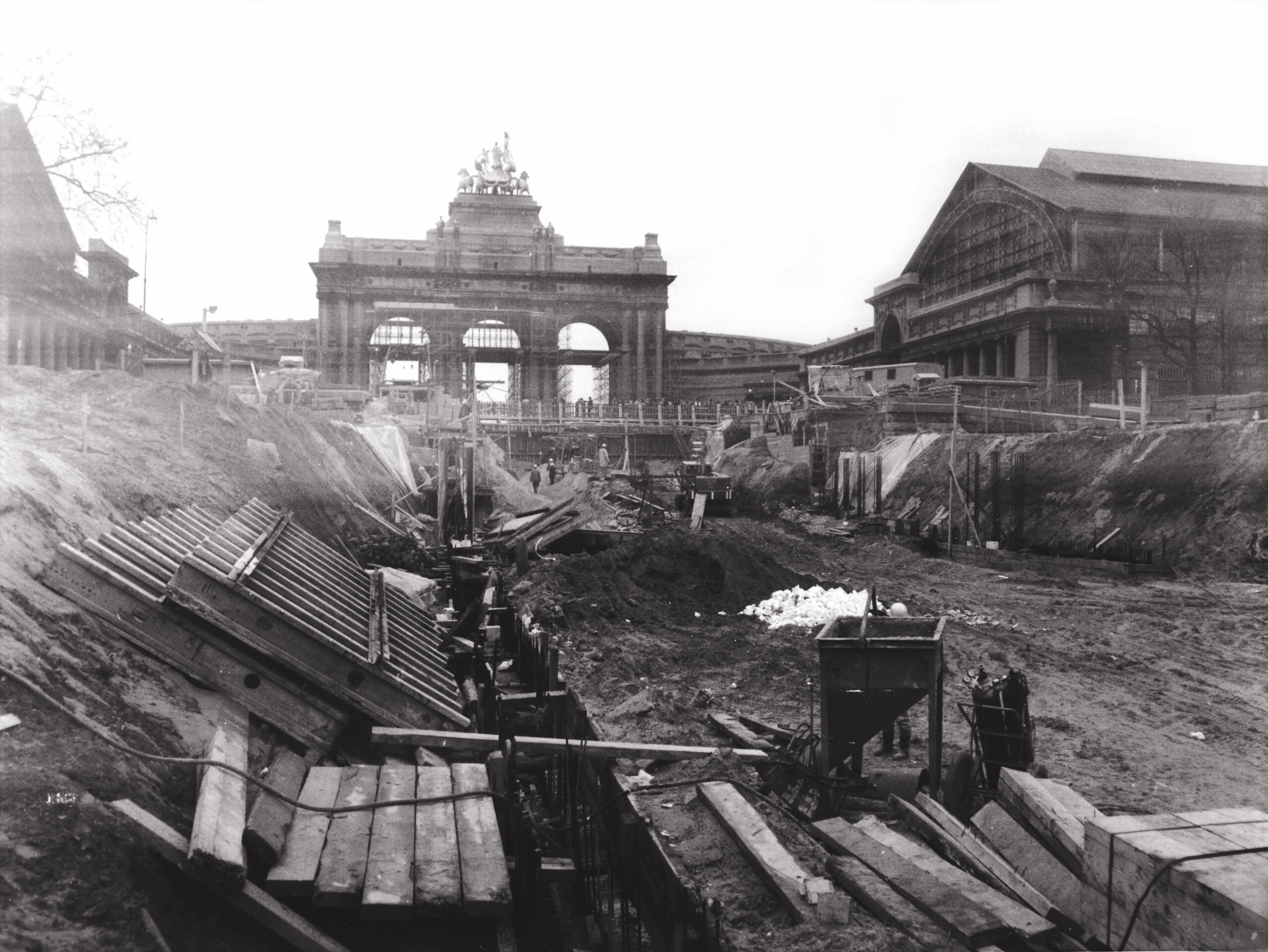
When construction finally began, Brussels did not generally burrow deep below the city in the manner of London's later Tube lines. Much of the network followed roads and was built using variations of cut and cover.
The principle sounds straightforward: excavate from the surface, build the walls and roof of the tunnel, then restore the street above. In some sections engineers first constructed retaining walls and a concrete roof slab, allowing excavation to continue beneath it.
The advantage was space. Brussels could build comparatively broad platforms, mezzanines and stations instead of squeezing passengers into narrow deep-level tunnels.
The disadvantage was what happened upstairs.

Credit: STIB-MIVB
Whole stretches of major roads became construction sites for years. Traffic was displaced, businesses suffered and neighbourhoods endured noise, dust, mud and enormous excavations. The technique being used today around the troubled Line 3 works follows the same basic logic: walls and roof are constructed from the surface before excavation continues beneath them.
Brussels' awkward soil also inspired more exotic engineering. During the original metro works, engineers sometimes froze the ground, making wet, unstable earth solid enough to excavate. During the exceptionally hot summer of 1976, workers beneath the Côte d'Or chocolate factory found themselves digging through artificially frozen soil while surrounded by the smell of chocolate. The site acquired an appropriately Belgian nickname: Dame blanche, after the ice-cream dessert.
Elsewhere, the complexity is hidden from passengers. At Schuman, for example, metro and mainline railway infrastructure intersect beneath one of Brussels' busiest road complexes; during its reconstruction, railway tracks were effectively suspended above the metro on bridge structures. At Arts-Loi, two metro axes cross on different levels beneath the Inner Ring road and its tunnels – an extraordinary subterranean sandwich of road, rail, platforms, passages and utilities. At Montgomery, the metro meets with perpendicular road tunnels as well as a tram line.
An underground gallery
The builders were also determined that this should not merely be functional infrastructure.
From the beginning, art was incorporated into the stations, giving each a distinctive identity rather than imposing a single uniform design. Today there are more than 90 permanent artworks across the metro and premetro network.
Some stations have become attractions in themselves. At Stockel, two enormous murals contain scores of characters from Hergé's Tintin adventures. Alma, designed by architect Lucien Kroll and artist Simone Kroll, turns columns into trees beneath a canopy-like ceiling and is itself a protected monument.
(continues below images)

Stockel station. Credit: STIB-MIVB

Pannenhuis metro station. Credit: Jenti Verbeke/STIB-MIVB
Montgomery has a wall designed by Folon. Pannenhuis, with its orange-red lighting, curves and space-age atmosphere, is such a perfect survivor of 1970s design that it has become a favourite location for photographers.
At Brussels-Midi, even archaeology became decoration: prehistoric mammoth, deer and bison bones uncovered during construction were incorporated into a display inside the station.
Expansion – and disaster
The network steadily pushed outward. New stations reached Molenbeek and Anderlecht; the eastern branch eventually stretched to Stockel; the western arms reached Roi Baudouin and Erasmus. In 1988, the premetro beneath the Small Ring became metro Line 2, and in 2009 the missing western link was completed, creating today's loop.
But the darkest moment in the metro's history came on 22 March 2016.
A suicide bomber detonated an explosive device aboard a train at Maelbeek station, shortly after two other bombs had exploded at Brussels Airport. Twenty people were killed in the metro attack and more than 100 were injured. The entire underground network closed temporarily, and services remained heavily restricted for weeks.
For a transport system built around the mundane rituals of everyday life, it was a profound shock. Maelbeek became one of the principal sites of remembrance for the Brussels attacks.
The missing line
The great unfinished chapter is Line 3.
A north-south metro has been discussed in one form or another for more than half a century. The plan was eventually to convert the existing premetro between Albert and Brussels-North station and extend it through Schaerbeek to Bordet, creating an 18-station, 10.3km artery across Brussels.
Instead, it has become a cautionary tale of Brussels megaprojects.
Costs ballooned, geological problems multiplied and construction beneath the Palais du Midi proved vastly more difficult than expected. Last year, the Court of Audit delivered a highly critical report, while the Brussels Parliament created a special commission to investigate the project.

Credit: STIB-MIVB
This year, the new Brussels Region government formally froze the northern extension from Brussels-North station to Bordet pending a technical, financial and strategic reassessment. Work is concentrating instead on infrastructure between Albert and Brussels-North station that can improve the existing premetro.
It is a strangely appropriate anniversary paradox. Brussels is celebrating 50 years of metro construction while confronting the limits of its ability to build the next one.
An underground legacy
The metro is not without other problems. Some stations have become focal points for homelessness, drug use and dealing, creating difficult questions about security, social policy and the role of transport staff.
Some stations feel distinctly less glorious than others. Escalators fail, infrastructure ages and the original signalling on Lines 1 and 5 is itself now approaching its 50th birthday.
Yet it is easy to overlook what Brussels built beneath its streets.

Cakes are served at a press conference on the celebrations for the 50th anniversary of the Brussels metro system, by Brussels' public transport company STIB-MIVB on Friday 4 September 2026 in Brussels. Credit: Belga/Mateusz Kukulka
The metro stitched neighbourhoods into the centre, connected railway stations with homes, offices, universities, hospitals and shopping streets, and provided the high-capacity public transport without which the modern capital could scarcely function. Its trains are electric, and expanding public transport remains essential if Brussels is to persuade more people to leave their cars behind.
It is an imperfect inheritance: an elegant network with some decidedly inelegant corners, grand engineering alongside unfinished projects, beautiful stations alongside troubled ones.
But 50 years after those gleaming orange trains first opened their doors, Brussels has something substantial to celebrate. Beneath a city often accused of never quite finishing anything lies nearly 40 kilometres of evidence that, sometimes, it does.
