
Three months into Ireland's EU Council Presidency, a leaked proposal on AI and personal data and growing criticism are putting the country's relationship with Big Tech under scrutiny.
On one side of Rue d'Arlon in Brussels last week, digital industry figures gathered for drinks at a reception hosted by Google to mark Ireland's presidency of the Council of the EU.
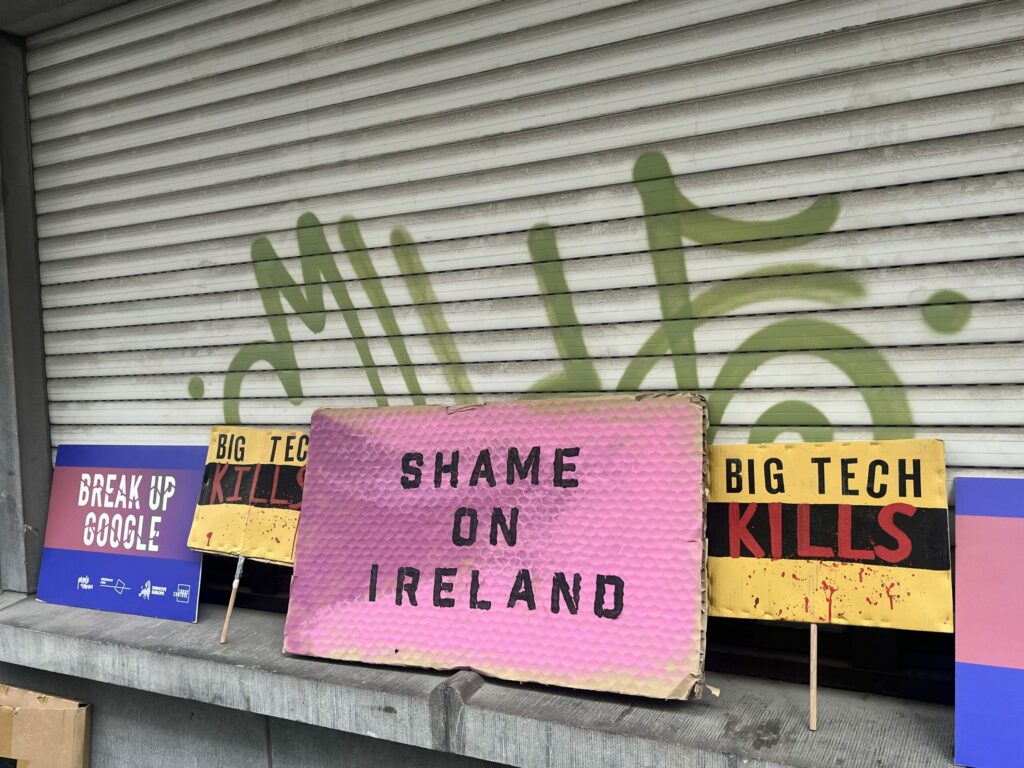
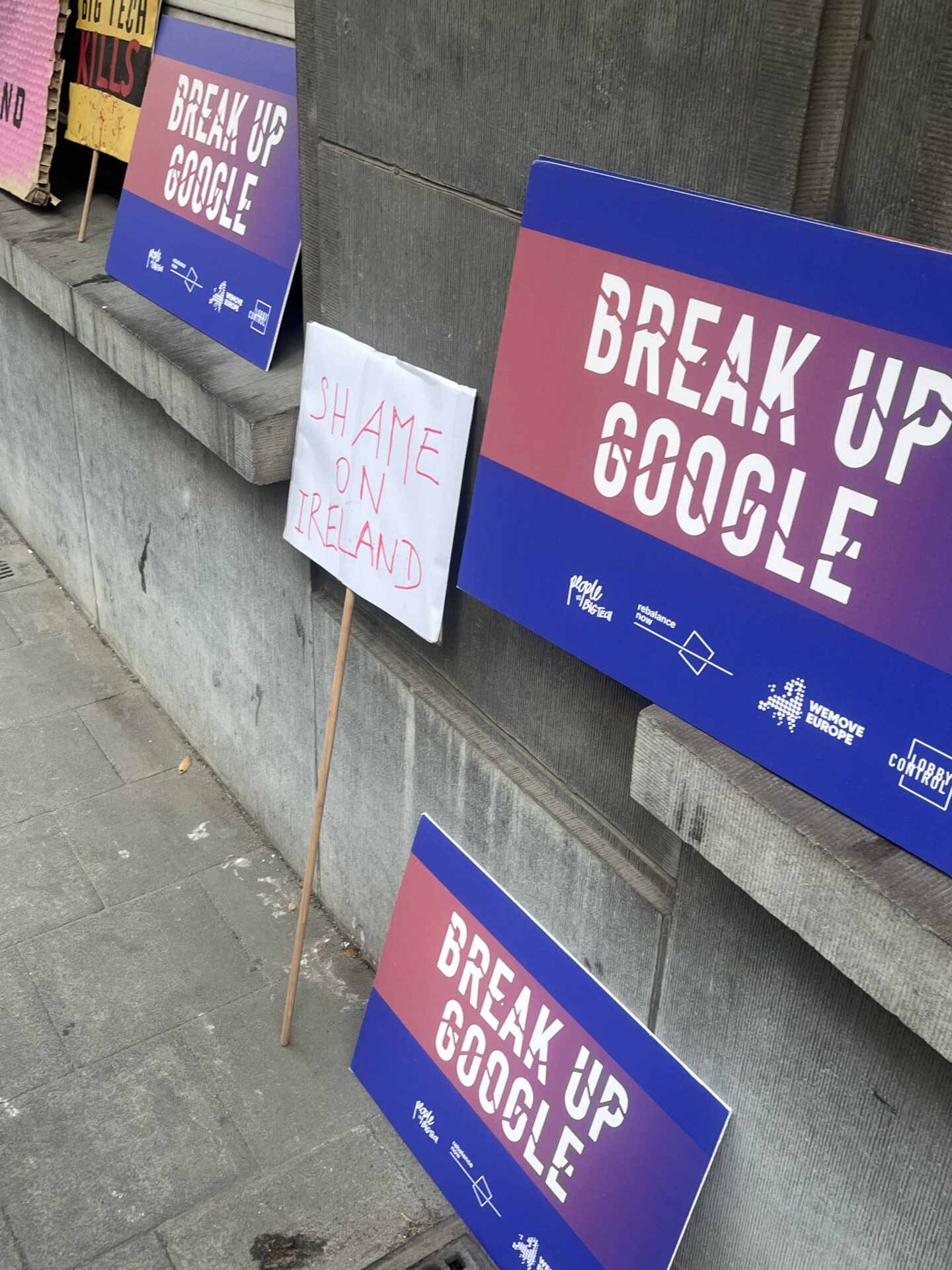
On the other, just meters away, protesters held up placards reading “Big Tech Kills”, “Break up Google” and “Shame on Ireland”.
In its role as President of the Council of the EU, Ireland has been leading EU negotiations on new laws, including rules affecting Big Tech companies, since July. The problem, critics say, is that many of those giants are based in Ireland.
One of the protesters on Rue d'Arlon was Benedetta Brevini, a professor of platforms and society at KU Leuven.
She is one of the more than 50 academics who signed an open letter published in the Financial Times in July, calling on Ireland to step aside from digital and tax files during its presidency.
Brevini and her colleagues are worried that Ireland’s close relationship with Big Tech could make it harder to take up the role of "honest broker" that the presidency requires.
"As citizens, as academics, we are concerned, because the concentration of this type of economic, political, ideological power in the hands of only a few corporations is something that is very detrimental for democracy," she said.
Credit: The Brussels Times
She pointed to Ireland’s economic dependence on the sector, intensive lobbying, and a leaked draft that could loosen Europe’s privacy rules. Brevini's biggest worry is what academics call "state capture."
"When states become captured by corporations, then of course they can't take decisions in the interest of citizens," she said. "We can vote in an election if we're not happy with the government, but we cannot vote the CEOs of Google out."
And because Ireland holds the EU Presidency, she fears the effect will reach far beyond its borders.
“When a state is captured by digital lords and they are supposed to mediate a digital agenda, of course the interest of the same digital lords will be pushed as priority,” she said. “So [I’m] not scared for Ireland, but for Europe”.
For her and the other protesters, a giant tech company such as Google throwing a party for the country now in charge of negotiating Europe’s tech rules perfectly symbolises the problem.
A leaked draft
Questions about Ireland's closeness to Big Tech are not new.
According to the Irish Fiscal Advisory Council, just two companies (not named but understood to be Apple and Microsoft) paid almost 40% of all corporate tax in Ireland in 2024 – amounting to roughly €11 billion.
Of the world's 20 largest tech companies, 16 have operations in Ireland, and more than 100,000 people in the country work in the sector. Many, including Google and Meta, run their European operations from Dublin, according to IDA Ireland, the country's inward investment promotion agency.
That also makes Ireland's Data Protection Commission the watchdog that enforces EU privacy rules on many of these companies, on behalf of the whole bloc. Privacy campaigners have long accused it of being too soft on them.
Now, a leaked draft of an upcoming EU legislation obtained by the privacy NGO the European Center for Digital Rights - NOYB (styled as "noyb," from "none of your business") on 21 September appear to show the Irish presidency pushing to let companies train AI on people's personal data without their consent – a step that goes further than the European Commission itself had proposed.
For critics, this is the clearest sign yet that Ireland cannot stay neutral on EU tech rules.
Bram Vranken, researcher and campaigner on Big Tech lobbying at Corporate Europe Observatory, told The Brussels Times that he agrees.
"All these concerns seem to be justified," he said. "We cannot trust the Irish presidency to be an honest broker. There is just too much overlap between Big Tech interests and the Irish government."
AI training without consent
The proposal is part of the Digital Omnibus, a package of changes the European Commission presented last November to the EU’s digital rules, including GDPR, Europe's flagship privacy law.
Under the Irish draft, companies could use people's data to train and run AI on the basis of their own "legitimate interest." In practice, that means they would not have to ask for permission first.
According to noyb, that could include data collected years ago, and data from people who have never used an AI service.
The organisation's founder, Max Schrems, called the plan a "digital expropriation" of Europeans, arguing that AI companies' profits would come before people's right to privacy.
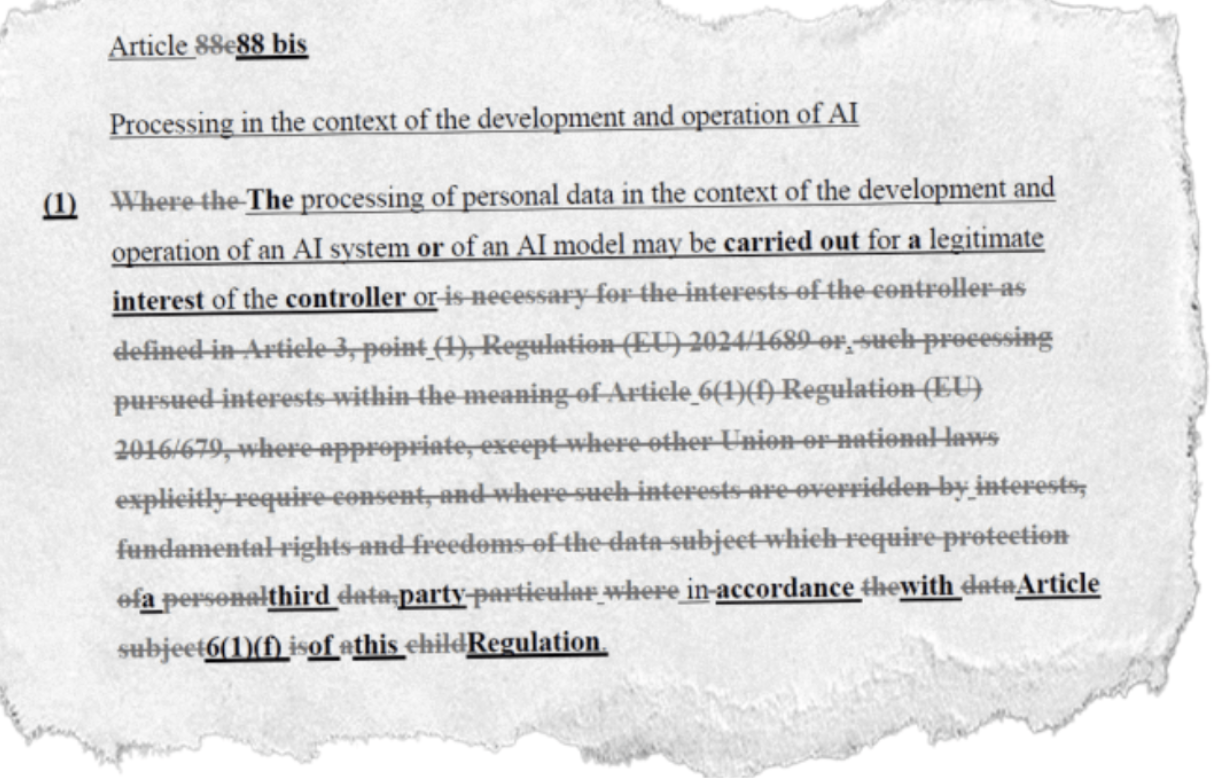
Extract from the Irish presidency's draft compromise on the Digital Omnibus, published by nyob.
Member States had already taken the AI clause out of the main text in June. Ireland's draft puts it back and, according to Vranken, goes further than even the Commission had proposed.
But Ireland is not alone. Germany and other large Member States informally back the idea up.
"This is a very concrete example of where the Irish presidency is pushing for severe deregulation of the EU's digital rulebook and even going further than the Commission's proposals," Vranken said. "That is where it's most clear that they are not an honest broker."
In a written statement, a spokesperson for the Irish Presidency said the presidency is working “with determination” to reach agreement on the package, which aims to reduce administrative burdens for businesses “while fully upholding data privacy and fundamental rights of citizens.”
"The Irish Presidency is carrying out its responsibilities with complete impartiality on behalf of the Council of the European Union.”
“This is Ireland’s 8th EU Presidency and we have a track record of delivering for Europe. This Presidency is no different,” the spokesperson said.
“Our role is to facilitate agreement among all Member States and to advance the Council's legislative agenda,” the spokesperson added. “Throughout our Presidency, we remain focused on delivering the ambitions of the 'One Europe, One Market' roadmap, including its digital priorities."
Barry Colfer, Director of Research at the Institution of International and European Affairs (IIEA) in Dublin, also sees it this way. This being Ireland’s eighth presidency, the government knows what to expect, he pointed out.
"They do take the honest broker role of the presidency really seriously, I think, and seek to perform it and to be seen to perform it," he told The Brussels Times.
On digital rules, he said, "Ireland’s position is not unique and more reflects the division of views there are in the EU, which is normal."
He pointed out that some of the criticism may have other motives. “There is an amount of covetousness from some Member States, due to Ireland's success in attracting this investment,” he said.
Vranken, meanwhile, also pointed out intensive lobbying by Big Tech.
Meeting the companies affected by new laws is a normal part of EU policymaking, but according to him, Google and Meta have had dozens of meetings and contacts with Irish policymakers on the Digital Omnibus.
Ireland has a little less than three months left at the helm of the EU. Asked what advice he would give Ireland for the rest of its term, Vranken was blunt: "Stop meeting Big Tech companies."
"They cannot pretend to be an honest broker and then have an open-door policy towards Big Tech's interests.”
