
Communication expert Reinout Van Zandycke has warned of possible foreign interference behind TikTok calls urging people to protest in cities across France and Belgium on 17 October.
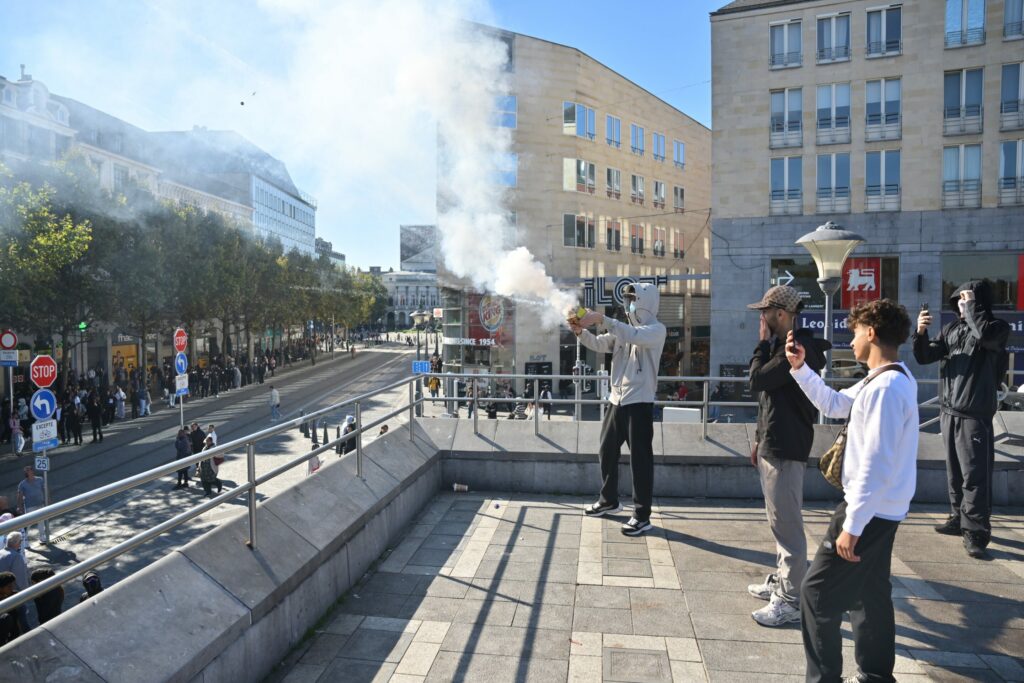
The warning comes after Friday’s protest descended into disorder, with videos appearing on TikTok almost immediately afterwards calling on people to return to the streets that day, including in Brussels. A national demonstration is also due to take place in France on 17 October.
Some of the videos calling for fresh protests have attracted up to half a million likes, Belga reported. Many feature AI-generated images showing groups such as the gilets jaunes, firefighters, students and school pupils surrounding a smaller group representing the state.
Related News
- Social liberals file complaint over alarmist social media posts
- School protesters in Liège shot with air rifle, police launch investigation
- Police use tear gas as Liège student protests turn violent
The most widely liked calls appear to come mainly from French accounts, including both suspected TikTok bots and influencers speaking directly to camera. One appeal from the French TikTok account V2 received 442,800 likes within a few hours.
Van Zandycke said social media has long been used to mobilise young people for street protests. During the Arab Spring in 2010, he noted, Facebook and Twitter, now X, played that role. “Only the channels change. Now it is TikTok; 15 years ago it was Facebook,” he said.
He said foreign powers have at times used such platforms to destabilise states, meaning “hybrid warfare cannot be ruled out”. Van Zandycke pointed to past allegations involving both the United States and Russia.
According to an Associated Press report, a US intelligence-linked operation used the social media platform ZunZuneo in an attempt to stir unrest against Cuba’s Castro regime in 2014, but failed. Van Zandycke also said there is clear evidence that Russia has previously been behind anti-Western social media campaigns.
He argued that many young people are vulnerable to this kind of propaganda. Some, he said, feel frustrated and unfairly treated, making them more receptive to such messages, while others simply ignore them.
The link is not automatic, he added. A TikTok video viewed hundreds of thousands of times will not necessarily bring hundreds of thousands of young people on to the streets, but such videos do tap into feelings that already exist.
He also highlighted what he described as “aura farming,” in which young people make obscene gestures at police officers and try to provoke them for attention online. At Friday’s protest, Belga reporters saw several young people dressed as Spider-Man, Teletubbies or Batman, and one boy said to be under 16 carrying a katana, a Japanese samurai sword.
“For many people, their digital identity is at least as important as their real one,” Van Zandycke said. “Through social media they want recognition within their own tribe. In a group that feels targeted by the police, dancing in front of a police cordon can earn a lot of likes and street credibility.”
The debate over how to respond is ongoing. Vooruit party leader Conner Rousseau has previously suggested banning social media for children under 15, while the Flemish government and the European Commission are both working on measures aimed at at least limiting its use.
In theory, Van Zandycke said, schools could try to teach more critical thinking about social media, people could be urged to use more common sense, and platforms themselves could be pressured to act. But he said he remains sceptical about how effective such measures would be.
“I am not very hopeful,” he said. “With one or two hours of history lessons at school, a teacher can do little. It is a losing battle and an unfair one. Some of these young people spend hours a day scrolling on their phones. A ban also seems unlikely to solve much, as examples from Australia show.”
Van Zandycke said the main focus should be on identifying which accounts are spreading the calls, potentially with the involvement of Belgium’s State Security Service. Even then, he said, the question remains what can realistically be done. “It is a very difficult issue.”
