
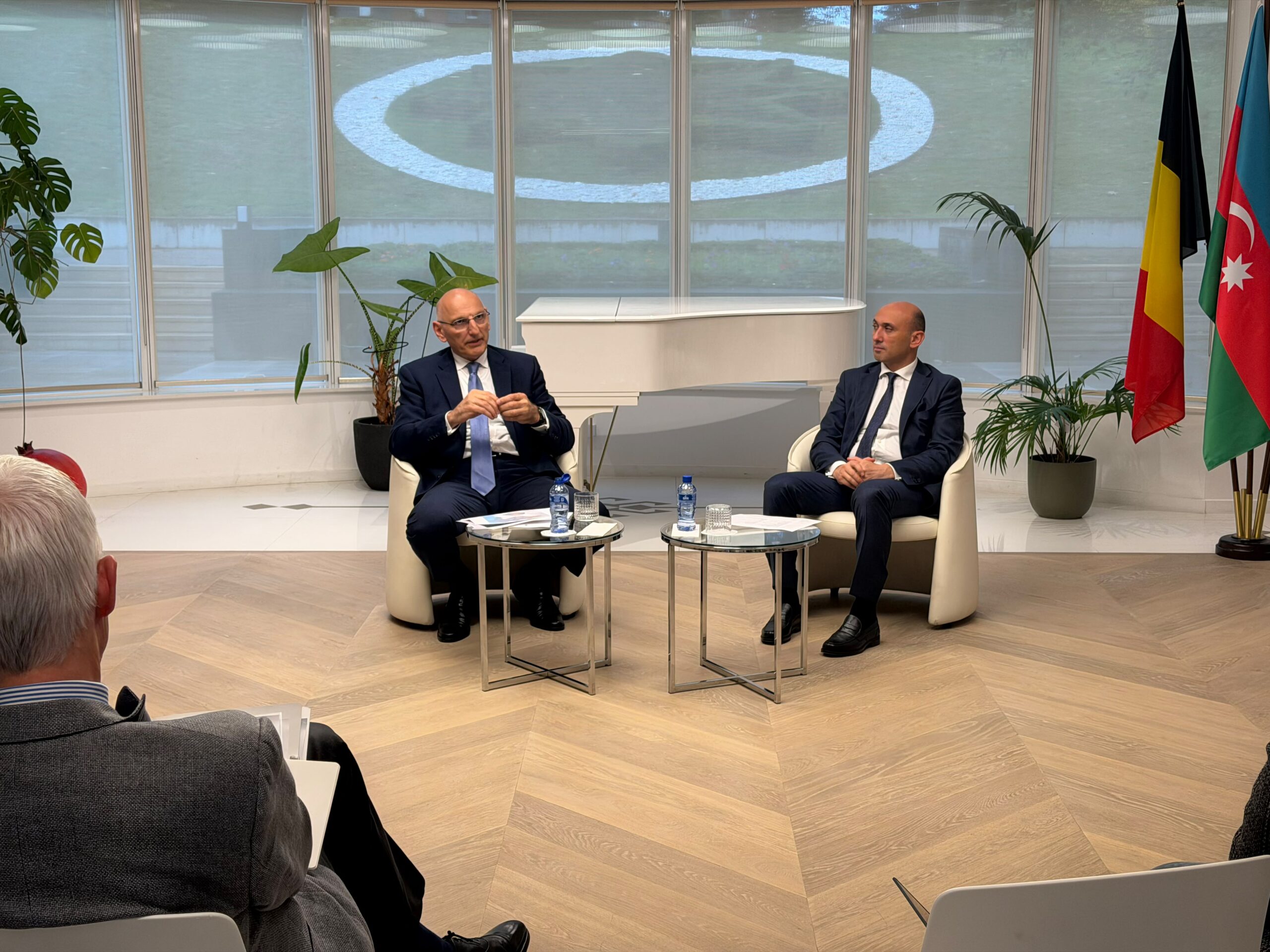
Azerbaijan and Armenia are "already living in a de facto peace situation", according to Elchin Amirbayov, Representative of the President of the Republic of Azerbaijan on Special Assignments. He was speaking at a briefing at the Embassy of the Republic of Azerbaijan in Brussels on 21 October.
Amirbayov was in Brussels for talks with Belgian counterparts, EU institutions and NATO. The visit follows the envoy's briefing in the same city last December, when he mapped out Azerbaijan's diplomatic priorities for 2026. Ten months on, his message was one of steady consolidation rather than new departures.
From the White House to everyday life
Amirbayov said the August 2025 summit in Washington had set off "a very steady process of consolidation of peace". Turning that spirit into a universal and durable peace is now the main priority of Azerbaijan's foreign policy, he said, and an agenda shared by Armenia.
He listed concrete steps taken since then. Bilateral trade and economic relations began at the end of 2025. Border delimitation is continuing, governments talk regularly at all levels, and civil society on both sides has been engaged.
Among these, he cited Azerbaijani diesel exports to Armenia. "A year ago one would consider this to be more of a science fiction, but today it's a reality," he said. The aim, he added, was to reach "all the Armenian population", who he said now benefit from lower fuel prices.
The last step before signature
The peace agreement on the establishment of diplomatic relations was initialled by the two foreign ministers in Washington but has not yet been signed. In Azerbaijan's view, Amirbayov said, the remaining prerequisite is for Armenia's constitution to be brought in line with the agreement.
He stressed that the constitutional reform was Prime Minister Nikol Pashinyan's own initiative, first floated in 2018. "We fully recognise that this is an internal process," he said, "and we don't want to be seen as intervening." Baku's only concern, he added, is that the peace be durable and irreversible.
Once that is addressed, he saw "no other major" obstacle to signature. Ratification, diplomatic relations and the opening of borders would follow. Asked about timing, he declined to speculate but urged that "this window of opportunity is not to be wasted".
He called irreversible peace "a win-win situation", not only for the two countries but for the region and for partners including the European Union and its member states.
Connectivity as 'the icing on the cake'
Amirbayov described connectivity as "the icing on the cake" of the peace process. He highlighted the US-backed TRIPP project through southern Armenia, which would link mainland Azerbaijan with Nakhchivan and connect onwards to Türkiye and Europe.
He said the project would also connect Armenia to regional pipelines and railways that had previously bypassed it, and that Armenia "will be part of this interstate trade".
He described economic interdependence between the two countries as "one of the best insurance policies for peace". Given instability to the north and south, he said, the region is increasingly referred to as an "arch of stability" and could become "one of the linchpins of global trade".
TRIPP is being managed jointly by the United States and Armenia. On the Azerbaijani side, Amirbayov invited the EU to help rehabilitate the 194-kilometre Nakhchivan railway. Unlike TRIPP, it does not need to be built from scratch, and Baku is awaiting a feasibility study from the EBRD.
He welcomed the European Commission President's announcement in Azerbaijan this summer that the EU is ready to support connectivity as part of post-conflict normalisation. With Türkiye also building the Kars–Iğdır line towards Nakhchivan, he said, "many countries will profit".
Energy supply and pipeline capacity
On energy, Amirbayov recalled that Azerbaijan has helped Europe diversify its supply since the Baku–Tbilisi–Ceyhan oil pipeline began operating in 2006. Azerbaijani gas now reaches ten EU member states.
Under the 2022 strategic partnership memorandum, Baku committed to doubling gas volumes to the EU by 2027. Amirbayov said deliveries of more than 12 billion cubic meters in the first half of this year meant the target was "easily achievable".
He also set out the constraint. The Southern Gas Corridor is fully booked, and several member states want more gas than it can carry. "We have necessary resources," he said, "but what we need is transportation infrastructure."
Because EU rules restrict investment in fossil fuels, he argued, Azerbaijan cannot be expected to finance new capacity alone without long-term contracts. "If a solution is found to that, of course we will be able to do our part," he said. "If there is a clear intention and desire to receive more gas from Azerbaijan, then we expect some bold decisions."
He added that Azerbaijan is itself pursuing the energy transition, with the share of renewables rising each year and investment in Caspian offshore wind, solar and hydropower. Natural gas, he said, will remain a transition fuel for some time.
A new legal basis for EU–Azerbaijan relations
Amirbayov noted that EU–Azerbaijan relations still rest on an agreement from 1999, which he called "completely outdated". Negotiations on a new comprehensive agreement resumed late last year, with the next round planned for December.
The text covers political, economic, trade, security and humanitarian cooperation. Amirbayov said both negotiating teams have a mandate to finish "as soon as possible". A separate document on EU–Azerbaijan partnership priorities, agreed in principle this summer, is also in preparation.
On trade preferences such as GSP+, he said progress would depend on the pace of the wider negotiations.
Russia, Ukraine and regional security
Asked how Russia viewed the US-brokered settlement, Amirbayov said Baku sees the peace as a win-win. "We don't think any country in the region or in a broader geographical context has something to lose," he said. "Maybe I'm too optimistic, but that's how we view it."
He said the parties reached this point because they took ownership of the process themselves, rather than relying on outside mediation. Relations with Moscow had been through a difficult period after the downing of an Azerbaijani passenger plane, he acknowledged, but that incident is "already behind us". Both sides want relations back to normal, he said, noting that Azerbaijan is the only country bordering both Russia and Iran.
On Ukraine, he recalled that Azerbaijan supports alleviating the suffering of the Ukrainian people and is committed to international law. He declined to speculate on hypothetical outcomes. Instead he offered Azerbaijan and Armenia's peace as an example that could help counter new dividing lines.
On security of critical infrastructure, he cited a spillover incident from Iran in early March, defused through dialogue with Iranian authorities. The best protection, he said, is predictable relations with neighbours, so that "no one is tempted to attack this infrastructure".
Societies at the centre
Amirbayov said the "Bridge of Peace" track-two format, which has met several times this year, will continue in the coming weeks and months. It has so far brought together media and think-tank participants and is expected to widen. The goal, he said, is to explain to people in both countries "the benefits of peace and the lack of alternative to peace".
He also wants Azerbaijan better known in Belgium. Azerbaijan Airlines plans to open direct Baku–Brussels flights next May. He described the country as a secular, multi-ethnic and diverse society, with landscapes from subtropical south to mountainous north, a growing wine-tourism scene and rich cultural heritage.
The briefing closed with further questions from the floor on bilateral and regional issues.
