
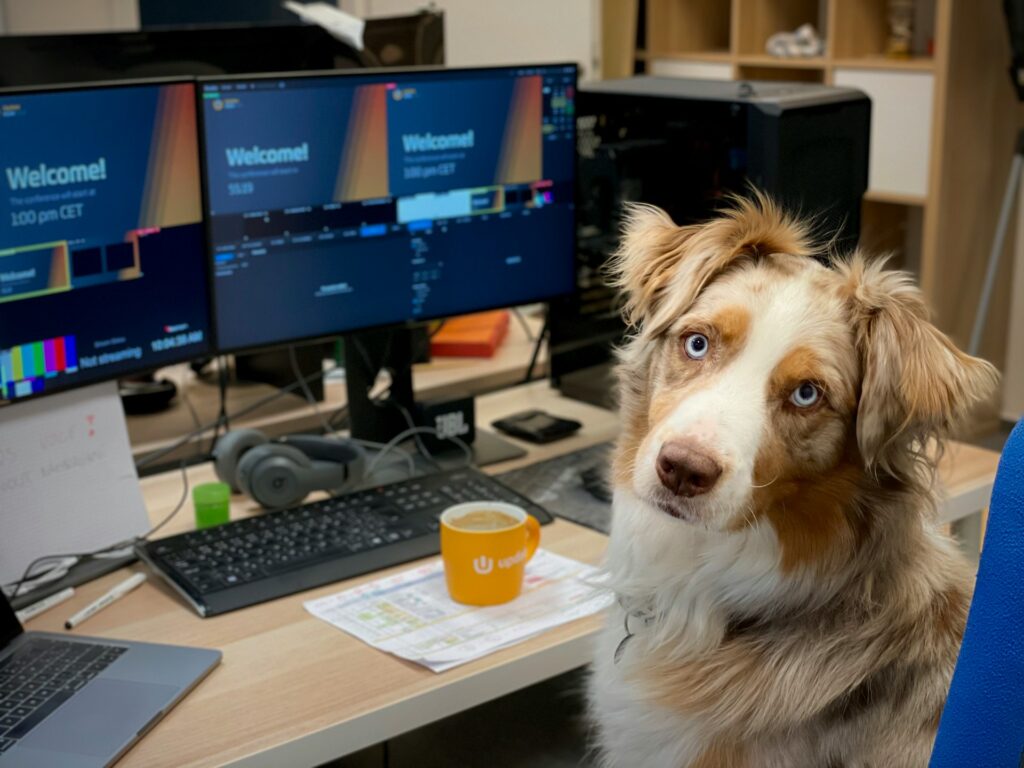
Kristina Chetcuti, a registered health coach (UKIHCA) specialising in behaviour change and lifestyle medicine (ELMO), answers your lifestyle dilemmas.
Q. "My job involves long days, late meetings and networking events. I live alone with my dog, and I feel guilty about how much time she spends by herself. My career is thriving, but my dog is miserable. This is stressing me out. I wish I could just bring her with me to the office. When I mention this, I am never quite taken seriously."
A. I wish I could just tell you: “Hear, hear!” For those of us who have a dog, that’s the dream: our four-legged companions perfectly happy asleep under our desks, while we get on with our work, guilt-free and happy in the knowledge that someone still thinks we’re downright amazing, even when we’ve missed a deadline.
Your predicament is not uncommon. Surveys in several countries seem to find that give or take around 10% of dog owners feel very stressed about leaving their pets alone for long periods (count me in that dix pour cent).
If this were a coaching session, we could identify the source of your stress: is it the length of the working day, the unpredictable meetings, or the evening networking?
We could explore what a good life would look like for both you and your dog, and come up with some options, maybe a dog walker or a dog daycare or a trusted neighbour.
But since we’re not in session, I’d like to look at your question from a different perspective on health, because dogs clearly have a pawsitive (sorry) influence on our wellbeing. So much so that maybe it's time employers considered the role dogs could play in staff wellbeing.
Here’s why: studies have found that dog ownership was associated with a lower risk of death, in particular heart diseases; dog walking can help people stay more physically active; and even in children, living with dogs has also been linked to better social and emotional health.
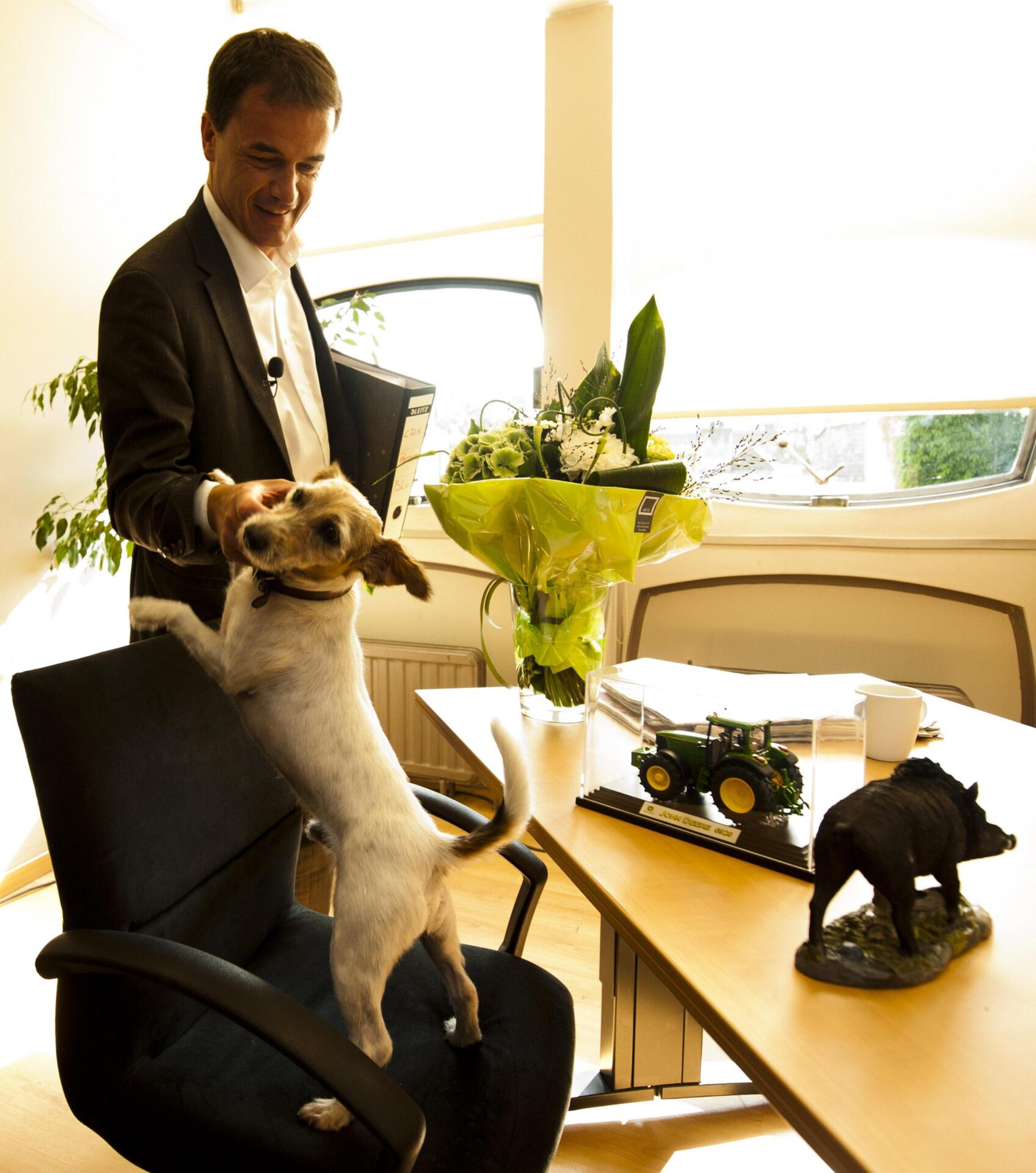
In 2011, new cdH (now Les Engagés) leader Benoit Lutgen pictured as he moves into his new office with his dog, in Brussels. Credit: Belga/Benoit Doppagne
There is no doubt that dogs seem to do us good, but we don’t yet know exactly how. Definitely there’s more to it than having someone greet you with unbridled joy and sheer, tail-wagging ecstasy every time you walk through the door.
And one possible connection lies in our gut. Our digestive system is home to billions of gut microbes which, as we’ve discovered over the 10 years or so, play a crucial role in keeping us healthy.
Now, it seems that sharing our lives with dogs can influence the tiny inhabitants of our guts, potentially for the better.
Scientists are still exploring exactly how this might influence our health. But when we cuddle with our furry friends on the sofa or maybe, ahem, share our beds, we’re exposed to microbes we might not otherwise encounter. If we could have them with us at the office, we’d all be sharing these potentially beneficial bugs!
It may not be just the close contact, either. Walking and playing with our dogs gets us moving, and physical activity can also make the gut microbiota happier, and in turn, make us happier.
Moreover, if dogs influence our gut microbiota, this could have implications for our health since an unbalanced make-up of the gut microbiome has been linked to various diseases, while a balanced one is being associated with better health (Wu et al., 2024)
You’ll notice that I’ve scattered links to scientific studies throughout this article, in case you need some evidence-based ammunition when lobbying your employer for dog days at the office. Because, yes, there are companies in Belgium where you can take your dog to work.
Some even go as far as offering ‘paw-ternity leave’: time off to help a new pet settle into its home.
In 2024, the company Mars Belgium conducted a survey on dogs at the workplace. This is Mars, as in the (irresistible) chocolate-bar makers, who also happen to be major pet food manufacturers (which I’m not such a big fan of).
But whatever we may think of their ultra processed foods, it seems that Mars takes its commitment to pets seriously – they have had a dog-friendly workplace programme for around two decades, with apparently, dog-friendly meeting rooms, walking routes and areas for rest and play. I digress.
Credit: Unsplash
The Belgian survey found that dogs could make office life more pleasant: employees in dog-friendly offices reported lower stress, better breaks and greater motivation to come into the office.
More than half of dog owners whose workplaces did not allow dogs said they would bring their pets if they were allowed to.
Well, it may surprise you to know that the European Commission itself was considering this a couple of years ago. When five MEPs asked whether pets could be allowed in EU buildings, the Commission apparently looked into the idea, even considering pilot studies with staff bringing their pets to work to see whether the idea had legs, so to speak.
No one seems quite sure what became of it, though.
Of course, there are good reasons why many workplaces don’t allow dogs. Chief among them is that not every employee is comfortable around the animals. Some colleagues may have allergies or a fear of dogs, or simply prefer not to share their working day with a four-legged colleague.
Employers also need to consider safety, hygiene, potential distractions and practical restrictions imposed by their buildings. Understandably, a laboratory or a kitchen might not be the ideal working environment for dogs.
But in many cases, there are ways to make it work. Dogs could, for example, be allowed only on certain days or in designated areas, helping to accommodate colleagues with allergies.
Of course, not every workplace can welcome dogs, but perhaps yours could find a way to make it work. I hope you’ll feel better equipped to discuss the idea with your employer, while finding a solution that works for both you and your dog in the meantime.
And if all else fails, shall we start a The Brussels Times petition on your behalf?
