

A new data centre in Brussels, which will soon become operational, is estimated to consume 140 Gigawatt-hours (GWh) of electricity per year in its first phase – accounting for around 3% of Brussels’ total electricity consumption. A second phase of similar scale is set to follow from 2028
The KevlinX BRU01 data centre was completed at the end of 2025, and should soon become operational. Grid operator Elia granted a connection capacity of 20 Megawatts for this first phase, with another 20 Megawatts to be added for the second.
“The first phase of this data centre alone consumes 3% of Brussels’ total electricity supply, and a second phase is yet to come,” said Brussels MP Lotte Stoops (Groen).
The data centre will be connected directly to the grid of the Belgian transmission system operator for high-voltage electricity, Elia, with a large-capacity 40 MVA connection.
“Every Megawatt of grid capacity allocated to these servers is capacity that can no longer be used for a hospital, a tram depot, or an electric vehicle charging station,” she stressed. “We must decide now how many such data centres Brussels can accommodate and examine what grid investments will be required.”
Security of supply
Globally, data centers are among the fastest-growing sources of greenhouse gas emissions due to their high electricity consumption.
Catherine Wojcicka, spokesperson for Elia, told The Brussels Times that the data centre’s impact will not necessarily affect the electricity supply to ordinary households. “These are separate matters.”
“The distribution system operators are responsible for local supply,” she said. “Even though that electricity comes via the Elia grid, this should be viewed within the broader context of the country’s security of supply.”
To analyse that security of supply and keep a close eye on developments, Elia carries out a study every two years. Based on the studies’ results, they can state whether or not an electricity shortage is to be expected.
Wojcicka stressed that there is no direct link between data centres and the impact on the price of electricity either. “Here too, we need to take a broader view of all investments in the grid before we can speak of an impact on the bill.”
Additionally, she underlined that the part of the bill paid for transmission and distribution is separate from the price of the commodity (the price of the electricity itself).
KevlinX BRU01 AI data centre in Neder-over-Heembeek, Brussels, on Tuesday 27 October 2026. Credit: Belga/Benoit Doppagne
In addition to electricity, the initial phase of the data centre is also projected to use up to 140,000 m³ of water per year, which is equivalent to more than 50 Olympic-sized swimming pools. A second phase of similar scale is set to follow from 2028.
These figures were revealed by Brussels State Secretary for Energy Audrey Henry (MR) in mid-October, in response to a parliamentary question submitted by Stoops.
The Brussels government views the data centre as a contribution to European digital sovereignty. The first phase has been designed for efficiency: "relatively little energy" is lost to cooling and other auxiliary systems, and the water consumption per kWh meets the target standards the industry has set for itself.
Henry’s figures confirmed this: for the first phase, the Power Usage Effectiveness is less than 1.2 (below the Belgian and European averages) and the Water Usage Effectiveness is less than 1. “This is in line with the target set out in the pact for climate-neutral data centres that use drinking water in temperate regions with moderate to high water stress,” she said.
Nevertheless, the total demand for electricity and water remains substantial, and Brussels currently lacks a strategy for evaluating such projects, according to Stoops.
Heat, water and PFAS
Numerous questions also arise from an ecological perspective. Cooling is achieved via an open-water circuit in cooling towers, which results in the evaporation of some of the water.
While there are good intentions to use the centre’s waste heat, there are no concrete plans as yet. A memorandum of understanding exists with Sibelga to utilise this heat in a future district heating network, but Stoops is calling for a concrete timeline to be attached to this commitment.
Questions have also been raised about whether PFAS (often referred to as “forever chemicals” as they do not break down in the environment) are used in the cooling technology. Stoops highlighted that leaks into the environment “can never be entirely ruled out.”
Additionally, rising demand threatens to drive up PFAS production, while there is still no definitive solution for their disposal at the end of their lifecycle.
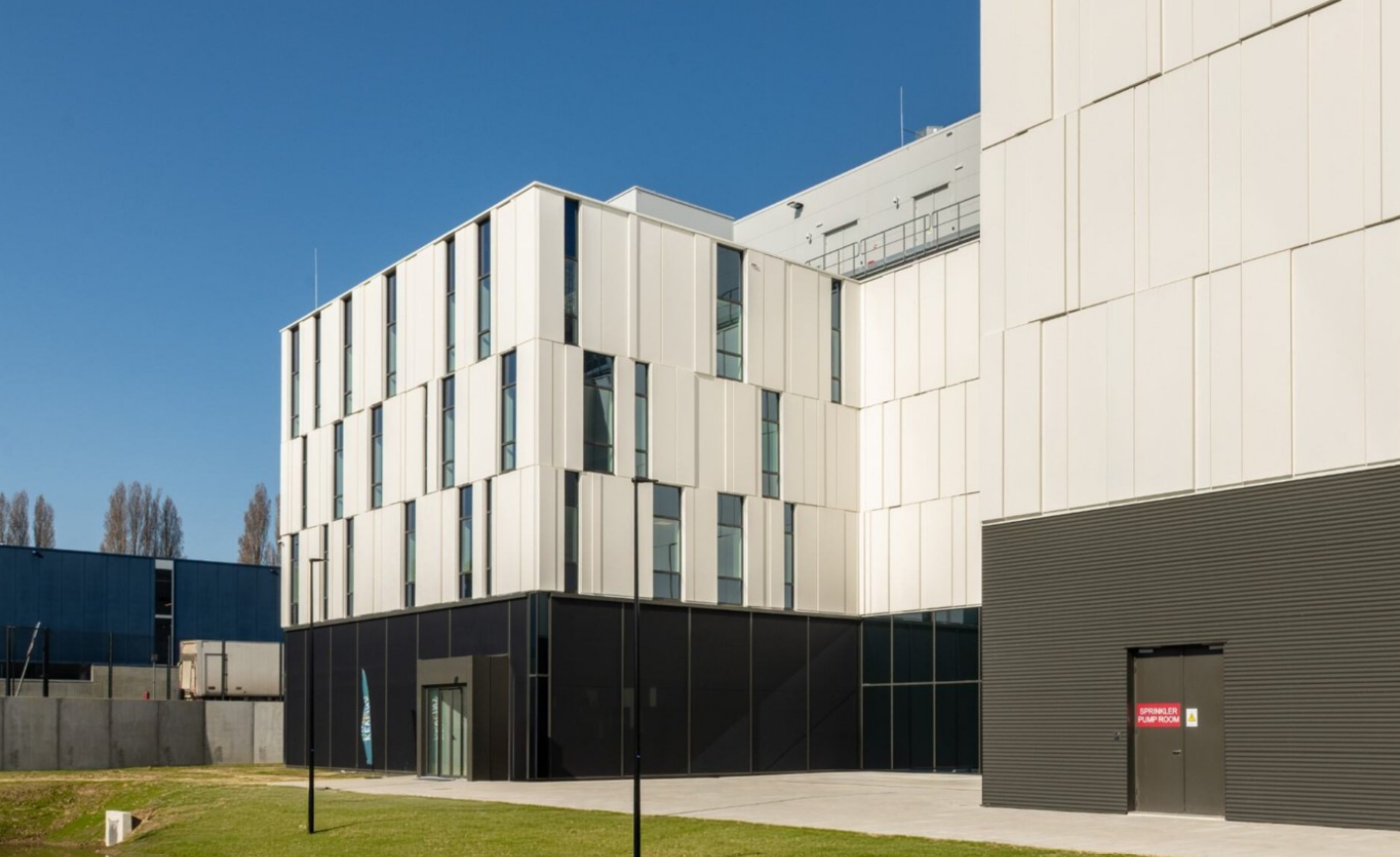
BRU01 data centre, in Neder-Over-Heembeek. Credit: KevlinX
Stoops is urging Brussels to develop a policy framework for data centres, which can provide guarantees regarding water usage (including the consumption of drinking water) and the presence of PFAS, while also establishing a concrete timeline for the reuse of waste heat.
Regarding grid capacity, she called for a clear overview: how much capacity remains, what grid investments are required, and who will pay for them? In her view, these costs should not be passed on to the utility bills of ordinary households.
“AI is an inescapable part of the world of tomorrow,” Stoops said. “Without a regional plan for ‘responsible digital development,’ we risk jeopardising not only our climate targets but also the access that Brussels residents have to clean water and electricity.”
The Brussels Times contacted the office of Brussels State Secretary Audrey Henry (MR) and KevlinX Data Centres for more information, but did not receive a response by the time of publication.
