
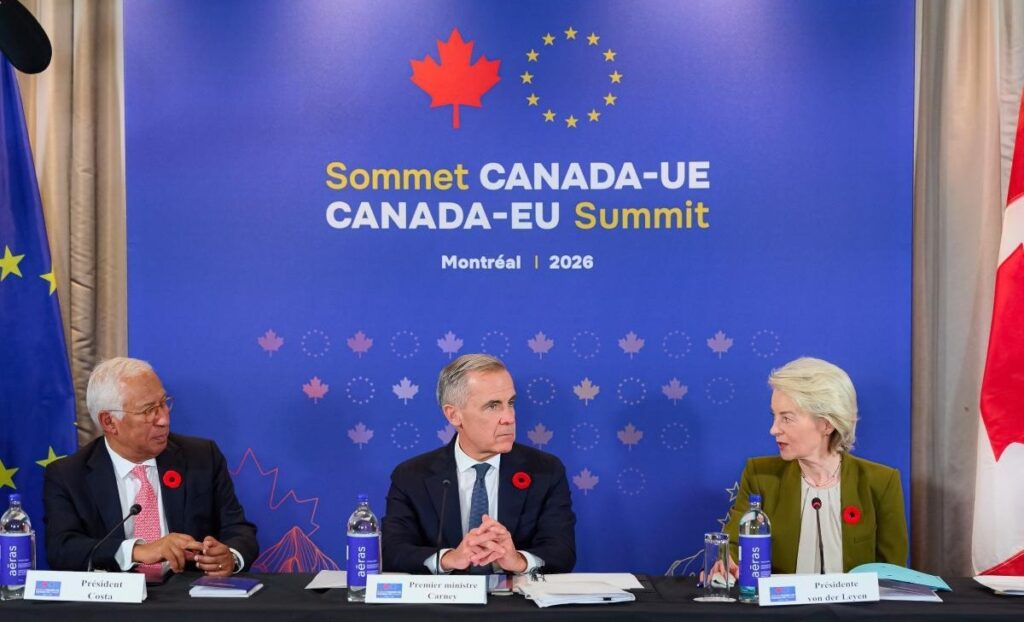
At the end of October, leaders from Canada and the European Union met to lay the foundation for a new international model that could make Canada the first associate member of the EU, but its importance goes beyond the relationship between the EU and Canada.
The new partnership will be developed in close coordination with Member States and the European Parliament before the next summit in June 2027. The resulting model could form a blueprint for deeper ties with other like-minded nations, including Japan, South Korea, and Australia according to Philipp Lausberg, a senior policy analyst at the European Policy Centre.
"This could be a test case and potentially a building block for a wider Economic Security Alliance," Lausberg told The Brussels Times.
Whether it's called 'associate membership' or an 'Alliance for the Future,' the new relationship the EU and Canada work out in the coming months may be applicable to other countries.
This idea isn't just speculation by policy experts at think tanks: the EU "would be open to replicating the same model with other close and trusted partners who are interested in deepening cooperation with us," an EU spokesperson told the Brussels Times, "developing secure supply chains, boosting research and innovation, and coordinating economic security policies."
The spokesperson emphasised that this relationship would only apply to partners outside of Europe, and declined to speculate on relationships with non-European countries.
Hurdles to EU membership in all but name
For Lausberg, what the relationship should look like is clear: a partnership with particularly deep integration in economic security, trade policy, the single market, competitiveness, and defence. "The ambition should be to approach EU membership in all but name," he said.
However, while it may be clear what this relationship should look like, implementing it may be more difficult. Integration on this scale would likely take years and face significant political obstacles, including debates over national interests and upcoming European elections.
"We have the election in France in April, so if [far-right Marine] Le Pen becomes the president, we don't know what she will do about this. She's very anti-EU," Lausberg said. "She has been very vocal about going much more the national way of pulling the national card and not the EU common approach, so this could endanger any further integration between the EU and Canada."
He said there was a narrow window to lock in progress before the initiative risked being watered down. A concrete roadmap of this partnership must be ready by the next summit in June, Lausberg said, but ideally before France's presidential election in April and May.
Why an economic security alliance?
For him, the importance of this partnership lies in its ability to provide economic security to the EU, arguing that existing trade agreements were designed for a more stable global economy. Current international partnerships are ill-equipped to deal with the weaponisation of trade, supply-chain disruptions, economic coercion, and strategic dependencies.
"The cooperation the EU has with its partners in the world are based on assumptions of a world that doesn't exist anymore," Lausberg said.
He argued that deeper cooperation is necessary because smaller countries increasingly struggle to defend their interests in a world shaped by competition between major powers such as the United States and China. He said working with trusted partners can strengthen countries' ability to protect their economic interests and preserve their sovereignty.
Critics of deeper international integration often argue that it erodes national sovereignty, but Lausberg rejects that view. For him, deeper cooperation strengthens rather than weakens sovereignty.
"We live in a world where international law is on retreat," he said, arguing that cooperation with trusted partners is increasingly necessary in a world dominated by larger powers.
"So if you are a small country, and you are alone, you might be as sovereign as you want, but you will be at the receiving end of these power struggles."
