
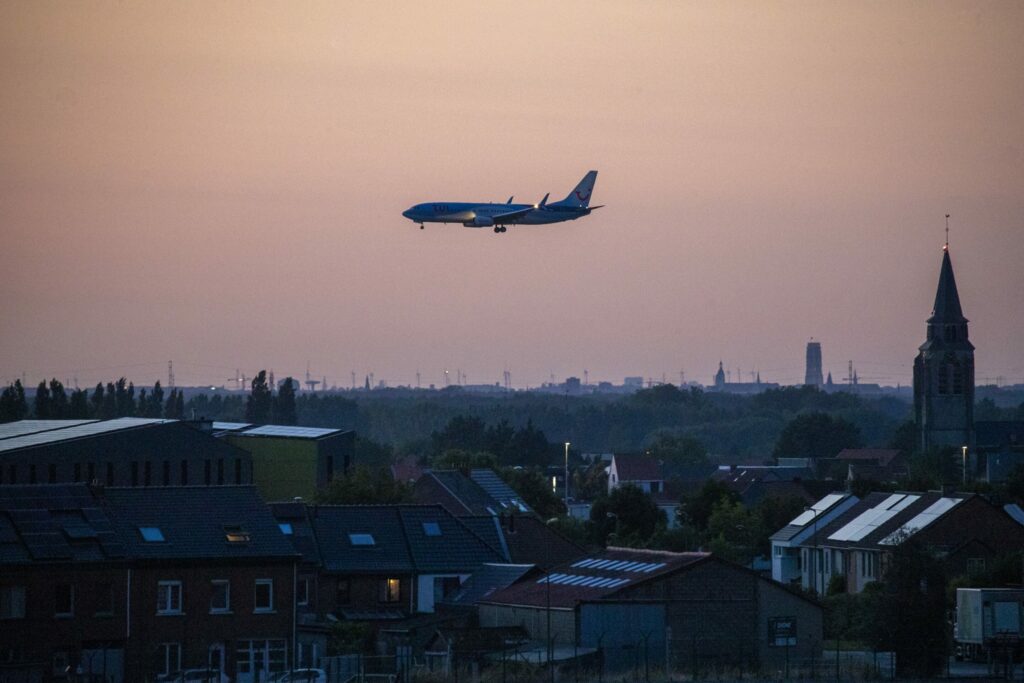
Changes to flight procedures at Brussels Airport introduced in October have failed to significantly reduce noise pollution for Brussels residents, according to an analysis by Brussels Environment.
Since 1 October 2026, aircraft using the RNP07L approach route to Brussels Airport have been required to begin their descent from a greater distance and at a higher altitude. Under the new procedure, aircraft align with the runway approximately 22 kilometres from the airport at an altitude of around 1,050 metres, compared to 16 kilometres and 800 metres previously.
The changes, introduced by Federal Mobility Minister Jean-Luc Crucke (Les Engagés), were intended to reduce aircraft noise for residents living beneath the flight path. However, initial findings from Brussels Environment suggest that the measures have made virtually no difference.
“These results are not surprising. Minister Crucke knew, thanks to a study he himself commissioned, that these changes would have no significant impact on Brussels residents,” Brussels State Secretary for Environment Ans Persoons (Vooruit) said in a statement on Thursday.
“We demand genuine measures that effectively reduce noise pollution, rather than a policy of empty announcements.”
Aircraft still flying at the same altitude
To assess the impact of the changes, Brussels Environment compared the descent profiles of approximately 200 aircraft landing via the RNP07L route in September and October 2025 with those of around 500 aircraft using the same route in October 2026.
The analysis found no significant improvement at any of the four noise monitoring stations located beneath the flight path. Although aircraft now begin their approach earlier and at a higher altitude, their descent profiles become almost identical to those recorded before the changes once they approach Brussels.
At 15 kilometres from the airport, aircraft fly at approximately 800 metres in both scenarios. At 10 kilometres, they descend to just over 500 metres, while at four kilometres, they are flying at around 200 metres.
According to Brussels Environment, these figures highlight how low aircraft fly over some of Belgium’s most densely populated neighbourhoods. The analysis also found that both maximum noise levels and overall noise exposure remained virtually unchanged compared to 2025.
Calls for more effective measures
The findings raise questions about the effectiveness of the federal government’s approach to tackling aircraft noise pollution around Brussels Airport.
While the revised flight procedure means aircraft begin their approach farther from the airport, Brussels Environment concluded that this has no significant effect by the time they reach the Brussels-Capital Region.
Persoons has therefore called on the federal government to introduce more substantial measures to address the problem.
