
Kristina Chetcuti, a registered health coach (UKIHCA) specialising in behaviour change and lifestyle medicine (ELMO), answers your lifestyle dilemmas.
Q. “Dear Kristina, I sometimes find myself yawning at really awkward times: halfway through a workout, during an animated work meeting mid-morning, or even when I go for a short walk at lunchtime. Sometimes it’s downright embarrassing. I sleep for about seven hours and don’t feel tired when I wake up, so is the yawning linked to a lack of oxygen or eating habits, or is it flagging some kind of health issue?”
A.
…
…
…Oops! This is not radio silence, this is me yawning. I promise, quand même, it’s not because I’m bored with your question, it’s just that, as science has established, reading or even just thinking about yawning always triggers one in me.
What is interesting in your question is that you didn’t say that you have been catching yourself yawning during a lengthy lecture on the complexity of Belgian language politics, which would be totally understandable. Rather, you’re yawning when you’re active and stimulated.
As it happens, the urge to yawn is still more or less shrouded in mystery. Although there are scientists who have made it the mission of their research, we still don’t know exactly why we yawn.
You ask whether it is lack of oxygen. It’s not. That, at least, we know now. For a long time, that was the main explanation for yawning: that it’s the body’s way of getting more oxygen when oxygen levels in the blood are low.
But this theory has now been ditched after participants in studies exposed to controlled levels of low oxygen, didn’t yawn more than usual.
Yawning is a reflex, so our body does it unconsciously. Clearly, something triggers this coordinated dance of movements involving our brain, facial muscles, jaw, breathing muscles and throat.
However, it can also happen when we voluntarily initiate it. For example, I force myself to yawn a lot when on a plane, to open my ear tubes and ease the pressure pain. Moreover, we can also suppress a yawn, which makes it a very complicated reflex indeed.

Credit: Pexels
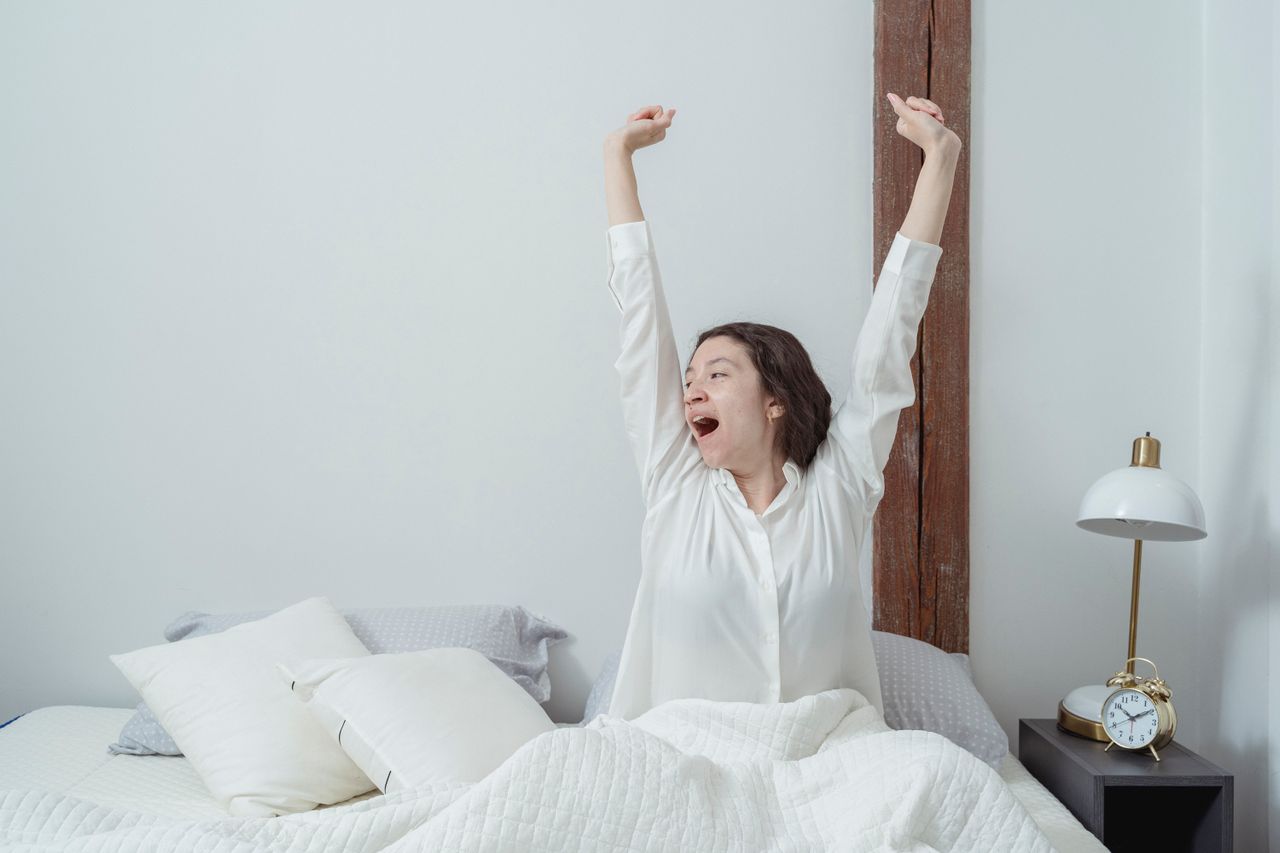
At the moment, researchers are debating three main theories. The first is the most obvious one: we yawn to "wake up" our brain. In fact, we typically yawn when we wake up or when bedtime is beckoning. It also tends to happen when we’re tired or bored. We start feeling drowsy, our eyelids grow heavy, our thoughts become fuzzy and our words start to slow down, and then bam! a yawn comes out.
Researchers think that, at this point, your body is making an effort to stay tuned in to its surroundings, and yawning may help it do just that.
Biologically, this makes sense because when we yawn, our heart rate increases, and we stretch our facial muscles which might make us feel more awake. It need not necessarily be a dull meeting. It could simply be that, on some level, you’re feeling more relaxed and your level of wakefulness dips, which may trigger a yawn.
In fact, you ask if your yawning could be related to food. There does not seem to be any direct link with food, unless the food makes you tired, which kicks off this alertness slump.
Yawning isn’t always a sign of being less focused; it can happen when we’re becoming more alert. Some people yawn when they’re stressed or anxious or concentrating intensely, and that could be an attempt to regulate that heightened state and bring it down a notch.
It can also happen when we’re moving between different environments. Say you’ve been sitting at your desk for a couple of hours and then you go for a walk in the biting cold. Your level of alertness suddenly gets a jolt and you yawn to level it out again.
Keep in mind that our body thrives on balance, and is forever trying to restore order.
The second theory is that we yawn to ‘cool down’ our brain. Some researchers believe that yawning helps regulate brain temperature, although exactly how this happens is still uncertain.
This could explain why yawning sometimes happens when our body temperature or the temperature around us is changing. Hence, the reason you might yawn when walking from a warm office into cooler outdoor air, or why you yawn mid-workout.
You get slightly overheated during exercise as your body temperature rises, and the yawn could be one of the mechanisms involved in bringing your brain temperature back to normal.

Credit: Belga
The final theory is based on the fact that yawning is contagious (even from your dog). Researchers who support this theory think that yawning functions as a form of communication, perhaps as a signal for group synchronisation.
Imagine, for example, a group sitting around a campfire at night. One person starts yawning. Another notices and yawns. Soon several people are yawning and becoming less alert.
From an evolutionary perspective, this could have the social benefit of helping a group move from being active to collectively feeling the need to rest.
However, in your case, unless there’s communal yawning taking place during your workout, in which case someone needs to have a word with the trainer, I don’t think this applies to you.
You ask whether yawning could be a red flag for health issues. If you’re yawning more than three times every 15 minutes, that can be considered excessive, particularly if it happens repeatedly without an obvious reason, and can occasionally be a sign of an underlying health issue, such as a sleep disorder, medication effects or migraine.
But in general, yawning on its own is usually nothing to worry about. If you’re in an etiquette-sensitive situation, suppressing it is fine too. There’s no evidence that suppressing a yawn causes a harmful build-up of anything.
Just don’t try to stop one with excessive force: there are rare case reports of injuries associated with forceful yawning, including jaw dislocation (!).
What can you do to yawn less?
Get some bright light
Brussels in November might well be contributing to your yawning. Grey skies mean less bright light reaching your eyes, and light has a real effect on alertness. Still, even the greyness is better than constant exposure to office lighting.
In one study, people exposed mainly to daylight during the afternoon were more alert later in the day than those exposed primarily to artificial office lighting.
Bottom line: whenever there are snatches of blue sky, grab your coat and head outside.
Cool yourself if you’re warm
Research suggests that temperature affects yawning frequency. It could therefore be worth cooling your face or neck during exercise, if you’re getting hot.
Look at your sleep
You say that you sleep about seven hours a night, more or less. Are you sure that’s enough for you? It could well be, but it could also be that your body is signalling that it needs a little more, even though you feel reasonably awake.
Look a bit more closely at your caffeine and alcohol intake and at what time you actually start feeling tired in the evening and how long you tend to resist going to bed.
Pay attention to your sleep duration and sleep quality, and see if there’s anything you need to tweak.
I hope this helps and that it hasn’t made you yawn even more. Watch this space for more updates on the ever-evolving science of yawning.
