
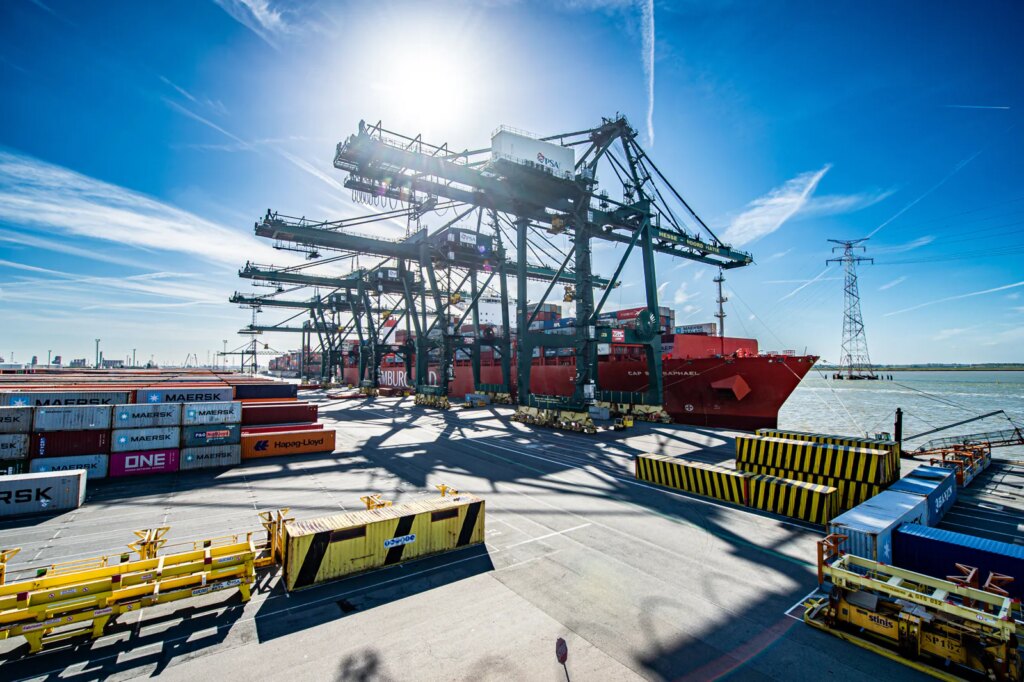
Commercial ships moored in European ports cause considerable harm to people and the environment. T&E, a European advocate for clean transport, has calculated that the cost amounts to €2.5 billion per year.
Around the port of Antwerp-Bruges, the cost of pollution runs to €270 million.
“On average, a ship berthed at the quay emits as much sulphur annually as nearly 20,000 cars,” states T&E in a report. “The hidden costs of this pollution are borne by taxpayers and hospitals.”
Previous research has also shown that people living close to a commercial port face a significantly higher risk of death from cardiovascular disease and respiratory conditions.
“Port communities are paying the price for ships that leave their engines running constantly,” said Eloi Nordé, a shipping expert at T&E.
Slow progress
There are already several European regulations in place regarding shore power. These allow ships to switch off their engines after mooring whilst still having access to electricity. But for T&E, these solutions and legislation are progressing too slowly.
“Fossil fuels may seem cheap,” Nordé said. “That’s because companies pass on the health and climate costs to society. Shore power could save society billions. It will also make port cities more liveable.”
Transport economist Thierry Vanelslander (University of Antwerp) describes the report as impressive. In his view, T&E has emerged in recent years as a research organisation that produces thorough work.
What strikes him most is the fact that a great many ships will be able to circumvent future European regulations.
The report calculated that future regulations could reduce the environmental impact of ships at anchor by 40% by 2030. “But most ships will be exempt,” it states.
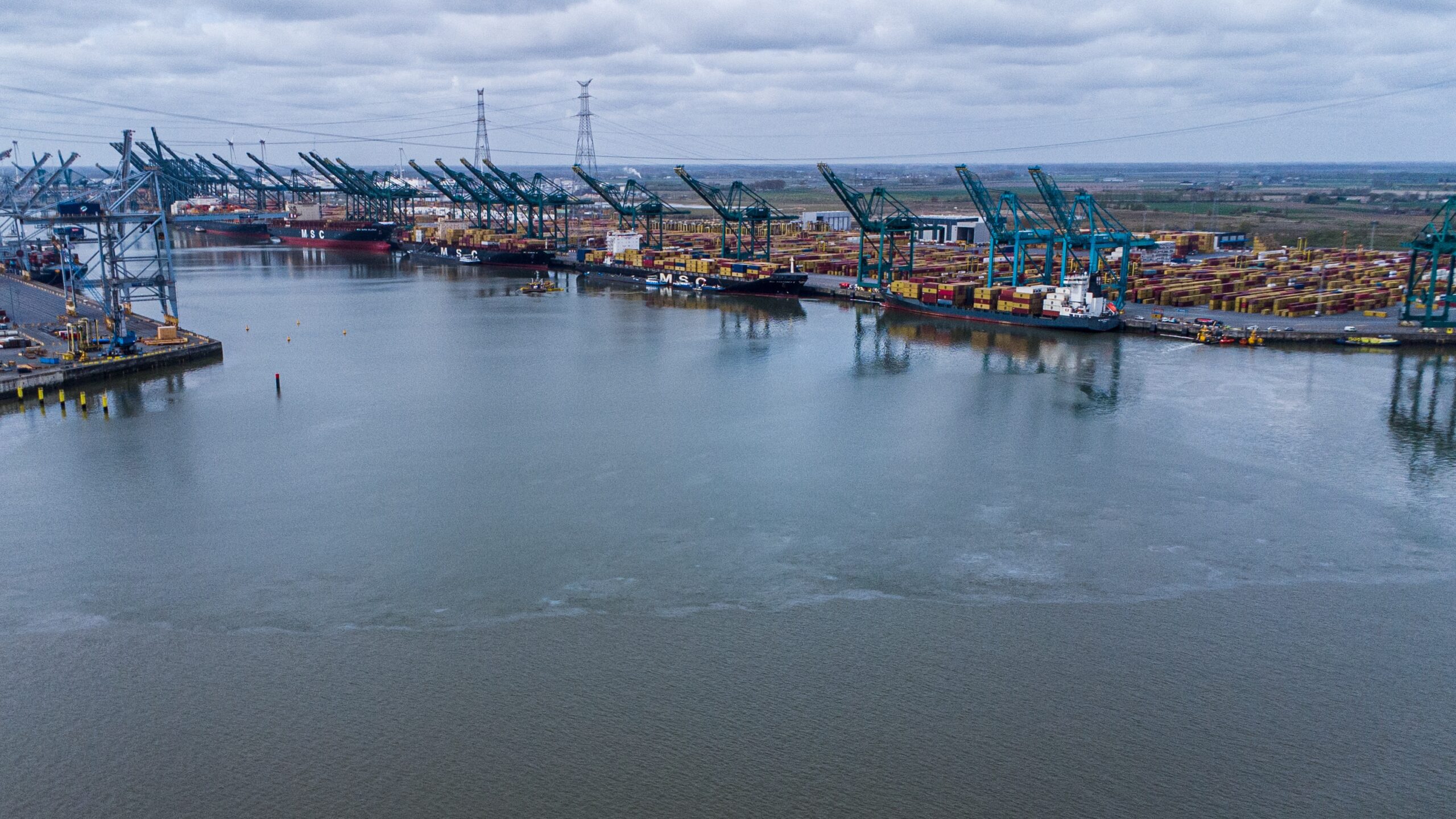
Oil stains are seen on 10 April on the water surface as maritime traffic is on hold in the port of Antwerp after an accidental oil spill. Credit Belga/Jonas Roosens
Under the so-called Alternative Fuels Infrastructure Regulation, only large container ships, ferries and cruise ships are eligible to connect to shore power.
This means that gas tankers, bulk carriers and other cargo ships are completely excluded. T&E therefore proposes that, in the forthcoming revision, the connection requirements be gradually extended to all types of ships in order to reduce emissions.
“Additionally, all ships in the smaller European ports are not taken into account,” Professor Vanelslander added. “The analysis focuses solely on the hundred largest ports. In fact, you should also include all the smaller ones – although there is little room for manoeuvre in the research as it stands.”
Why isn’t the roll-out of shore power happening as quickly as some would like? “There is a very heavy reliance on organisations such as Fluvius and Elia,” explained Vanelslander.
“There are the usual problems with permits, and in reality it is the large container terminals that decide where they will invest in shore power first.”
Saving billions
The Port of Antwerp-Bruges said it actively encourages the use of shore power. “This report refers to sulphur (SOx), but regulations on this have long been in place at IMO (International Maritime Organisation) level, specifically regarding how much sulphur is permitted in ships’ diesel.”
The port authority also pointed to the report by the Flemish Environment Agency, which recently showed that the targets set for sulphur in Antwerp are being met. “As for nitrogen (NOx), shore power could well be a key factor in working towards future standards.”
T&E stated in the report that stricter rules on air pollution around ports could save society billions. “And it protects the health of port communities,” it said.
“Instead of connecting to the electricity grid when they moor, thousands of commercial vessels currently run their diesel generators day and night to power their on-board systems,” the report added.
The European Union is due to review the regulation at the end of this year.
Finally, the analysis showed that Rotterdam is the most polluted, with costs of €340 million, followed by Antwerp (€220 million, excluding Zeebrugge), Marseille (€120 million), Hamburg (€120 million) and Genoa (€110 million).
“By closing the loopholes in EU rules, €1.5 billion in health and climate costs could be saved. The current policy gap is causing significant planning uncertainty for port authorities and grid operators.”
According to T&E, once health and environmental costs are factored into the price of energy, generating electricity using fossil fuels at the quay is twice as expensive as using shore power.
The Clean Port Coalition, an alliance of industry representatives, therefore wishes to accelerate the roll-out of port electrification and shore power.
