
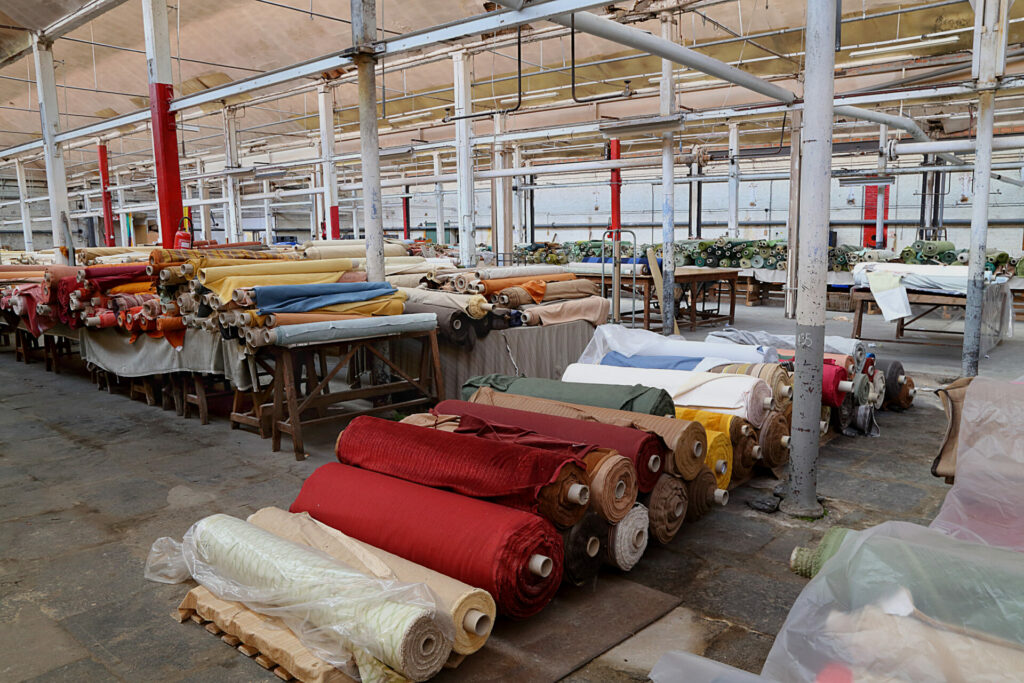
Flanders' historic textile industry is in serious danger of being wiped out as a consequence of soaring energy costs and government-mandated wage indexations, De Tijd has reported.
The industry — which grew to European prominence during the Middle Ages and was even admired by the Romans — generated only half as much revenue last year (€4 billion) as it did in 2001. The fall in carpet sales, Flanders' largest textile sector, was particularly precipitous, dropping 30% compared to the year before.
Moreover, numerous decades-old factories — including the Ideal Floor Coverings plant in Wielsbeke and the Balta Group yarn factory in Avelgem — are scheduled to close within the coming months, leaving hundreds of Flemings facing a potentially prolonged period of unemployment.
"It's a battlefield," said Joe Lano, the owner and CEO of Lano Carpets in Harelbeke, referring to the European textile market.
Inflation the main culprit
Although rising competition from China has led to a decline in demand for European-manufactured textiles, it is high inflation, and in particular soaring energy costs, which are principally to blame for the Flemish industry's woes.
"[Inflation] added to the declining demand in Europe and the US," explained Philippe Hamers, the Belgian CEO of Victoria, a British carpet company which bought half of Balta Group in July last year. "But that worried me less than the high production costs. The market is picking up again, but the expensive European energy is probably the new normal. Just like the high wage costs in Belgium, you can't reverse it either. That's why we closed Balta's yarn production in Avelgem and partly moved to Turkey."
Hamers added that the Belgian Government's policy of mandated wage indexations also bears significant responsibility for the current crisis: "We cannot let our strategy depend on what the Government decides. Waiting for the Government takes too long. Labour costs are rising too fast in Belgium. It is a cynical calculation, but due to the closure of our yarn factory in Avelgem, we have 220 fewer people on the payroll."
Hamers also heavily criticised the EU's energy policy, and suggested that the bloc's efforts to cushion the blow of high energy prices to European industry were largely ineffective.
"If something ever happens at the EU level, it is purely symbolic," he said. "The price ceiling for gas of €180 per megawatt hour is laughable, because it is still seven times more expensive than a year ago, before the war in Ukraine broke out."
Part of a broader crisis
In many ways, the Flemish textile industry's current difficulties mirror those afflicting the Belgian economy as a whole.
On Friday, The President of the Federation of Belgian Companies (FEB) warned that Belgian businesses are facing an economic "tsunami" of up to €55 billion in the coming months as a consequence of soaring energy and labour costs.
Similarly, market analysis firm GraydonCreditsafe recently found that bankruptcies in Belgium increased 44% last year compared to 2021, and forecast that high energy prices coupled with government-mandated wage indexations could force many more small and medium-sized enterprises to become insolvent this year.
Related News
- 'Empty spaces in city centres': Bankruptcies in Belgium set to increase in 2023
- Belgian companies face economy 'tsunami' of up to €55 billion
GraydonCreditsafe's analysis was further corroborated by the results of a recent poll by the Union of Middle Classes (UMC), which found that three-quarters of Belgian independent retailers fear becoming insolvent in the near future. In a similar fashion to Flanders' textile company owners, shopkeepers attributed their financial difficulties to soaring energy bills, government-mandated wage indexations of employees, general inflation, and global geopolitical tensions.
The UMC survey also found that the vast majority of shops had resorted to cost-saving measures in order to remain solvent, including reducing their heating and switching off their outdoor lighting.
