
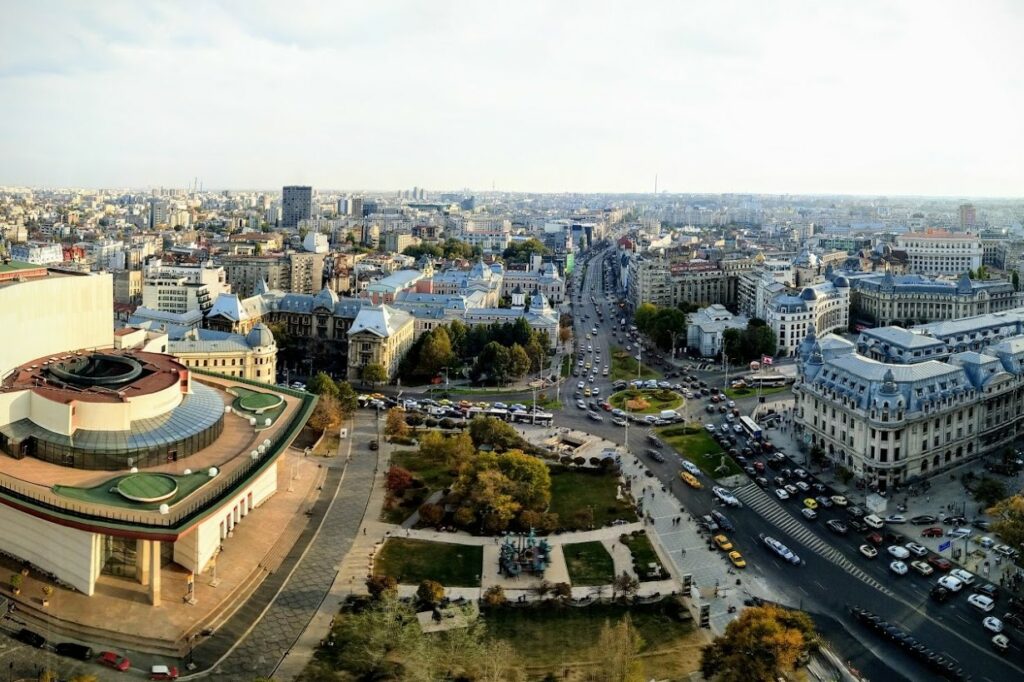
At least 20 Belgian real estate companies are active in Romania, with developers seeking to capitalise on a growing economy and rising purchasing power, while taking risks on their investments, reports De Tijd.
Real estate developments flourish in Romania in a near unrestricted fashion and Belgian businessmen are in the top 10 of biggest foreign investors in the Eastern European nation, according to the PWC accounting firm.
In Bucharest, the country's capital, Belgian business is an integral part of the cityscape: a supermarket owned by the Delhaize group, which shares its logo but goes by the name Mega Image, has over 650 stores, from huge 'concept stores' to small corner shops (in Brussels, Delhaize lists a mere 100 shops on its website). Yet most other Belgian investments are not recognisable by familiar logos.
Last week, Belgian real estate group Huyzentruyt announced a 10,000-square-meter residential project in Voluntari, a suburb in the north of Bucharest, where they intend to build 120 apartments for the upper middle class.
The Belgian group entered the Romanian market just a couple of months ago but hopes to make a revenue of €75 million in Romania by 2030. Huyzentruyt expanded its business to Romania in an attempt to replicate the success it had in Polish real estate.
Ambassador Van Ees visited @mega_image_ro leadership in Bucharest, market leader in #Romania’s capital and successful part of @AholdDelhaize. At the end of 2019 MegaImage will have 750 shops around the country. We discussed among others cooperation with local agricultural sector. pic.twitter.com/n1QTza0CnW
— Wijnand Marchal (@wynmar) November 15, 2019
Belgian companies are financing business parks, commercial centres, housing complexes and parking garages all around Romania, which is the sixth most populous country in the EU and whose real estate sector attracted around €800 million from foreign investors in 2021.
Warehouses de Pauw (WDP), a logistics firm owned by one of the wealthiest families in Belgium, has a portfolio of €1.1 billion in Romania – the company's third most important market behind Belgium and the Netherlands. WDP owns over 1,2 million square meters of land in Romania, including a 58-hectare logistics park which is one largest areas of land ever traded for construction in the country.
Speedwell, a residential developer created by Flemish businessman Didier Balcaen, has a €500 million plan to turn an old factory in the centre of Bucharest into apartments, De Tijd reports. The developer plans to build around 6,000 across the country. Speedwell is only active on the Romanian market and manages a fund of investments from 20 Belgian entrepreneurs, including frozen fries magnate Jan Clarebout and interior specialist Jan Ollevier.
"In terms of large projects, in Flanders, you only have Nieuw-Zuid in Antwerp and the Arsenaal site in Ghent," Jan Demeyere, Speedwell co-founder, told De Tijd. "In Romania, you can still develop many large, old industrial sites in cities. We have already bought a shoe factory, a hat factory and a lingerie factory."
Very happy to support the development of the industrial real estate sector in 🇷🇴 Romania. Our new €150 million loan will boost @WDP_EU's green and inclusive growth plans. 🌿🏬 #EBRDgreen https://t.co/zajNn9vUzC pic.twitter.com/qIiAmLNvHm
— The EBRD (@EBRD) July 16, 2020
'Building is faster here'
Foreign developers see an increasing demand for quality homes, from either the most well-off in Romania or ex-pats, but they have to put at least 40% of their own money into a project since Romanian banks will only finance a maximum of 60%. Depending on location, developers will also put money into local infrastructure, like roads, to make their projects usable.
The Romanian real estate market has an intricate web of problems, especially in Bucharest where business interests often prevail over the public concern. This has seen the city lose many of its green spaces to crowded real estate developments, often built with improper materials; a crucial issue in a city that is bound to face a major earthquake sooner or later.
Bucharest's current mayor has had a moratorium on spatial implementation plans in place for the past two years, in an effort to stop the reckless construction projects inside the city.

Though often picturesque, Bucharest has often prioritised financial gain over livability for residents. Credit: Canva
Belgian investors are incentivised by a market that continues to grow, even when the Belgian one is slowing down. In the last 3 years, the price of apartments in cities like Bucharest and Cluj-Napoca skyrocketed, but many analysts predict that there is a bubble waiting to burst.
The relaxed rules on labour may help developers get their money's worth. "Building is faster here because labourers work six days a week and 12 hours a day. Construction does not stop in summer or winter. There is continuous work. And the quality we deliver in Romania is just as good or even better than in Belgium, " Didier Balcaen, Speedwell founder told De Tijd.
Recently, more migrants from Asian and Middle Eastern countries are working in construction sites in Romania, in a system that has been compared to modern slavery, as these workers, who are often overworked and provided inadequate housing, are legally tied to their employer for a year.
Related News
- New York's 'Flatiron' skyscraper auctioned for $190 million
- Belgium's budget burden: IMF forecasts tiny economic growth
- Belgium offers to buy €1 billion worth of real estate from the EU
Belgian businessmen warned against seeing Romania as a cheap country, reports De Tijd. The average gross wage in Romania is about €800, and the minimum gross wage was just recently raised to €600, but there is a steep difference when it comes to high-paying jobs.
"The net wages of executives, especially in Bucharest, are at the level of Belgium", Ivan Lokere, CEO of the Alinso company which has an industry park outside of Bucharest, told the outlet. "You shouldn't start it for the cheap."
