
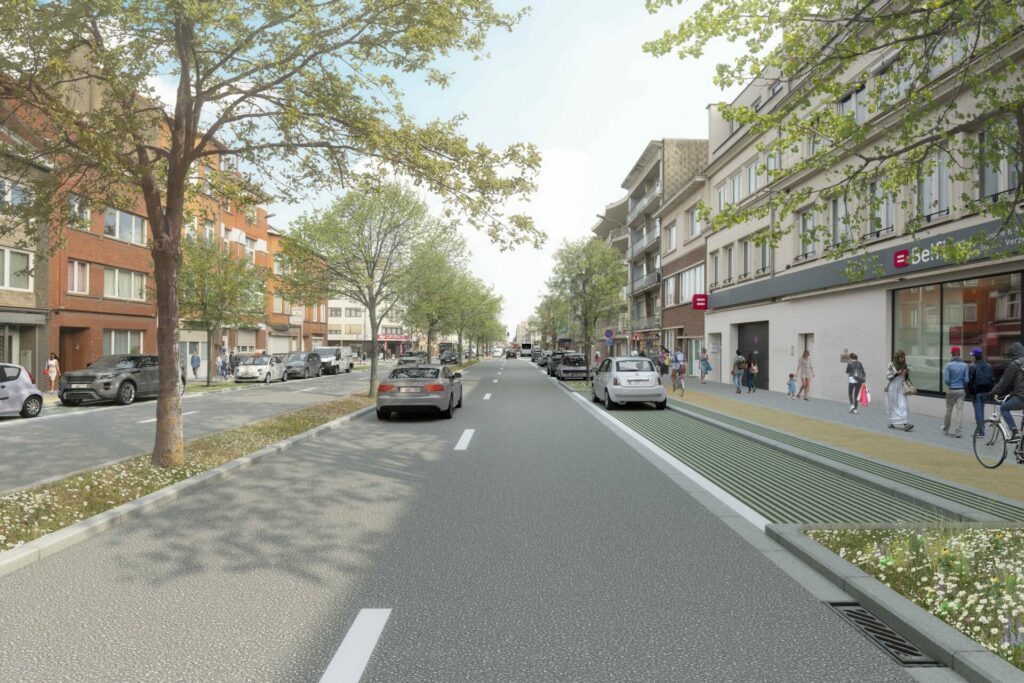
Brussels Mobility has announced a complete overhaul of a section of the Chaussée de Ninove, a key carriageway in and out of the city centre, to make it safer and more liveable for locals.
The works will focus on a section of more than 1 km between the border with the Brussels Region, near the Ring Road, and Boulevard Mettewie to the North of Anderlecht. A permit application has been submitted.
"The west of Brussels also has a right to beautiful, green, renovated avenues. The quality of infrastructure, aesthetics and the presence of trees in a street has a major impact on the quality of life in a neighbourhood," Elke Van den Brandt, Brussels Minister for Mobility.
She noted that as a carriageway to Brussels it is "essential that its design gives a welcoming first impression of our Region".
Works on the other parts of the Chaussée de Ninove, between Boulevard Mettewie and the West Station and then between the West Station and the canal are also being assessed with a view to giving "the entire stone road a facelift."
Aims of the works
The public space around this section of Chaussée de Ninove is currently in poor condition: "There is no greenery at all. A refurbishment is urgently needed."
The project's main aim is to improve safety, mobility and quality of life. To this end, the pavements will be considerably widened with new paving stones and safe pedestrian crossings added, particularly at school entrances.
One-way bicycle lanes will run on both sides of the carriageway, separated from the road by a buffer zone to guarantee cyclist safety. The road will remain with 2x2 traffic lanes, sometimes more at junctions.
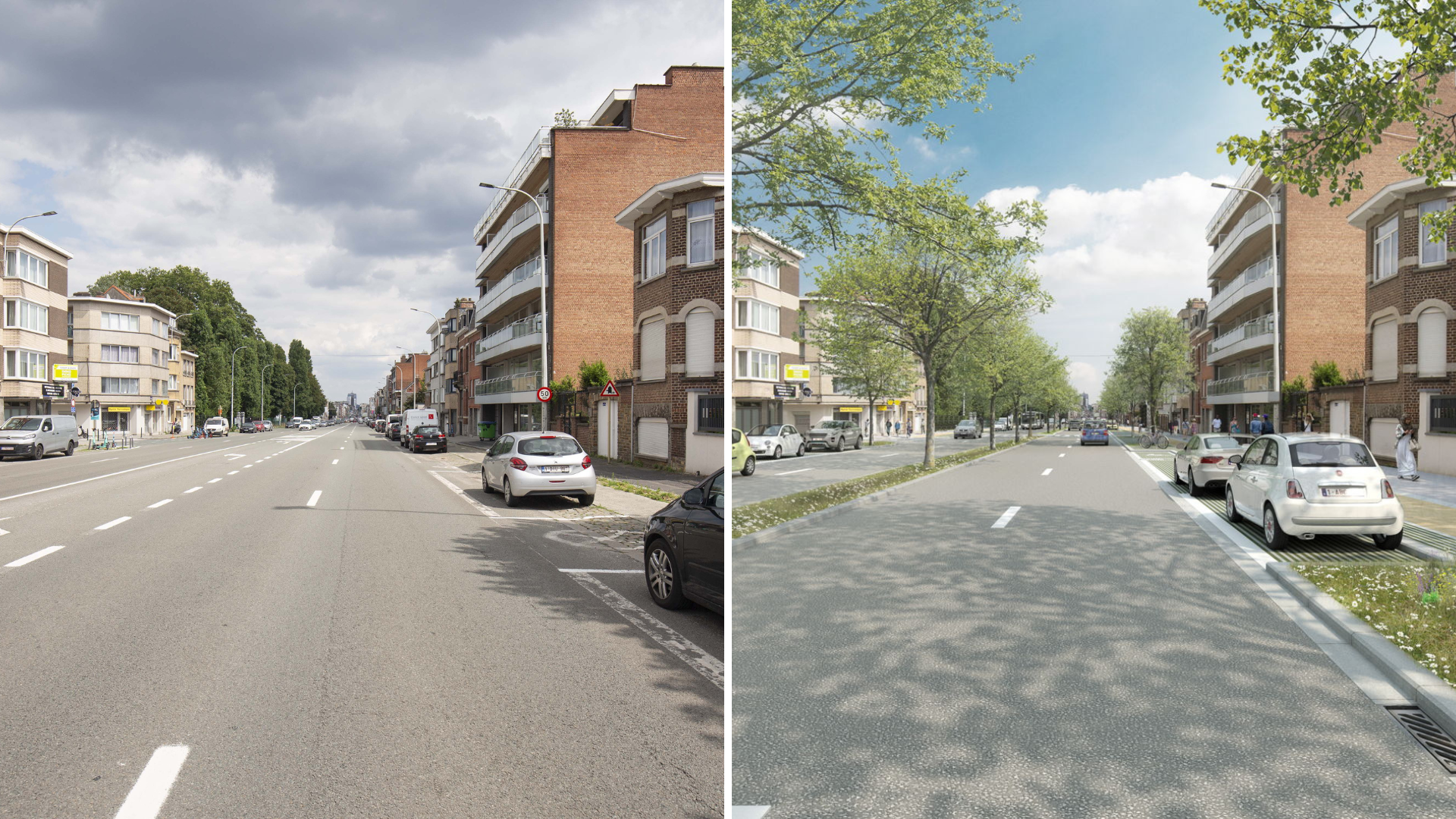
The road before and after the works. Credit: Brussels Mobility
Aside from road safety, the project will also help the region better prepare for the effects of climate change. "More green spaces, trees and landscape elements should not only beautify the road scene but also help reduce urban heat islands," Brussels Mobility spokesperson Inge Paemen said.
Integrated rainwater management systems will maximise the infiltration (after storage) of rainwater into the ground to limit the risk of flooding. 10% of the project's surface area (2,834 m²) will be newly planted areas. An additional 132 trees will be planted in three rows: one in the middle of the brick road and two between the parking spaces.
The number of parking spaces will be reduced to allow for trees and to create delivery and cycle parking zones, but the aim is to "preserve the necessary parking spaces and facilitate access to local businesses".
The public enquiry for this particular section of the carriageway will take place in January, giving people a chance to see the plans and provide feedback.
