The year 2025 was a yet another difficult year for artists around the world with threats not only continuing but increasing, according to the recent State of Artistic Freedom Report published by Freemuse, an international organisation which monitors artistic freedom.
“What we see is that attacks on artistic freedom are no longer, mostly, limited to isolated cases against individuals or organisations,” Alfons Karabuda, Vice Chair of Freemuse, wrote in the foreword to the report. “They are becoming part of a broader political developments that affect the foundations of democratic societies.”
The new report highlights suppression of artistic freedom and devastation of cultural institutions in countries and regions at war – Gaza, Lebanon, Iran, Ukraine, Sudan and Myanmar.
A special focus is placed on bans in the UK of artistic expressions and events linked to the Israeli-Palestinian conflict. It affects not only artists who protest against Israel's warfare but also Israeli artists who do no support its government.
Artistic freedom falls under the broad remit of freedom of expression and is a fundamental human right, protected in several international and European conventions.
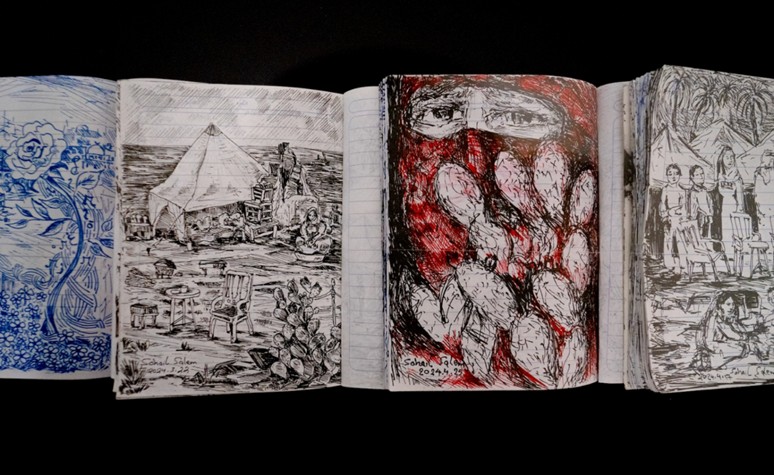
Palestinian artist Sohail Salem’s ‘Under Fire’ uses salvaged materials to depict Gaza, credit: Freemuse/ Daret al Funun website
According to the report, a follow-on effect of bans and censorship of artistic freedom is self-censorship which has emerged as a pattern across every region covered in the report. Being hidden, it is hard to measure. Very few artists say publicly that they have to censor their artistic expressions. Artists and institutions avoid controversial theme fearing legal repercussions, public backlash and the loss of funding.
“Censorship is the biggest problem which artists and cultural institutions are facing,” Norwegian film director and human rights defender Sverre Pedersen, Executive Director of Freemuse, told The Brussels Times.
“According to reports from other NGOs, in Europe, up to 50 % of artists are affected but the figure could be higher because many are censoring themselves and don’t report it,” he said.
Many artists and writers in for example the Nordic countries have experienced threats, violence and harassment, and several have left assignments or changed their focus as a result. This emerged from a report in 2024 based on a survey to over 3,000 artists and writers in Denmark, Iceland, Norway and Sweden.
In the US, the Trump administration puts the resilience of free speech values to the test in its campaign against “diversity, equity, inclusion and accessibility”. In countries such as Turkey, Myanmar, Iran and the UK, counter-terrorism legislation is used against artists. Palestinian artists in Israel and the West Bank are also hit by such legislation.
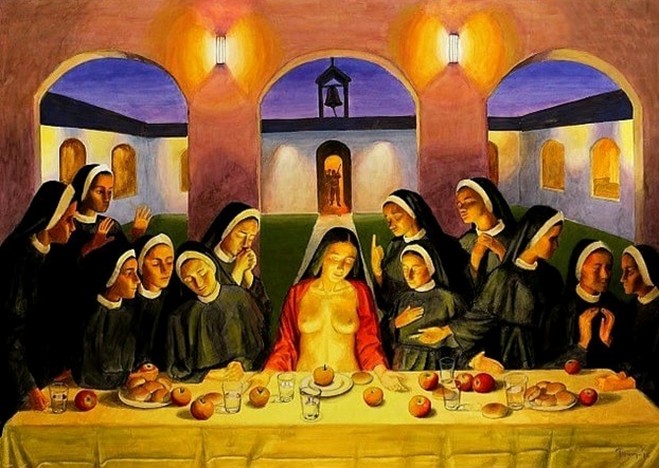
Indian artist Tom Vattakuzhy’s ‘Supper at Nunnery’ triggered backlash at the 2025 Kochi-Muziris Biennale in India, after protests from the Church, briefly closing the venue before the work was withdrawn and the exhibition reopened, credit: Freemuse/Tom Vattakuzhy, Facebook.
The criminalisation of blasphemy and “insult” to religion remain one of the most persistent threats to artistic freedom. Nowhere is this more extreme than in Afghanistan where artistic life has practically been abolished and women are prohibited from singing.
The report includes separate country and regional chapters on the situation in the US, Afghanistan, Iran, Turkey, Myanmar, Eastern Europe and South Caucasus, Sub-Saharan Africa, and Latin America.
Sverre Pedersen says that Freemuse is not short on data. “Our reports are based on collected data and interviews with artists. In countries where Freemuse has good contacts, the reporting is more comprehensive. However, it has been a conscious choice from Freemuse to focus on trends and the situation in selected countries because in our opinion it gives a truer picture of the current situation.”
He is open about the fact that monitoring artistic freedom in countries like China and North Korea is difficult. “If we were to publish statistics on what we have managed to document from such countries, it would give a very incomplete picture.” Freemuse’s board has raised the issue and decided that more comprehensive data will be collected for next report.
He says that artistic freedom in Europe is increasingly threatened by censorship, threats, harassment, and violence. Specifically, performing artists have reported high instances of sexual harassment and direct threats. Some governments use national security laws or anti-defamation/blasphemy statutes to prosecute artists for works that criticize political figures or national symbols.
“Key threats include the weaponisation of public funding to promote specific political narratives, harassment of artists by pressure groups, and the restriction of content deemed 'controversial' or critical, especially in Hungary, Poland, Italy, and Germany.”
“Far-right parties are in government, alone or in coalition, in several EU member states,” he added. “They seek to champion a cultural policy framed around an idealised past, moral policing, and a suspicion of contemporary diversity — creating pressure for conformity in what kind of art are developed, financed and made public.”
An issue raised in previous reports is if there are legitimate limitations on artistic freedom. What is Freemuse’s opinion about this today?
“Freemuse does not have an official position on what are legitimate limitations on artistic freedom. We believe that whenever authorities use arguments that these are legitimate limitations, they must be analyzed and assessed concretely,” Sverre Pedersen replied.
“We do believe that it’s very important that those who work with artistic freedom and freedom of expression must have an ongoing dialogue about the limits of freedom of expression, otherwise we will be in danger of ending up as freedom of expression fundamentalists.”
“When this is not touched upon in the 2026 report, it is because the situation is now so serious and demanding for artists in all parts of the world that there are other matters that must be prioritised. Democracy and human rights are under such great pressure that now it is important to mobilise for these values when you are threatened by autocracy, fundamentalism and dictatorship.”
A challenge to artistic freedom is anti-terrorism legislation. Should legislation ban support of terrorism and art which could encourage hate crime or inspire other people to carry out terrorist acts?
“Freemuse is very critical of banning. Not least because the legislation and rhetoric surrounding anti-terror measures are often very vague in order to give the authorities as much leeway as possible. We see also that anti-terror legislation is widely used to silence artists.”
As usual, the report ends with a number of recommendations that are addressing the increasing threats against artistic freedom. Artists and cultural bodies have also mobilised around a proposal for a European Artistic Freedom Act on binding legal protection across Europe but the report falls short of recommending it.
“Freemuse supports it, “Sverre Pedersen commented, “but we do not believe that it will solve all challenges. We want to have artistic freedom high on the European agenda. Meaning concrete actions to defend artists and artistic freedom and systematic monitoring and documentation of violations of artistic freedom in Europe.”
Asked about the report and the proposal, a European Commission spokesperson replied: “The need for strategic direction and strengthened political commitment for cultural policy in Europe has become increasingly pressing. The European Parliament, the Council, and stakeholders across the EU have stressed the importance of having an EU strategic framework for culture.”
In the EU Work Plan for Culture 2023-2026, the Commission presented a Culture Compass for Europe - a long-term strategic vision for culture and cultural heritage. Last November, the Commission launched the Culture Compass, which will include a new ‘EU Artists Charter’ for fair working conditions for artists and cultural workers.
Furthermore, a new report on the ‘State of Culture in the EU’ will track progress in the cultural and creative ecosystem, with particular emphasis on artistic freedom.
