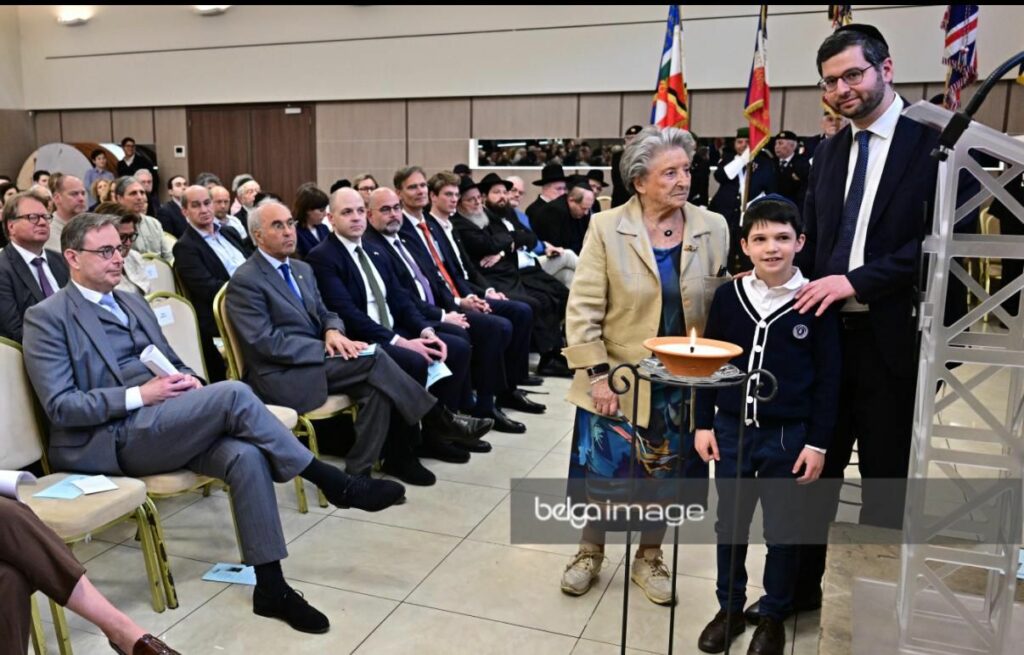
Belgium’s Prime Minister Bart de Wever expressed his support for the Jewish community in the country at an event on Wednesday in Antwerp commemorating the end of WWII and the Holocaust.
The event happened to take place on the same day as the Antwerp Public Prosecutor’s Office confirmed that it had indicted three persons, known as mohels, who perform circumcision according to Jewish practice, and intended to refer them to the court.
Circumcision or brit milah (covenant of circumcision) for religious reasons of newborn boys, is performed by specially-trained practitioners who do not necessarily have to be physicians, and is crucial for Jewish life in Europe.
The indictment is an escalation in a legal-medical dispute that erupted a year ago after police raided the homes of the circumcisers in the local orthodox Jewish community and threatens the future of Jewish life in the country. The community had expected that the investigating prosecutor would determine whether non-medical circumcision is a matter of freedom of religion or whether it required regulation.
At the event, the chairperson of the ‘Forum of Jewish Organisations’ in Antwerp, Baroness Regina Sluszny, described the indictment as a “shock of historic proportions”. Herself a Holocaust survivor, who was hidden as a child during WWII, she questioned if sustainable Jewish life is possible in a country where ritual slaughter has been forbidden and where circumcision is under judicial pressure.
“The Jewish community have been part of Belgium since the establishment of the country. Freedom of religion is not something which suddenly can be abolished by an ‘activist’ interpretation of the law by judges and prosecutors,” Sluszny said. She called on the Belgian government to ensure that Jewish life in Belgium is not only tolerated but effectively protected.
Indictment without evidence
According to the indictment, seen by The Brussels Times, the prosecutor claims that the circumcisers have carried out punishable acts of “intentional blows with premeditation under abetting circumstances with premeditation, intentionally having inflicted injuries or blows” on male babies. They are also accused of having practiced medicine unlawfully.
A third charge sounds as an ancient blood libel accusing them of having used their mouth to suck blood away from the wound immediately after the circumcision of two babies. This ritual practice is still used in some ultra-Orthodox Jewish communities despite the risk of herpes transmission. In ancient times it was believed to protect the baby from danger but it is not an essential part of the circumcision.
Belgium’s Foreign Minister, Maxime Prévot, claimed in media that the judicial investigation stemmed from denunciations made by members of the Jewish community itself.
In fact, the police action was prompted by a complaint by a private person in conflict with the Jewish community in Antwerp. His allegations that Jewish boys were “mutilated” and “infected” when circumcised were taken seriously by a former Belgian justice minister who instructed the prosecutor’s office to launch an investigation. The allegations are now repeated in the indictment.
The indictment includes a list of more than 100 names of babies that have been circumcised in Antwerp during December 2023 - January 2025, without any evidence that they have been mistreated or injured. Nor is it likely that it has happened.
In Judaism, circumcision is performed on the eighth day after birth but the ritual can be postponed for health reasons. Circumcision at that early age is considered safe and significantly reduces the risk for complications compared to if it was performed at a later age. Experience and a sterile environment are more important than whether the practitioner is a doctor or a certified ritual practitioner.
Some might argue that circumcision requires the child’s consent and that there should be an age lime of 18. That would logically lead to a ban of all circumcisions, Muslim and Jewish, including those performed in hospitals by physicians.
Not regulated in Belgium
Male non-medical circumcision is largely unregulated in the EU. Sweden and Denmark require licensing of the persons who perform it in the Jewish communities.
In these countries, circumcision can be performed by non-physicians if the persons have been licensed by the authorities at the proposal of the religious community and medically trained staff is present. Germany does not require licensing of circumcisers recognised by the Jewish community if the baby is under the age of 6 months.
Asked before the indictment if Belgian legislation requires male circumcision for religious reasons to be performed by physicians, a spokesperson of Health Minister Frank Vandenbroucke replied affirmatively. The spokesperson also stated that the legislation does not allow a mohel to perform circumcision without a medical doctor present.
In fact, the issue of circumcision for religious reasons is not explicitly dealt with in the legislation and leaves the door open for interpretation. The law only states that “no-one may practice medicine who does not possess the legal diploma of Doctor of Medicine, Surgery and Obstetrics, obtained in accordance with the legislation on the awarding of academic degrees”.
Until the sudden police raid in Antwerp, no problems were reported and circumcisions took place unhindered under the supervision by the local child welfare authorities. Circumcisions have reportedly continued during the investigation and will continue unless a court will issue a legally binding judgment criminalizing circumcision.
Israel’s president Isaac Herzog has condemned the indictment of Jewish circumcisers in Belgium. “This is incomprehensible, outrageous, and something that doesn’t resonate after, decades ago, the Jews of Belgium were expelled for being Jews and sent to the concentration camps and extermination camps.” He called on the Belgium authorities to reverse the decision.
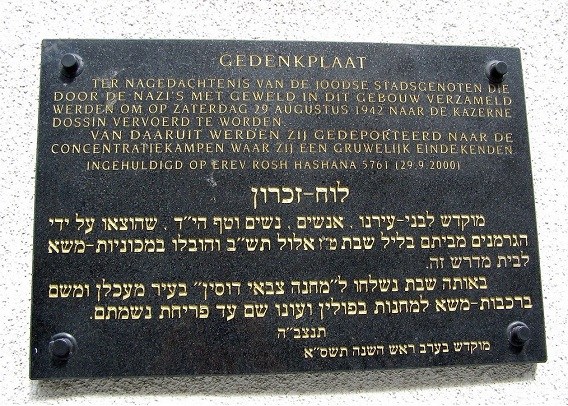
Memorial sign in Dutch and Hebrew at Terlint Street 33, Antwerp. Jews were brought on trucks to this building before they were sent to Kazerne Dossin in Mechelen on 29 August 1942 and from there on goods vans to their death in Auschwitz. The memorial was erected on 29 September 2000 and mentions the Nazi-German perpetrators without mentioning the collaboration of local Belgian police.
In his speech, Prime Minister De Wever said that a memorial which will give a name to all the victims of the Holocaust in Antwerp will be inaugurated next year. He also condemned the “new antisemitic way of thinking that is being normalized and thus becoming embedded in society”. The first point of contact for antisemitism in this country, that is me, he added.
Historian Herman Van Goethem, former rector of Antwerp University, has written a book about Antwerp during the year 1942 - in Dutch “1942, Het jaar van de stilte” or “1942, The year of silence”. It refers to the year when the Belgian authorities kept silent about the Nazi persecutions of Jewish people, and when some on the local level in Antwerp collaborated willingly with the occupation force.
Asked about the book, Bart De Wever, at the time mayor of Antwerp and a historian by training, told The Brussels Times that he found it compelling. “The acknowledgement of the bitter truth is that evil didn’t simply descend upon us and that it dragged many people into its whirlwind. It is necessary to connect past and present in a true alignment for a better future.”
The Commission keeps silent
At a conference in Brussels last month, European Commissioner Olivér Várhelyi underlined that antisemitism, hatred, violence and the glorification of terror have no place in Europe. At the centre of the conference was a proposal for the establishment of a ‘Special Protected Minority Status’, aimed at ensuring enforceable legal protections and long-term safeguards for Jewish life in Europe.
“We will continue to protect and support Jewish life, and we will continue to fight antisemitism,” Várhelyi said. As Commissioner for Health, he is expected to deal with an upcoming proposal on enabling male circumcision for religious reasons without infringing on the EU Member States’ health competency.
His cabinet did not respond to a request for comment on the indictment. Nor did the cabinet of Equality Commissioner Hadja Lahbib, the former Belgian foreign minister, reply. Last February, she announced that the Commission had approved a European Citizens’ Initiative on abortion rights.
Like circumcision, it is also a health issue which falls under the competency of the EU Member States but in this case the Commission found a ‘creative’ EU-wide solution without harmonising their legislation or infringing on national competency.
A Commission spokesperson confirmed that it was aware of the media reports about the indictment but had no comment to offer. “Judicial and police investigation are national competences. In accordance with the Treaties, Member States define their own health policies, including the delivery of health services and medical care.”
The Commission declined to reply to a question if the Belgian policy is in line with EUs action plan on combatting antisemitism and fostering Jewish life in Europe. Nor did it confirm that it is working on an EU-wide solution for male circumcision for religious reasons.
Magnus Brunner, Commissioner for Internal Affairs and Migration, added the following: “The European Commission is committed to combating antisemitism in all its forms, in line with the EU strategy to combat antisemitism and foster Jewish life.”
No EU country is exempt of external scrutiny. The judiciary in each country is monitored in the Commission’s annual rule of law report. If Belgium does not withdraw the charges against circumcision and dismisses the indictment, it risks becoming the first EU Member State to criminalize circumcision on dubious grounds.
