
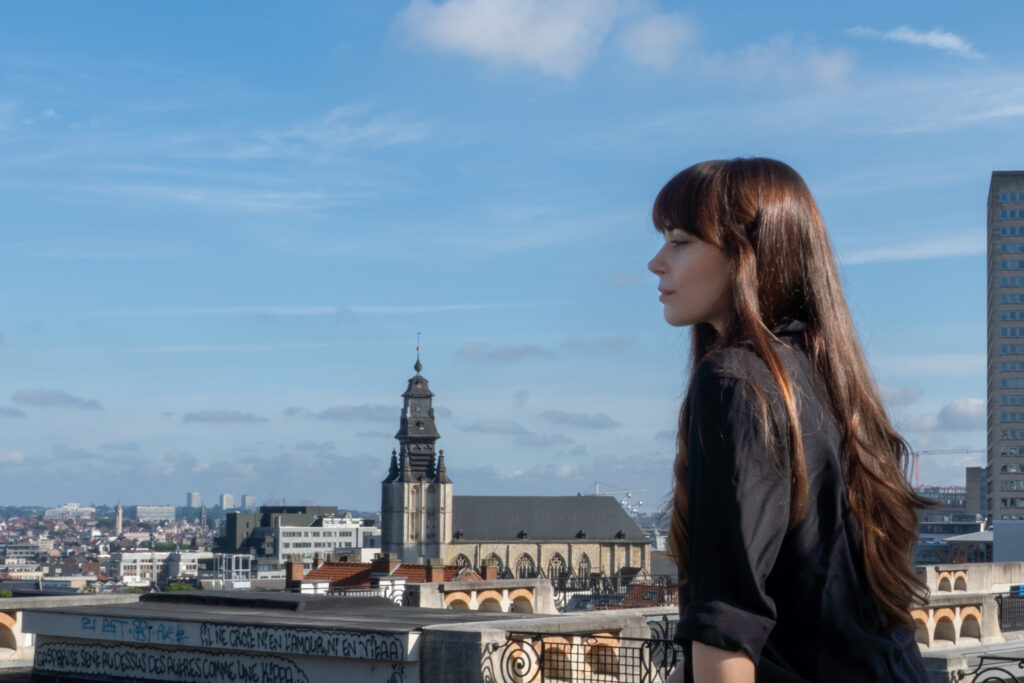
Belgian National Day is an important day of unity for a country that brings together so many diverse communities, languages and cultures. As an expat who has just obtained permanent residence status, I see 21 July as a day to take stock of the things I value most in Belgium - the country I’ve come to see as home.
Coming from the US, I’m ashamed to admit that Belgium, or more specifically, Brussels, only entered my consciousness when I heard the news about the devastating terrorist attacks that happened in March 2016.
A few years later, I ended up coming here purely by chance. I was planning a trip to Ireland and it just so happened that the cheapest ticket to Europe was through Brussels. At the time, I was studying political science, and I seized the chance to spend a few days in this most political of cities to help me decide if I would continue my studies here.
Overcoming the first hurdles
When I moved to Brussels, it didn’t take long for my starry-eyed dreams to be confronted by their first challenge: the Brussels rental market.
Desperate to start my new life as soon as possible, I naively took the first halfway decent room I could find online, only briefly inspecting it before signing a year-long lease. In my defence, my hand was being pushed by the omnipresent invisible hand of the country’s administrative bureaucracy, which stipulated that I must first have an address before being able to obtain the basic necessities for daily life in the modern world: registration and legal residence rights, an ID card, a bank account, health insurance, a phone contract and the ability to receive mail.
Thus began my love-hate dance with the Belgian administration - a routine I think should be recognised as the country’s official choreography, in the absence of a national one.
Within a couple of weeks, my accommodation had become completely intolerable. In a moment of hopelessness, and by some stroke of luck, I remembered the business card for The Expat Welcome Desk service that had been given to me in my school welcome package.
I sent an email asking for support, and the next day they returned with the contact details of several legal services I could follow up with. I sent emails to all of them, and within a few days, I was sitting at an Exki in front of a lawyer with the Syndicat des Locataires.
Over the next three weeks, he advised me on numerous options and communications with my slumlord-come-landlord, eventually helping me settle by finding a tenant to sublet from me in record time while I secured a new apartment. I can’t tell you how many times I called the man with all manner of frantic questions, and he stood by my side like a soldier. I sent him a Christmas card for several years afterward.
Having these two experiences back-to-back is something I’ve come to recognise as embodying what it means to be, or to live, in Belgium: a place where we are at once constricted, but also held, by red tape.
Yet it’s due to all these formalisations and systems that an open space is created, where time is forced to slow down—no matter how much we might want fast results and immediate progression. It’s within these empty spaces, and the promise of being safeguarded, that we collectively make our homes.
How do I love thee Belgium? Let me count the ways...
Belgium a country that has not one but three national languages, where the percentage of foreign-born residents is 17.8%—well above the EU average of 13.9%. And where Brussels alone, as a global capital, stands out with its foreign-born population being more than triple the EU average and nearly three times Belgium’s own rate.
Once I had lived in Belgium long enough for it to be considered my de facto home, one of the first things people asked me, usually after wondering why I would trade the California sun for 200 days of rain a year, was: “Do you like it?”
I never quite know how to answer that question, so I usually start by listing the things that have kept me here, despite my having the freedom to settle in any European country. I like walking down Avenue Louise, even at off-peak hours, and hearing five different languages spoken in the time it takes me to get a croissant at the bakery around the corner.
I like the intimacy of Brussels, where there’s the feeling that you’re only one introduction or conversation away from a connection that changes everything - or perhaps you’re already unknowingly brushing shoulders with a big political player whose signature today might be tomorrow’s news.
I like knowing that, geographically, I’m practically on the doorstep of, or within comfortable traveling distance to, most other major European countries - offering a degree of freedom, mobility, and connectivity that my expat soul requires.
Even with all the frustrations, I like living in a country full of contradictions and absurdities. Where we hold the world record for going 589 days without an official government, the longest political stalemate in modern history, while somehow managing to function throughout. I like the fact that the country was basically invented as a kind of buffer zone between France and the Netherlands. That there exists a government solely for the Sonian Forest park, with its own inter-regional management commission.
Belgium's bureaucratic paradoxes
Nothing better illustrates these bureaucratic paradoxes than the country’s law on compulsory voting, which means that those eligible to vote are required to do so, with increasing fines for each repeated offense. Although in practice, enforcement is rare, it still carries symbolic and institutional weight.
Introduced in 1893 alongside universal male suffrage, the intention of the law was to strengthen democratic participation, especially among the working class. The system reflects the surreal logic of the country: that participation is mandated to preserve freedom, and that accountability is enforced not necessarily through power, but through the slow weight of institutional choreography.
Since arriving in Belgium, I’ve come to know and appreciate all of these cognitive dissonances, dualities, and ambiguities - and to accept them as part of the package, alongside the many advantages Belgium has afforded me.
This Belgian National Day, I am celebrating the unlikely journey that brought me here, and the choice to remain and be held in the stillness between the country’s dichotomies, where true belonging takes shape. Here, nestled between three national identities, a myriad of bizarre cultural symbols, and the daily absurdities of public systems, I have discovered a unique kind of freedom in the in-between spaces. Today we celebrate these spaces that have manifested as Belgium, the nation.
