
As Belgium prepares to celebrate its National Day on 21 July, the event serves as an opportunity to take stock of the country’s international standing: how its culture, diplomacy and identity are perceived by key allies around the world.
For the United States, the world’s largest economy, Belgium is more than just the capital of Europe. It’s a long-standing partner in defence, trade, and cultural exchange, with deep historical ties that date back to the trenches of the First World War and extend into the boardrooms and laboratories of the 21st century.
From Wallonia’s war cemeteries to Silicon Valley boardrooms, the U.S.-Belgium relationship continues to evolve in both symbolic and tangible ways.
To mark the occasion, The Brussels Times spoke with Kathleen Lively, Chargée d’Affaires at the U.S. Embassy in Brussels, about how America sees Belgium today, and what makes this cross-Atlantic bond endure.
Trusted partner
“Belgium is a trusted ally, a close NATO partner, and honestly a country that has given us some of life’s greatest pleasures,” Lively said. “Ask most Americans what comes to mind when they hear ‘Belgium,’ and you will get an enthusiastic list: chocolate, beer, waffles, and fries (with mayonnaise, of course!).”
But Belgium’s cultural impact stretches beyond cuisine. “American music lovers owe a quiet debt to Adolphe Sax, the Belgian inventor of the saxophone, an instrument that became a cornerstone of American jazz, blues, and soul. And of course, a whole generation of Americans grew up watching the Smurfs every Saturday morning, not realizing their little blue heroes were a Belgian creation,” she said.
Increasingly, Belgian brands are making inroads in U.S. households. The U.S. embassy flagged companies such as Lotus Bakeries, which now bakes its beloved Biscoff cookies in North Carolina, and Duvel, which brews Belgian favourites like La Chouffe in locations in the U.S. Agristo, another Belgian company, recently announced a major investment in North Dakota to bring even more Belgian fries to American plates.

Biscoff products have conquered American supermarkets, with the brand expanding rapidly into the U.S. market. In 2019, the Belgian biscuit company opened a new production facilitiy in Mebane, North Carolina, to meet U.S. demand. Credit: Belga/ Kurt Desplenter
On the economic front, Lively pointed to a consistently upward trend. “Trade between the United States and Belgium has grown steadily over the past decade and continues to do so. While not enough people on either side of the Atlantic realize it, Belgium consistently ranks among our top trading partners worldwide and is currently the 11th largest destination for U.S. exports, remarkable for a country of its size. It’s a clear example of how critical we are to each other’s prosperity.”
The embassy sees particular strength in sectors like pharmaceuticals, chemicals, logistics, aerospace, and emerging technologies. Belgium is part of the F-35 fighter jet programme and increasingly collaborates with the U.S. in matters of energy and digital infrastructure
“The future of U.S.-Belgium trade is full of promise,” the chargée d’affaires asserted. “We are especially excited to welcome the upcoming Belgian Economic Mission to California chaired by HRH Princess Astrid this October.”
Partnership forged in blood
Beyond cultural and economic ties, the commitment of the United States to Belgium has been forged on the battlefield. During two successive world wars, American soldiers fell to protect the territorial integrity of the Belgian nation, a sacrifice which is still remembered today.
“Commemorations of shared sacrifice remain among the most powerful symbols of the strong U.S.-Belgium bond. This past year, we marked the 80th anniversary of the Battle of the Bulge, honouring the more than 19,000 American service members who lost their lives defending freedom on Belgian soil,” Lively said.
“Every year, across cities and small villages alike, Belgians hold heartfelt tributes to American soldiers from both World Wars. There was even a Belgian student who led a crowd funding effort to bring American WWII veterans to Europe! These acts of remembrance are deeply moving and remind us that the friendship between our nations is rooted in values, not just treaties.”
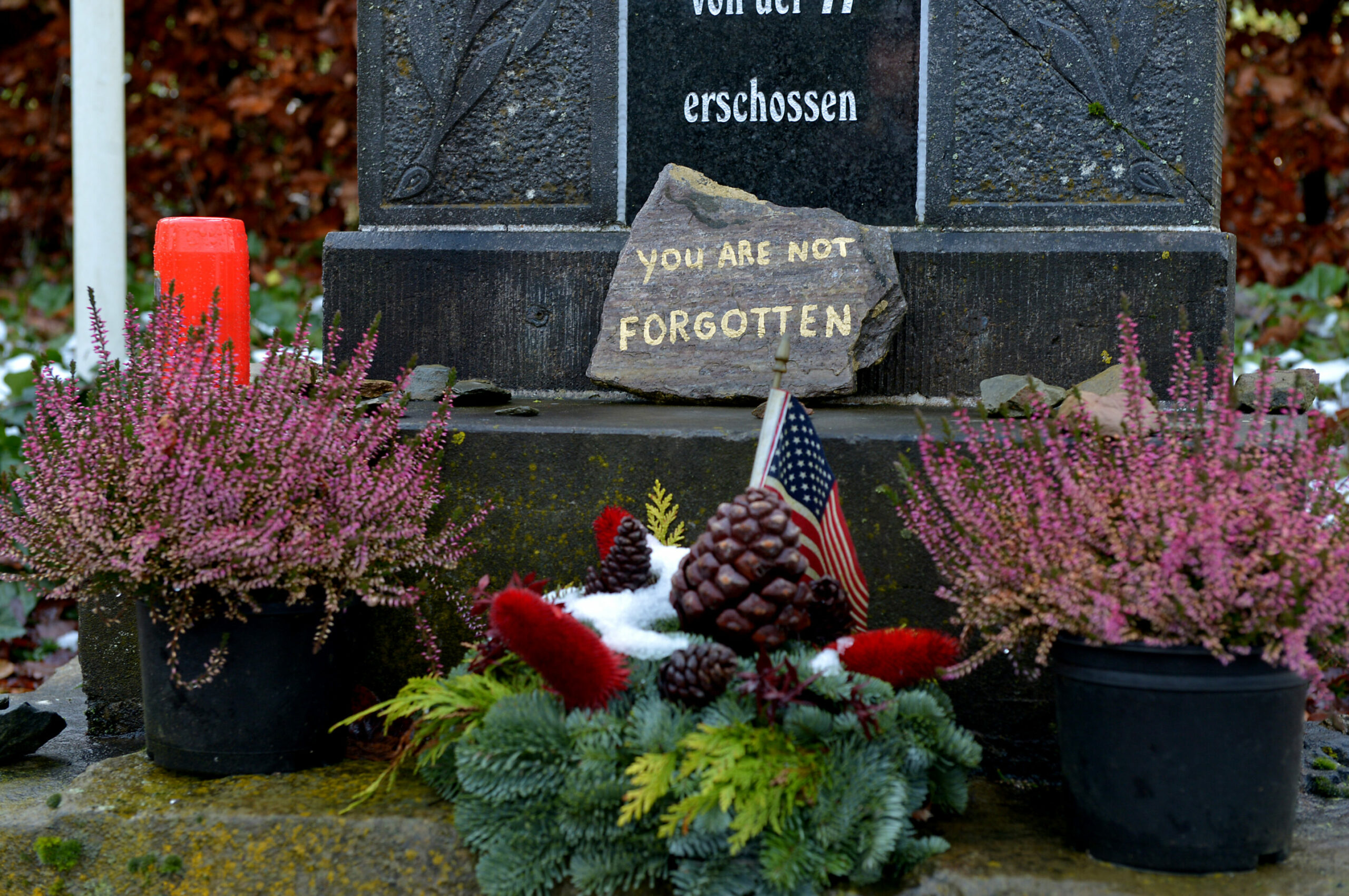
A memorial stands on a hill outside of Wereth, Belgium, Dec. 10, 2014.The memorial is a reminder of the heroic acts of 11 African American U.S. Soldiers during World War II. They took refuge in the small town, and after the Germans captured them, they refused to divulge information about the family who housed them. The 11 Soldiers were led from the city and executed. Credit: U.S. Air Force/ Airman 1st Class Kyle Gese
At a day-to-day level, the embassy enjoys its role as an active member of Brussels’ civic and diplomatic landscape. The Embassy of the United States in Brussels owns an impressive diplomatic hub on Rue Ducale, not far from Arts-Loi, which was first opened in 1919. In 2022, it announced plans to relocate to a new location in Etterbeek, in the former ING Building in Cours Saint-Michel.
“The U.S. Embassy is proud to be part of the rich civic life of Brussels, the beating heart of Europe. We’re not just observers, we’re active participants in the fabric of Belgian society. We’re engaging daily with Belgians across government, business, security, and civil society, working together to make our relationship even stronger,” she said.
Defence and learning
These cultural ties extend to education, with the United States regularly hosting academic talent from Belgium. Notably, Belgium’s Princess Elisabeth is currently enrolled at the Harvard Kennedy School, where she received an Honorary Award from the U.S. Department of State’s Fulbright Programme.

A close up on a pin badge of a fighter jet at Belgian colours, during a visit to the Luke Air Force Base in Glendale, Maricopa County, Arizona, United States, on Wednesday 23 April 2025, organised by Belgian defence to discover the advanced technologies of the F 35, the fifth generation of fighter aircraft. Credit: Belga/ Benoit Doppagne
“Belgium hosts one of the oldest Fulbright programs in Europe, launched in 1948, and the connections it forged are long-lasting. Several prominent Belgian leaders are Fulbright or U.S. exchange program alumni, including the current and former Prime Ministers, underscoring the real-world impact of educational exchanges,” the representative of the U.S. Embassy said.
Related News
- Home away from home: A Brussels trip around North America
- Belgians who made America: 246 years of Belgian-American connections
The embassy also works with local historians to shed light on shared but lesser-known stories. “We have helped tell the stories of remarkable heroes like Augusta Chiwy, a Belgo-Congolese nurse who saved countless lives during WWII, and the Wereth 11, African American soldiers killed by the SS whose courage and sacrifice is remembered annually.”
The ‘Speedbump of Europe’ no longer, Belgium is deepening its defensive ties with its international partners, and especially the U.S. In line with NATO spending objectives, Belgium is now investing into new defence technologies and partnerships.
“Our cooperation is cutting-edge, literally,” Lively said. “Belgian pilots train in the U.S., in anticipation of the arrival of Belgium’s new F-35 fleet, highlighting the strength of our strategic partnership.”
As Belgium celebrates its national day, these quiet, enduring links, from waffles to war memorials, continue to define the country’s international identity. In the eyes of the United States, Belgium is more than a partner; it is a symbol of shared history, mutual prosperity, and enduring friendship.
