
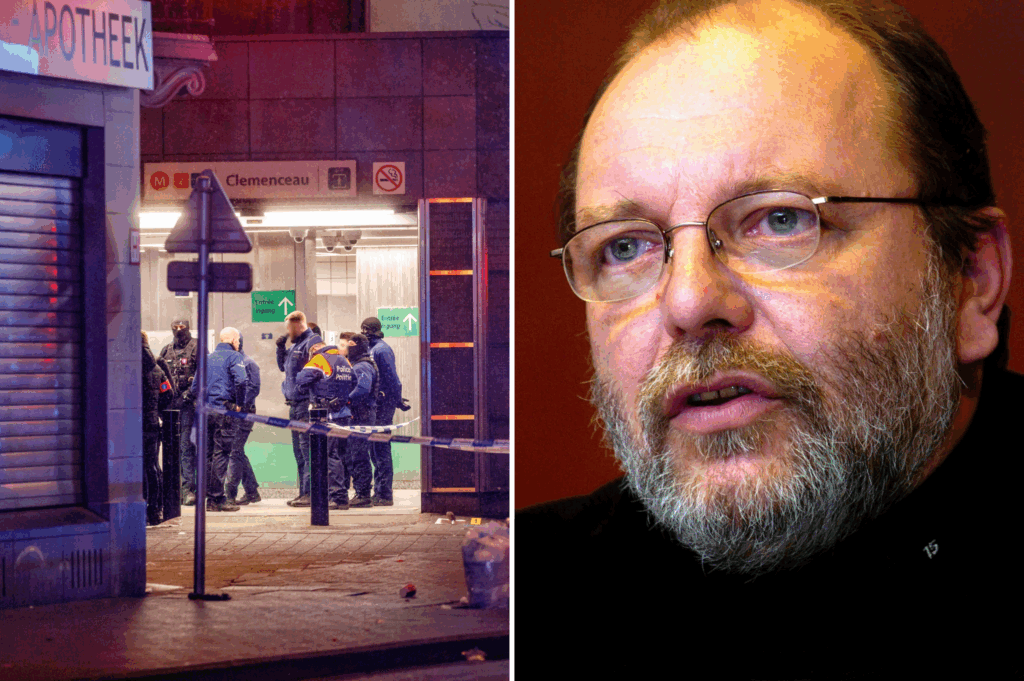
Alain Hutchinson (PS), the official responsible for liaising between Brussels and the European institutions, found himself in trouble after a clumsy phrase during an hour-long interview.
Speaking with a journalist from Euractiv in English, French-speaking Hutchinson said that recent incidents, referring to drug-related shootings, don't happen where expats live and work. "It happens in the rotten parts of the city, in Anderlecht, in Molenbeek, in places like this," he precisely said.
The phrasing caused immediate controversy, with Belgian outlets Le Soir, Bruzz and Sudinfo all reporting the story.
The Brussels Times contacted Hutchinson for clarification. Our interview was conducted in French.
He first stated that he was unaware of the existence of Euractiv. This may seem somewhat surprising for a Brussels liaison to the EU. Euractiv has been and remains one of the major media outlets reporting on EU affairs, and is read daily by members of the institutions here. It is owned by Mediahuis – a big player in European media and publishing. He maintained that his choice of words was a mistake and that his comments had been taken out of context.
He also stated that he reached out to the journalist to clarify that his words had been inaccurate.
He had been speaking with him for nearly an hour about various topics. He had been searching for the English equivalent of "quartiers défavorisés" (which can be translated as disadvantaged or impoverished neighbourhoods), and settled on "rotten" instead, a word he typically uses in French to express having a bad day (un jour pourri).
However, he maintained that this is not his vocabulary when discussing Brussels, considering that he's an elected socialist politician and a veteran of Brussels politics who has held regional posts since the creation of the Brussels-Capital region in the late 1980s.
In the 1990s, he indeed served as chief of staff to the Minister-President of the Region. From 1999 to 2004, he was the State Secretary for Housing. Actively involved locally in Saint-Gilles, he served there as alderman for Education. Since January 2015, he has held his current position as Brussels government commissioner to the European institutions.
He also pointed to projects such as Molenbeek 2030, Brussels' bid to make the municipality the European Capital of Culture, as evidence of his commitment to the very neighbourhoods now under scrutiny.
"I have spent my political life working for these areas," he said. "I have always fought against social and cultural 'ghettos', because cities only thrive when there is real mixité; people of all origins and backgrounds, living together."
"Never in my life have I insulted the people of Brussels," he told us. "If anything, my fight has always been to support the most vulnerable neighbourhoods, and my political career shows it." He maintained: "this was just a bad press manipulation to create a buzz."
The mayor of Saint-Gilles, Jean Spinette, also commented to Sudinfo, saying: "It really is just a translation mistake! Alain was talking about the socially disadvantaged neighbourhoods in Brussels' so-called 'poor banana'. He was himself one of the driving forces behind the neighbourhood contracts and housing reform in Brussels. So if there’s one person (even if he now has a slightly 'smart', 'European' side to him) who has genuinely helped improve access to housing for the most deprived and develop the very districts in question, it’s him!"
The wider context
Brussels has experienced a surge in gun violence this year connected to rival drug gangs. According to figures cited by the Public Prosecutor, there have been nearly 60 shootings in 2024 so far, around 20 of them this summer.
Prosecutor Julien Moinil, currently under police protection after receiving death threats, has described the situation as "alarming" and stated that everyone living in Brussels is at risk of being shot.
The shootings have been concentrated in municipalities such as Anderlecht and Molenbeek, but incidents have also occurred in Ixelles, Brussels City and even near the EU quarter. In 2023, a parliamentary assistant was injured by a stray bullet at Porte de Namur, just two metro stops from the Berlaymont.
Hutchinson’s original intention, he says, was to reassure international officials that their workplace in the European quarter has so far been spared.
"I never said the European quarter could never be affected – this violence could touch anyone in Brussels," he stressed. "What I said was that, up to now, the institutions themselves have not been directly impacted."
Nevertheless, the word "rotten" was used, and Le Soir confirmed that Euractiv’s audio proved it. Hutchinson, however, claims that his words were taken out of context.
It seems Vlaams Belang are seeking to make political capital with the controversy, translating the remark as "dirty neighbourhoods" and accusing the socialist of dishonesty. They point to the commissioner's socialist colours and accuse them of being "irresponsible", "putting the entire Brussels population at risk" and "carrying on lying to everyone to pretend all is well."
The row comes as Brussels remains without a new regional government, despite elections more than 15 months ago. This means Hutchinson continues in his role in a 'caretaker' capacity.
At the same time, he has clashed with Belgian Prime Minister Bart De Wever (N-VA) over the financing of renovations around Schuman, the symbolic heart of the EU quarter. He also pointed out that Flanders decided to make Brussels its capital, but the Brussels-Capital Region is constitutionally one of the country's regions – just like Flanders.
Whether Hutchinson said what he meant or not doesn't change the fact of the matter; Brussels continues to grapple with organised crime and the implications of urban policy that can and are impacting all municipalities and communities.
The expat population represents 23% of Brussels residents. While gun violence resulting from drug trafficking is currently undeniably more prevalent in specific areas of certain municipalities, there is no tangible proof that it will not travel to so-called 'safe' neighbourhoods.
