
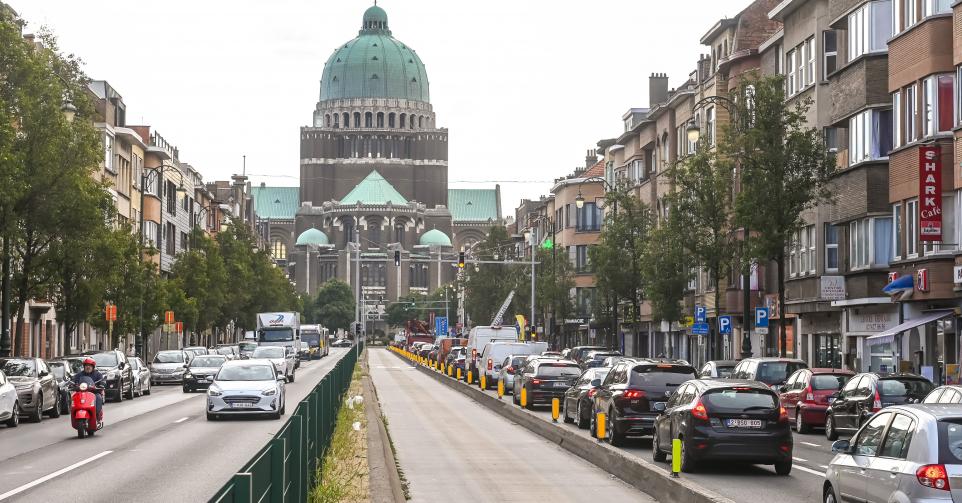
The urban renewal of the Charles Quint Avenue, the commercial backbone of Ganshoren, has sparked mixed reactions from local shopkeepers and authorities.
Often considered unsafe, polluted and busy, the avenue is an important axis that connects Brussels-West with the Centre, as well as Ganshoren to Berchem Sainte-Agathe.
The project, initiated by urban.brussels, aims to revitalise the avenue and change the urban landscape into a boulevard with pedestrian-friendly zones and a cycling path that will connect to the Flemish "cyclostrade" C2.
The aim is also to ease jams by simplifying junctions and improving traffic light control, for a smoother flow of cars and buses.
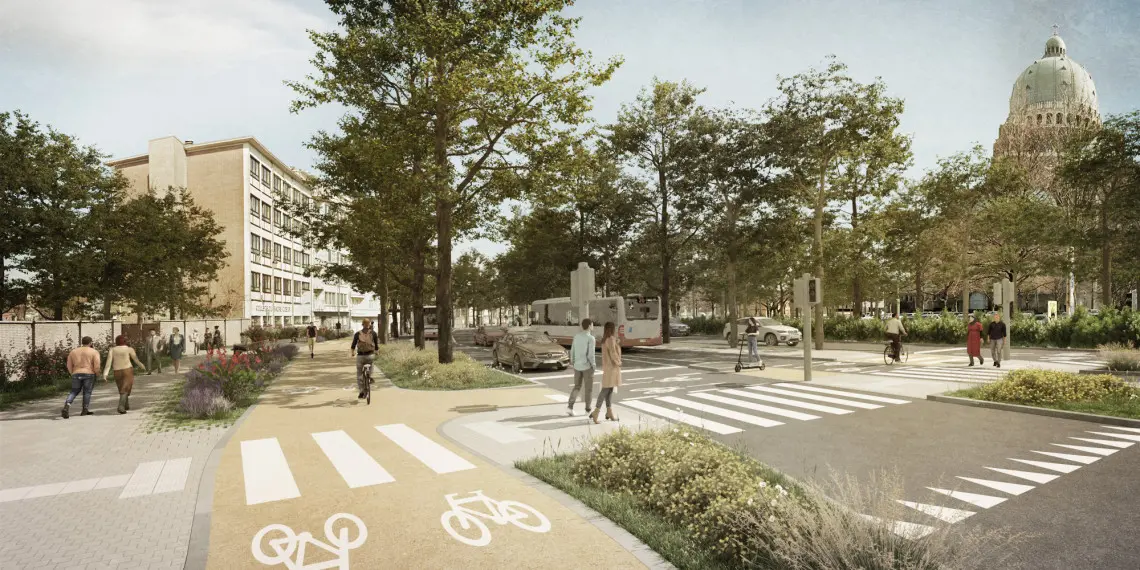
The project, initiated by urban.brussels, aims to transform it into an urban boulevard with pedestrian-friendly zones and a cycling path that will connect to the Flemish “cyclostrade” C2. Credit: Brussels Mobility.
However, the project is met with worry from local shopkeepers and authorities.
Local authorities
Berchem-Sainte-Agathe mayor Christian Lamouline (Les Engagés) has condemned the unilateral decision. "The council and I issued a negative opinion; there were 11 petitions and around a thousand signatures, but the minister chose to ignore them", he regrets.
His main worry lies with the knock-on effect on local traffic: "Turning the Chaussée de Gand into a one-way street will simply push all the cars onto the already congested Chaussée de Zellik. People leaving Basilix won’t even be able to head back towards Berchem via the Chaussée de Gand. It will be catastrophic."
Far from bringing neighbourhoods closer, he argues, the project "only reinforces the wall between Berchem and Ganshoren."
Ganshoren's mayor, Jean-Paul Van Laethem (ProGanshoren), holds a more nuanced view.
The municipality gave the renewal project a general positive review, but it did so with reservations, particularly over the loss of so many parking spaces.
"For fifty years, we've been asking for something to be done about this Avenue. You can't criticise inaction and then, when things finally move forward, fail to acknowledge that at least it’s happening," he said to Sudinfo.
Though he admits that "many parking spaces will disappear," Van Laethem believes the planned compensations and wider redesigns represent progress. He also sees the project as a chance for shopkeepers.
However, this is not the view held by the local shopkeepers.
Ganshoren shopkeepers' Union has warned in a recent statement that the loss of 153 parking spaces could be detrimental to the local businesses.
"Their survival is now in jeopardy. Without solutions, this street could turn into a commercial desert," stated David Steegen, president of the Union of Shopkeepers.
Following the closure of the long-standing San Daniele restaurant and amid renewal plans for what is seen as a neglected avenue, the Union acknowledged the efforts to modernise the area. Still, it stressed the severe economic consequences of the measures being considered.
Halving parking spaces, closing Rue Beeckmans and introducing paid parking, he argued, would damage access for both customers and residents already struggling in a difficult atmosphere.
The Union is calling for practical alternatives such as free parking for locals and clients, while also criticising rising terrace taxes and a 20% increase in cadastral charges, which threaten the already fragile hospitality sector.
Out of the 250 businesses in Ganshoren, more than 150 are located on Avenue Charles Quint, and the Union warned that their very future is now at stake.
