
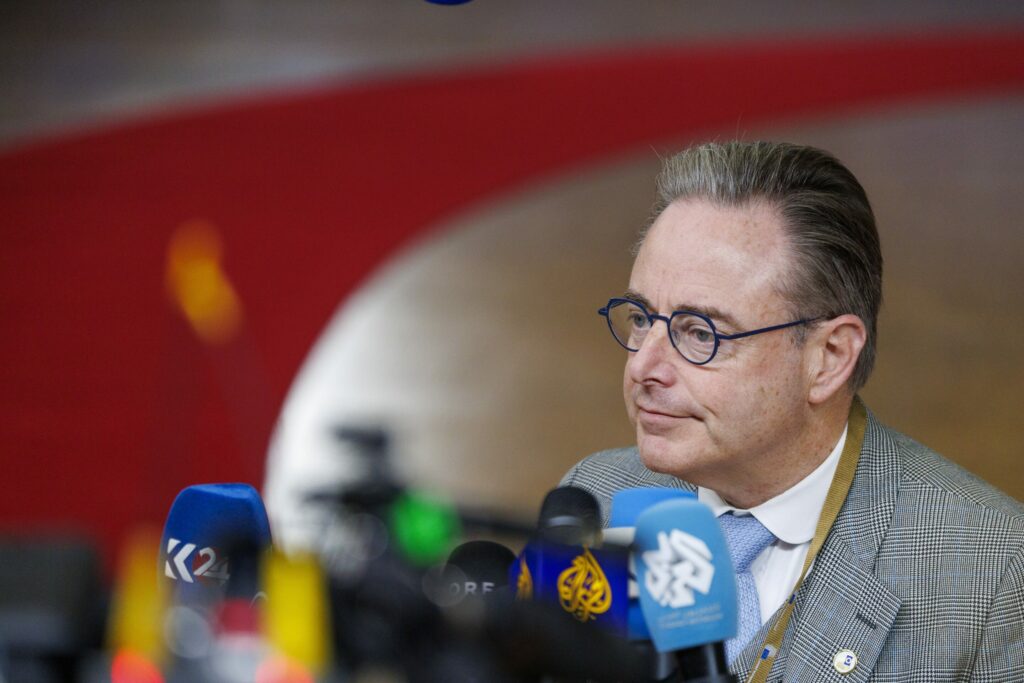
The international press has criticised the Belgian Prime Minister Bart De Wever's cautious attitude regarding the mobilisation of frozen Russian assets for the benefit of Ukraine.
At a meeting in Brussels last week, EU leaders failed to agree on a plan to use billions of euros worth of Russian assets to support Ukraine in its war against Moscow.
Most European capitals want to use the €170–180 billion of frozen Russian Central Bank assets located at Euroclear, which is headquartered in Brussels. The loan proposal aims to channel some of these funds into Ukraine’s reconstruction.
Belgium fears the high risks of such an arrangement, and ultimately obtained a significantly softened conclusion that did not mention Russian assets. The Commission must return with “options” to cover Ukraine’s financing needs for 2026 and 2027, according to the published conclusions.
De Wever emphasised the risk of Russian retaliation, warning that Moscow could seize Belgian businesses or confiscate money from Western banks. He cited previous Russian actions against companies, such as Google.
The original intention, according to De Wever, was for Russia to bear Ukraine’s reconstruction costs as part of a peace agreement. “If we ignore international law, we risk empowering Putin, who could confiscate equivalent amounts and recover his funds, leaving us with nothing but problems,” he said.
Condemnation across Europe
This attitude is not going down well with European observers and media.In France, Le Monde was particularly biting about Belgium's attitude.
"With the exception of the very Russophile Hungary, the 27 thought they would reach an agreement in principle on the use of Russian assets immobilised on their soil. Alas! That was without counting on Belgium, which disrupted the plan of Antonio Costa, the President of the European Council, and Ursula von der Leyen, her counterpart at the Commission," lamented the French newspaper.
The Süddeutsche Zeitung also raised the issue Belgium's stubbornness in validating the "reparation credit" to Ukraine. "Belgium blocked the plan to use Russian assets to finance a multi-billion loan to Kyiv, thus preventing the powerful signal expected from being sent to Moscow," wrote the Munich-based newspaper.
In Eastern Europe, commentators were equally unimpressed. The Polish newspaper Rzeczpospolita interviewed an anonymous diplomat who denounced the attitude of Belgium.
They said Belgium was a country "which for years maintained that Euroclear was a Belgian institution in order to be able to tax Russian assets, and now, suddenly, we are told that it is a European institution and that all the member states must bear the risks."
The diplomat added: "The pressure on De Wever is all the greater because Belgium has so far provided relatively little aid to Ukraine and its defence spending is among the lowest in NATO."
Euractiv, a European news site, compared De Wever to US President Donald Trump. "Europe discovers that De Wever is harder to convince than Trump," said its headline.
The outlet continued: "European leaders met at a summit on Thursday, bolstered by the idea that Donald Trump finally seemed to be joining forces with them to end the war in Ukraine. (But it was) ultimately to find themselves hampered by a recalcitrant Flemish nationalist."
