
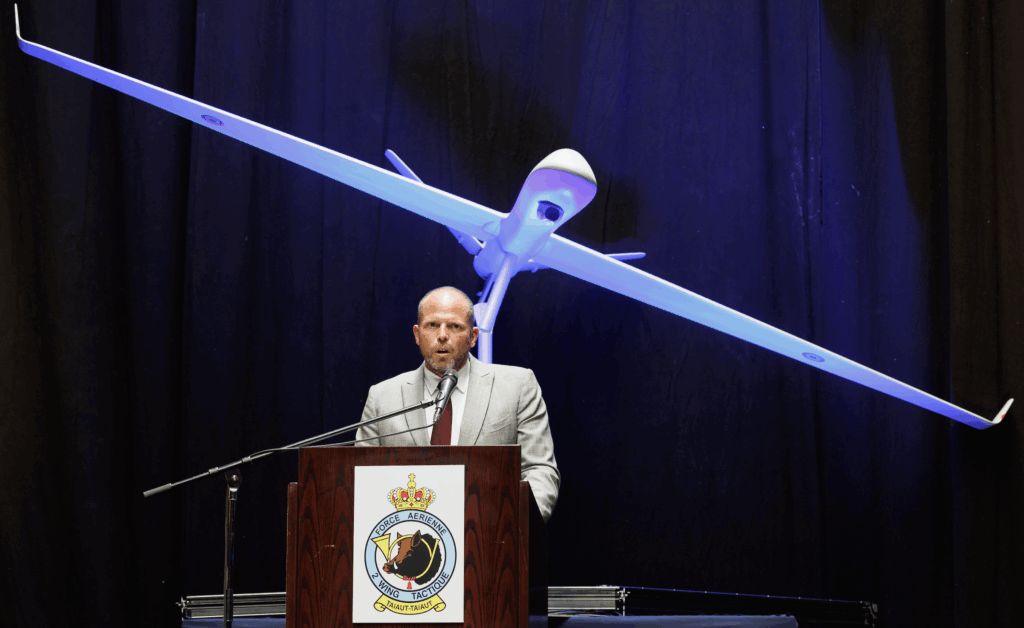
Belgium will purchase drone interceptors from Latvia, Defence Minister Theo Francken (N-VA) announced on Monday.
The acquisition comes as part of the €50 million anti-drone plan intended to enhance the country's defensive capabilities in light of recent drone sightings around military bases, airports and a nuclear plant.
Belgium will purchase a number of ‘Blaze’ counter-drone interceptors from the Latvian company Origin Robotics, as Francken announced together with Latvia's Defence Minister, Andris Spruds.
Latvia’s Origin Robotics interceptor drones after successful tests will contribute to Latvia’s counter-drone capabilities. The system will also be provided and used in 🇧🇪 Belgium. European defence co-operation moves ahead! pic.twitter.com/J2l2s3viCx
— Andris Spruds (@AndrisSpruds) November 17, 2025
How ‘Blaze’ works
‘Blaze’ interception drones combine AI recognition and radar navigation, and can immediately follow fast-moving targets (up to 220 kilometres per hour) and detonate by command.
These first-person-view (FPV) drones weigh no more than six kilograms and can be launched directly from the case in which they are transported in, writes De Standaard.
Thanks to AI support, operating these types of drones does not require excessive prior training. The detonation happens if the pilot confirms. 'Blaze' has a 'three-level safety system' to prevent unintended detonation, and a self-destruction protocol, for when the geofence is breached, communication is lost, or a critical failure.
'Blaze' interceptor systems have been tested on the battlefield in Ukraine, and according to Origin, received positive feedback.
When will Belgium get them?
For now, it is unclear if Belgium bought these systems in order to stop drones flying above its military bases and airports, as seen in recent events.
When contacted by The Brussels Times, the Defence Minister's spokesperson said that the information was confidential and declined to comment. They also did not disclose the number of drones purchased or the cost.
In his post on X, Francken wrote that Belgium will receive these counter-drones in "a couple of weeks".
In recent months, Belgium has experienced a rising number of drone incursions, with sightings above military bases, a nuclear plant and disrupting airport traffic in Brussels and Liège.
During the crisis on 4 November at Zaventem, Belgium’s federal police failed to deploy its drone interception team, despite having the capability to detect and neutralise hostile drones.
Brussels Airport was forced to halt flights for half an hour again on 13 November due to a possible drone incursion. In all cases, the suspected drones were never located.

Two police officers pictured in Brussels Airport departure hall on the evening of Tuesday 4 November 2025, in Zaventem. Credit: Belga/Emile Windal
With Belgium having struggled with intercepting these drones, France, Germany, and the UK anti-drone teams have been providing equipment and training. The drones are suspected to be linked to Russia, although it was never firmly confirmed.
Besides domestic needs, drones have become a key aspect of modern warfare. Each month, Russia is launching thousands of Shahed drones at Ukraine, while further scaling up its production. In July, Belgium joined the International Drone Coalition for Ukraine, founded by Latvia and the UK, which also supports the development of drone technologies.
As well as the short-term €50 million package, Francken plans to invest €500 million in a long-term "comprehensive anti-drone package".
Strategic importance
In November, the Latvian company's CEO, Agris Kipurs, told Janes reporters that Origin Robotics plans to launch mass production of thousands of Blaze interceptors in December. At the moment, it produces hundreds of 'Blaze drones for Latvia, the Netherlands, Sweden, and Ukraine.
Kipurs asserted that 'Blaze' could be manufactured at a cost tenfold lower than some of the existing loitering munitions, such as the Iranian Shahed series, reported DEFCROS News.
Each Shahed is estimated to cost $35,000 per drone, wrote the Centre for Strategic and International Studies (CSIS).
Meanwhile, Ukraine has been using kamikaze interceptors to counter Russia's extensive attacks, becoming a frontrunner in their production. EETimes wrote that those drones cost $300-$5,000 (€258 to €4,300), depending on configuration.
