
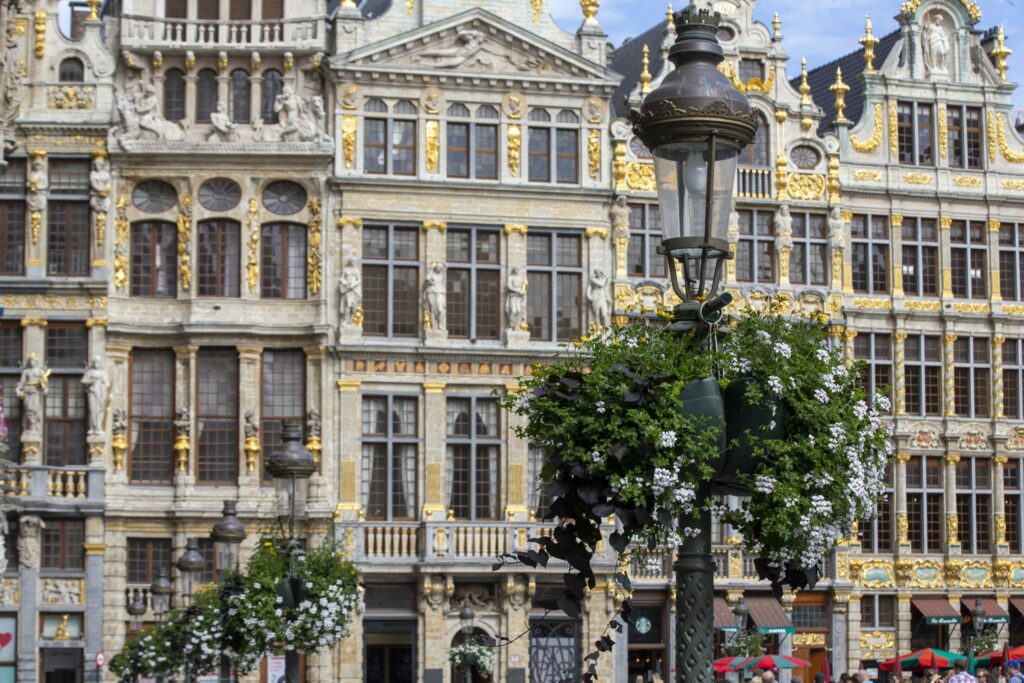
Home to European institutions, a thriving multilingual population, world-renowned Art Nouveau heritage and a thriving contemporary arts scene, Brussels proudly identifies itself as a leading capital city in Europe.
Yet despite sitting at the political centre of the EU, it struggles to project the cultural confidence and dynamism associated with Europe’s major capitals. The gravitational pull of the institutions has never fully translated into cultural or economic power, leaving the city with a title it cannot quite embody and an international profile that does not always feel like one on the ground.
What results is a city caught between its symbolic status and its lived reality: a capital without a cohesive centre, a cultural powerhouse without a shared sense of belonging, and an economic landscape where growth clusters around EU institutions while many neighbourhoods remain disconnected from the prosperity and professional networks that define the city from the outside.
With the release of the Culture Compass for Europe, a sweeping framework placing culture at the centre of EU policy, a long-needed shift comes into view that could help Brussels bridge its internal inequalities, build cultural and economic strength, and shape a more clearly defined Belgian identity.
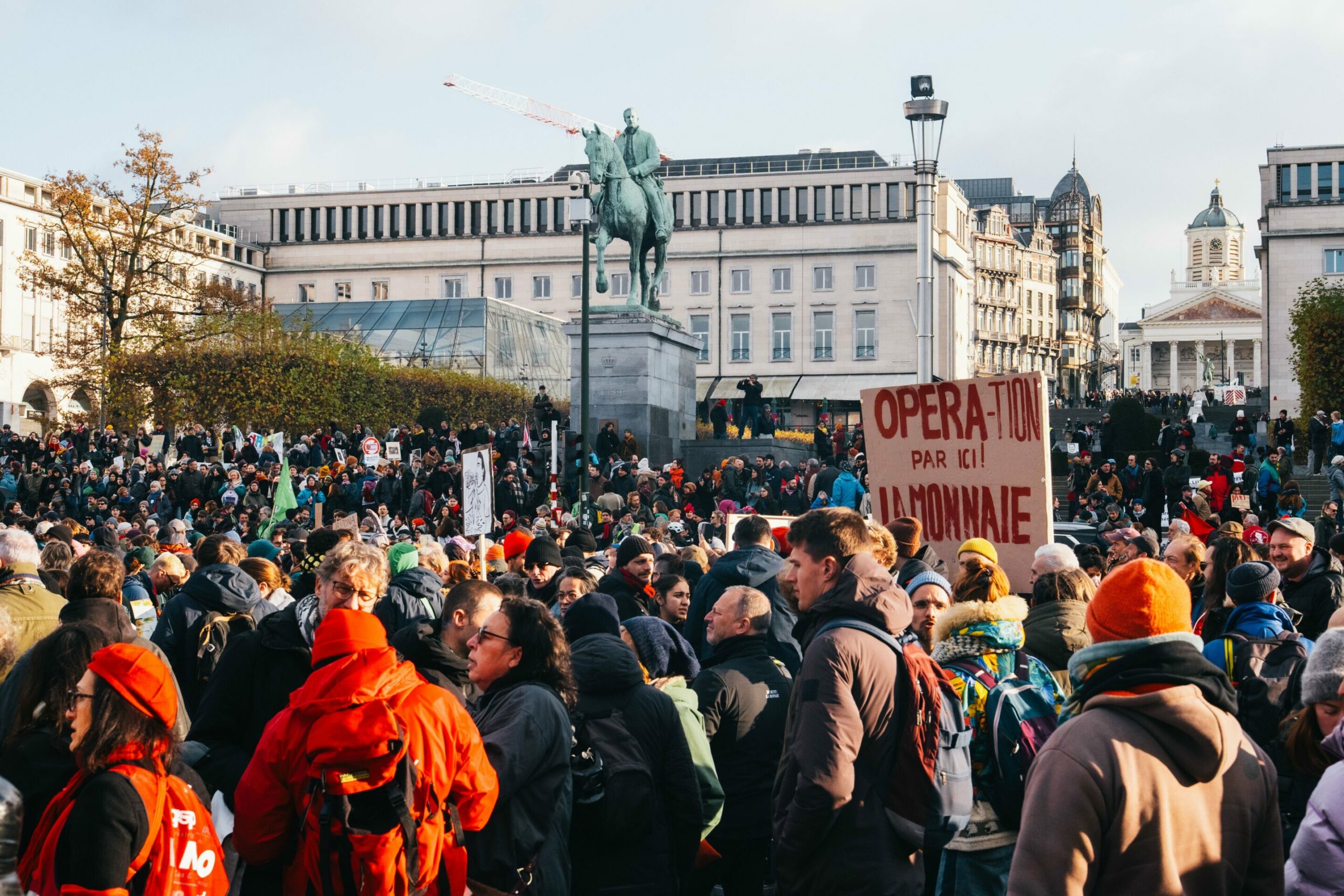
A protest action by the cultural sector in Brussels, during a general strike to denounce the consequences of Federal Government measures, on Wednesday 26 November 2025 in Brussels. Credit: Belga/Marius Burgelman
Culture Compass for Europe
As the EU’s most ambitious cultural framework in over a decade, the Culture Compass redefines culture as a driver of democracy, economic competitiveness, social cohesion and territorial development. It replaces the 2018 Agenda for Culture and acts as a strategic anchor for the next EU budget cycle (2028–2034).
Its vision rests on four pillars: culture as a public good and European value; empowerment of artists and cultural professionals; culture as a source of competitiveness, resilience and cohesion; and culture as a tool in Europe’s global relations.
To make its agenda tangible, the Compass introduces tools to reshape how culture functions across the EU, from a new competitiveness strategy for cultural and creative industries to the European Cultural Data Space, which will modernise digital infrastructure and data sharing.
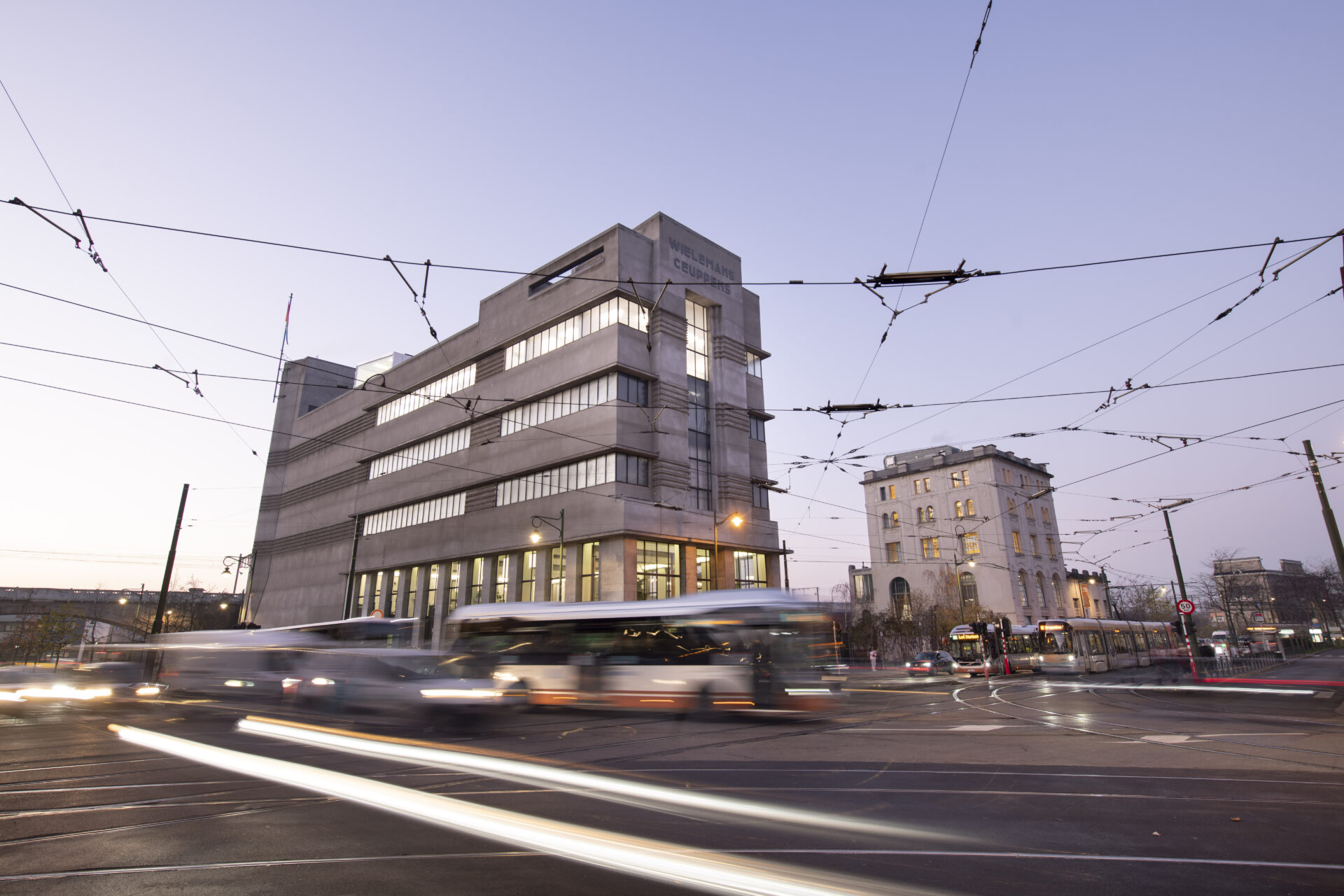
The WIELS Contemporary Art Centre in Brussels is located inside a former brewery. Credit: Belga
It also strengthens the European Heritage Label, expands Creative Europe and cross-border mobility schemes such as youth culture passes, and sets the stage for an EU Artists’ Charter, an AI strategy for cultural sectors and a European partnership for resilient cultural heritage — measures aimed at protecting creators, adapting to technological change and positioning Europe’s cultural ecosystem at the forefront of innovation.
Carried through into policy, this lens could address the access gaps, governance fragmentation and under-leveraged strengths at the heart of Brussels’ challenges.
Road Map for Brussels
Brussels’ cultural inequalities are not new, but the Compass gives them a new political significance. By linking cultural participation to territorial cohesion it allows neglected areas to qualify for the same category of structural investment as transport or housing.
In practice, this could mean reopening libraries that have stood shuttered, strengthening youth centres or creating neighbourhood-based cultural hubs that are not decorative add-ons but recognised contributors to social cohesion, safety and economic opportunity.
Beyond social cohesion, the Compass pushes cities to treat culture as a driver of economic development. For Brussels, this opens a path to diversify an economy long dominated by the institutions by activating some of its most underused assets: its Art Nouveau heritage, its industrial canal zone and its diverse but under-supported creative workforce. These are the foundations of cultural tourism, urban regeneration and innovation ecosystems — the same forces that power growth in cities like Amsterdam or Copenhagen.
Brussels has already expressed its conviction and commitment to culture at the highest level. At the 2025 Europa Nostra European Heritage Hub Forum, Mayor Philippe Close remarked, “In Brussels we want to prove that a European Capital can combine modernity and memory. In concrete terms, we are converting industrial buildings, we are enhancing our historic green spaces, and we are preserving living traditions.”
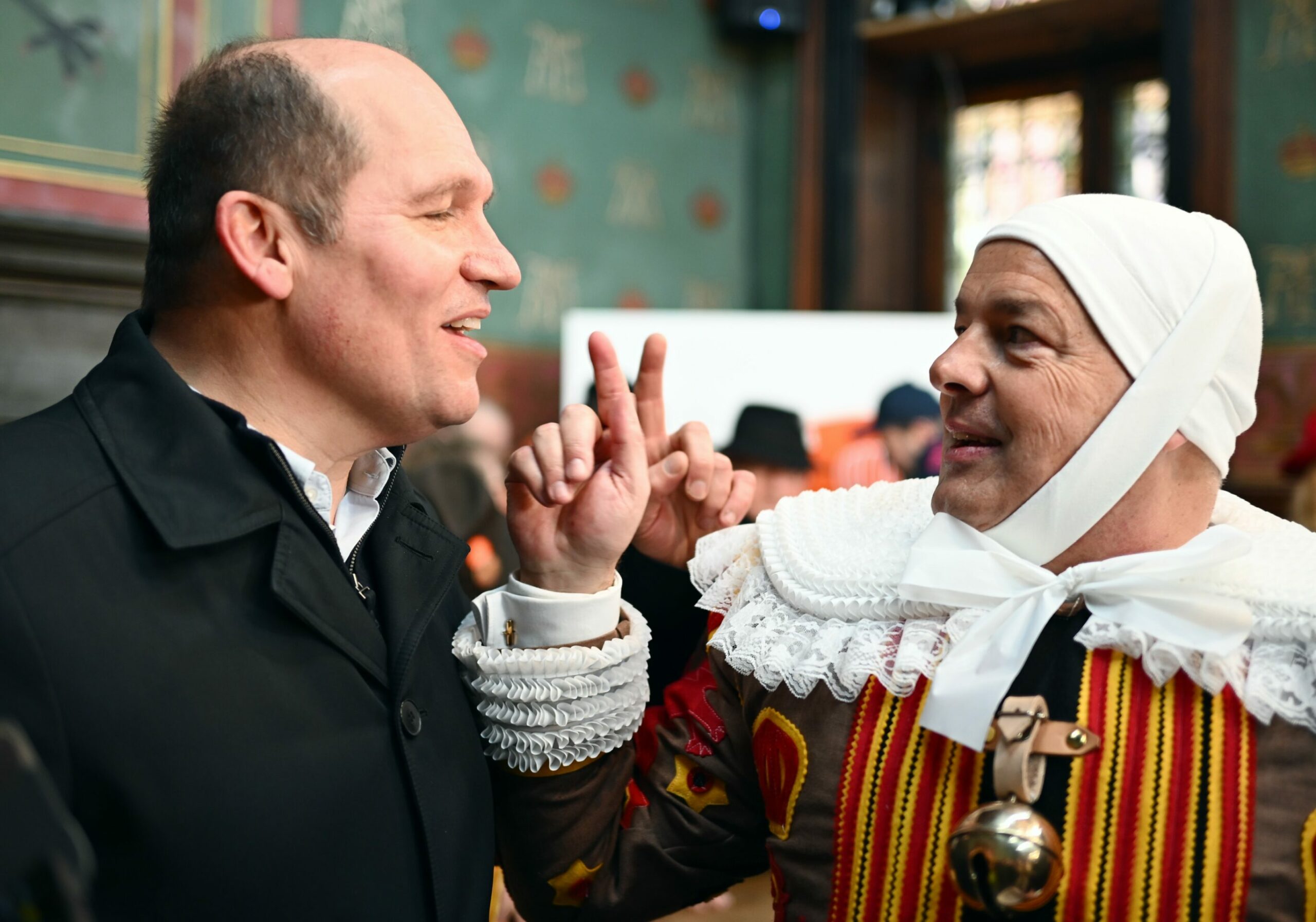
Brussels mayor Philippe Close and the Mayor of Binche Laurent Devin meet at the carnival in the streets of Binche, Tuesday 13 February 2024. The Binche Carnival is a UNESCO-listed tradition and one of the most ancient of Wallonia. Credit: Belga
Europa Nostra has advocated for a cultural compass for over a decade; with the framework now in place, the organisation is working to disseminate it and secure its implementation within the upcoming EU budget cycle. Its Secretary General, Sneška Quaedvlieg-Mihailović, advocates for a holistic approach to cultural heritage that recognises it as integral to the social fabric and long-term resilience of cities.
She states, “Investing in culture is investing in quality of life, social cohesion and well-being — and when you improve those, you strengthen the workforce and the economy. Culture isn’t an extra; it’s a foundation. The next step is ensuring the Cultural Compass reaches the regional level, where the Committee of the Regions will be central to carrying this forward.” This view encapsulates what the Compass seeks to embed in the next budget cycle: culture not as an afterthought but as a structural pathway to a stronger Europe.
If the framework laid out in the Compass is strategically aligned with, the effect becomes cyclical rather than linear. New cultural investments would strengthen Brussels’ competitiveness as a cultural capital, which would, in turn, attract more investment, talent and heritage tourism. In a reinforcing loop, this would sustain Belgium’s cultural identity — not as a fragile, bilingual compromise, but as a living cultural force capable of influencing how Europe sees itself.
