
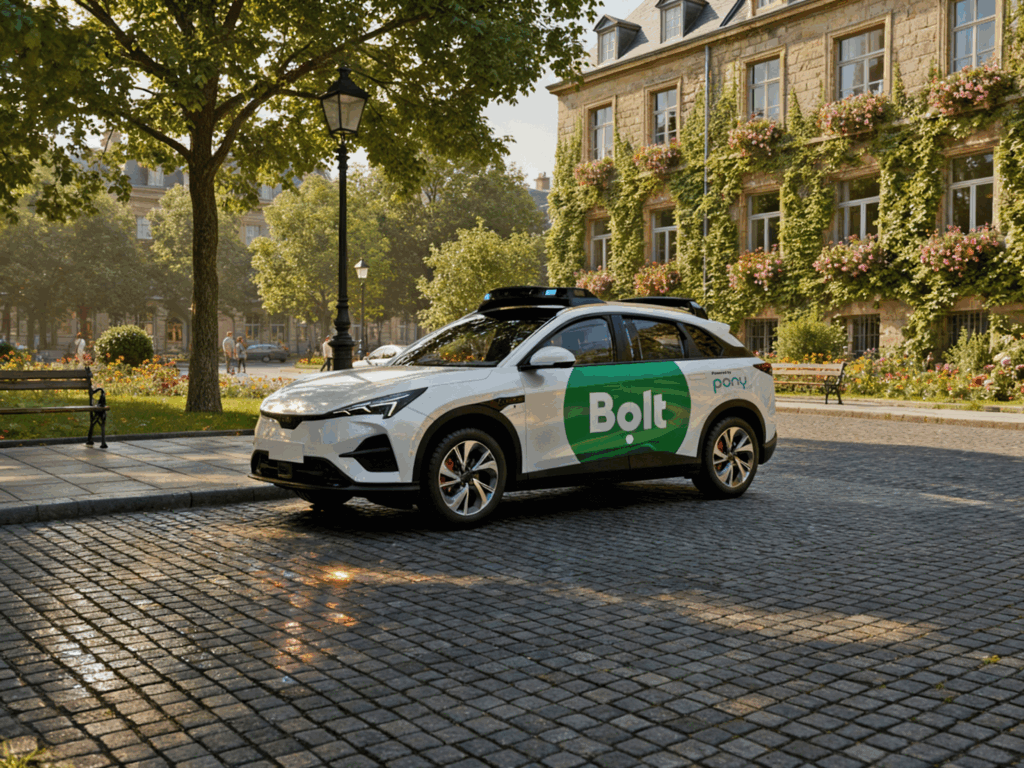
Self-driving taxi service may become the new European reality as early as the end of 2027, as Bolt and Pony AI announce a partnership to launch autonomous vehicles in Europe.
Bolt is a company that provides mobility services, such as taxi service, car rental and car sharing, scooters and e-bikes and food delivery.
Together with Pony.ai, a Chinese autonomous driving technology company, they plan to integrate Pony.ai's technology into Bolt's services.
Bolt aims to provide a fully driverless ride-hailing service in the EU within a year after the first deployments planned in 2026.
The partnership will first focus on real-world trials, safety validation, and developing customer experience. The pilot project will be trialled in several European cities, as well as in non-EU countries within Europe. Currently, it is unclear whether such trials will take place in Brussels.
Bolt is an independent company funded by the EU. As the ride-hailing platform is expanding globally, Bolt is ideally positioned to roll out autonomous vehicles "fully in line with European safety and data protection standards", said Bolt's founder and CEO, Markus Villig.
Is Belgium ready?
Belgium’s current legislation does not allow the commercial roll-out of autonomous transport, but preparatory steps are being taken.
Belgium's Minister for Mobility, Jean-Luc Crucke (Les Engagés), has initiated an intergovernmental group dedicated to autonomous vehicles, already working on a clear regulatory framework for testing autonomous vehicles and putting them into circulation.
The Federal Government is working to ensure that the three regions are properly prepared, the Minister's spokesperson told The Brussels Times.
"It is essential that Belgium is ready to welcome autonomous vehicles on its territory," the Minister's spokesperson told The Brussels Times. "Close collaboration between the federal level, Flanders, Wallonia and Brussels is essential."
According to the roadmap published by Flanders, 'robotaxi' and 'roboshuttle' licensing procedures can begin at the regional and local level towards the end of July 2026.
The European challenge
The issue for the widespread adoption of self-driving taxis in Europe, as opposed to the US, stems from both EU regulations and infrastructural constraints specific to each member state.
Many European cities have historic infrastructure, with narrow roads and irregular street patterns, which pose a challenge for autonomous transport in Europe.
The EU data privacy regulation, General Data Protection Regulation (GDPR), also requires companies that heavily rely on data collection to ensure full compliance.

A self-driving Waymo car in the US. Credit: Unsplash
Meanwhile, US and Chinese companies are already operating large-scale driverless fleets. Pony AI also has experience in operating fully driverless services across China in Beijing, Guangzhou, Shanghai and Shenzhen. The company currently operates a fleet of 720 robotaxis and approximately 200 autonomous trucks.
In the United States, companies such as Waymo have been introducing self-driving taxi services. These have not yet become commonplace across the entire US, but they are widely available in several cities, including Atlanta, Austin, Los Angeles, Phoenix, and San Francisco.
The European autonomous vehicle sector needs both investments and regulations, Bolt's spokesperson told The Brussels Times.
Regulation across Europe remains extremely fragmented. "Rules for commercial operations often differ from city to city, which makes it difficult for operators to scale. We essentially have to start from scratch in every new location."
"Automotive has historically been a pillar of European industry, but autonomous vehicles are now transforming the sector at high speed. If Europe cannot compete within the next 10–20 years, our automotive industry giants will be bankrupt," he said.
