
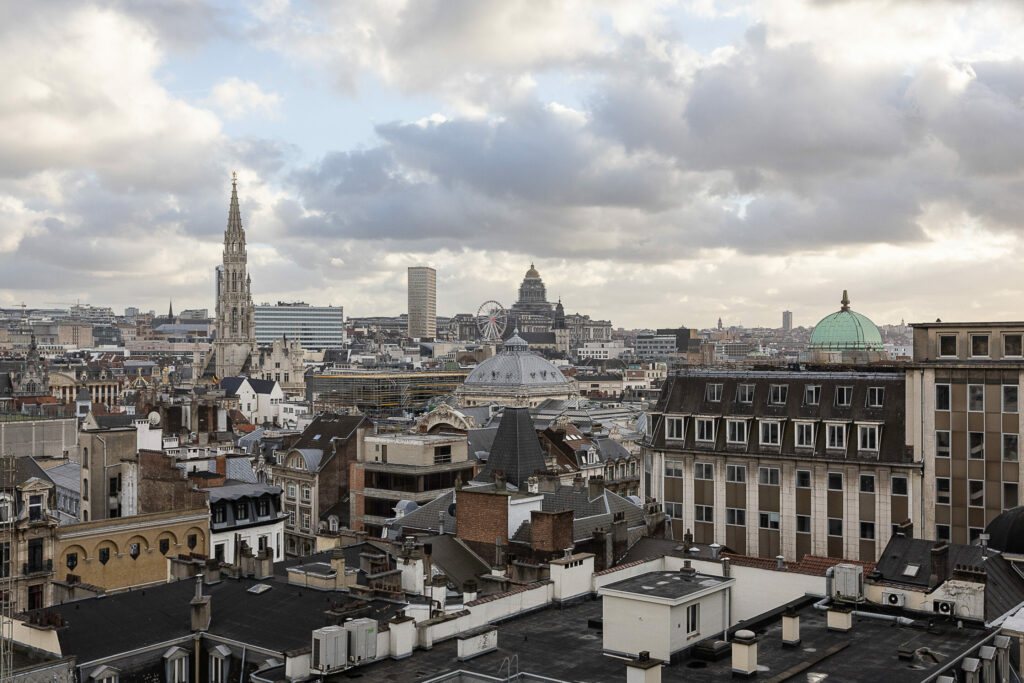
Brussels is set to break a record on Tuesday, surpassing 540 days without a government, previously held by the Belgian federal government between 2010 and 2011.
The prolonged political stalemate is rooted in complex linguistic and ideological divisions within the Brussels-Capital Region.
Governance in Brussels has been complicated by an institutional protection mechanism introduced in 1999 aimed at safeguarding Dutch-speaking representation against the majority French-speaking population.
This arrangement has inadvertently attracted groups aiming to exploit the system, focusing on easier parliamentary access rather than linguistic identity.
The result has been an increasingly fragmented political landscape, as evidenced by the elections in June 2024.
On the French-speaking side, the liberal MR party took a clear lead but failed to achieve an outright majority with their potential ally, Les Engagés.
Meanwhile, the left-leaning parties, including the PS, PTB and Ecolo, alongside Dutch-speaking allies such as Groen and Vooruit, secured 48 seats collectively in the 89-member regional parliament.
Efforts to form a government have been plagued by ideological divisions, vetoes, and political infighting.
The initial negotiations stalled, with parties such as Open VLD refusing to enter a coalition without the centre-right nationalist N-VA, while others like the PS and Ecolo ruled out alliances with N-VA altogether.
The MR and Les Engagés expressed their readiness to form a coalition with the PS and Dutch-speaking partners, but these efforts repeatedly hit roadblocks. Conflicting visions on religion and fundamental political principles have exacerbated an already fractured environment.
Key political figures stepped in as mediators, yet attempts to bridge divides between left-leaning parties and centrist or right-leaning groups yielded no breakthrough.
Heated disputes emerged, including one between MR president Georges-Louis Bouchez and PS leader Ahmed Laaouej, further entrenching mistrust among negotiators.
The financial situation of the Brussels-Capital Region is growing critical, with mounting deficits and dwindling liquidity.
Standard & Poor’s recently downgraded the region’s credit outlook due to financial uncertainty. Moreover, local banks have indicated their intention to terminate significant credit lines by the end of 2025, heightening fears of a liquidity crisis.
The deadlock shows no signs of resolution, with vetoes and entrenched positions making a majority coalition almost impossible. Discussions about strengthening the caretaker government have been floated, but attempts to establish an emergency budget have failed.
Brussels now risks spiralling further into financial instability if political leaders fail to find a solution in the coming months.
The crisis serves as a stark reminder of the complexities inherent in the region’s fragmented political system.
