
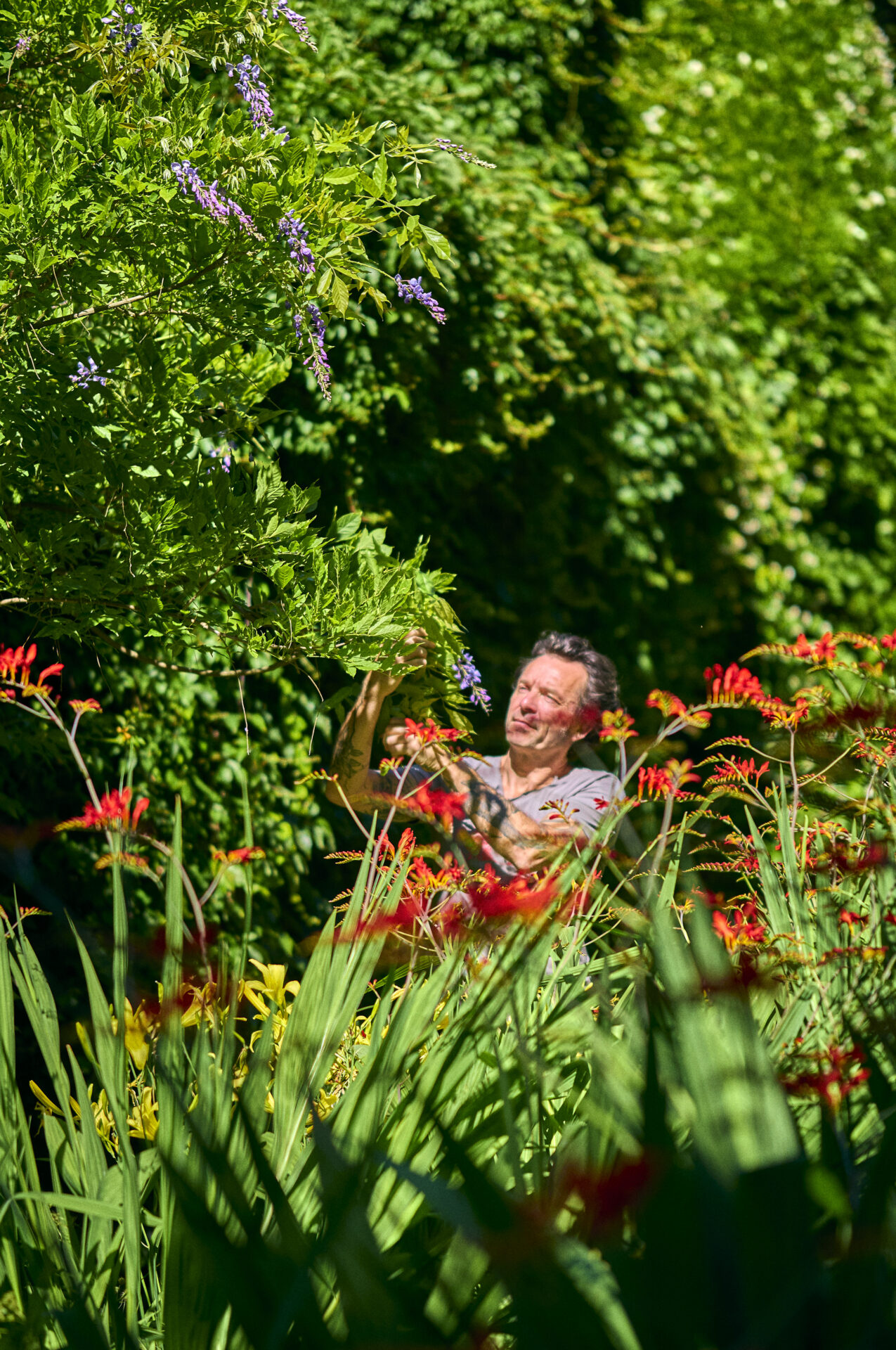
When Arne Quinze steps into the garden behind his studio in Sint-Martens-Latem, the world outside seems to disappear. What was once a simple garage has been transformed into an exuberant ecosystem of vines, foliage, unexpected blooms and untamed growth. Quinze, whose artworks have been installed in cities across Belgium and the world, pauses and beckons me over to a yellow, bell-shaped flower and inhales deeply. “Smell this,” he says. “Wonderful.”
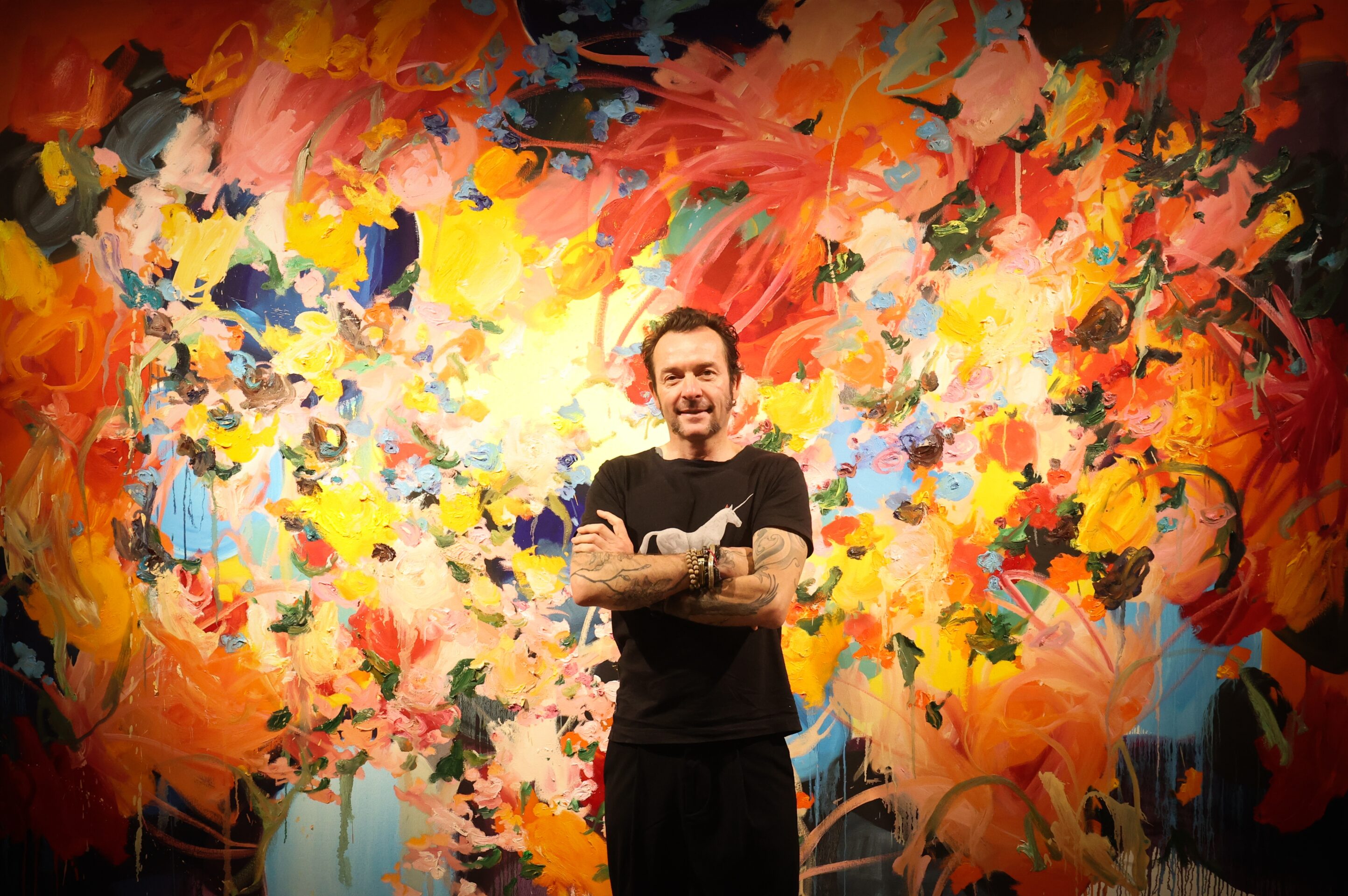
Inside his studio, dressed in grey-checked harem pants and bright yellow trainers (an outfit as much statement as uniform), Quinze surrounds himself with bursts of colour: canvases that resemble floral fireworks, giant houseplants that guard the space, models of previous installations that resemble dioramas of ambition.
He grew up surrounded by flowers, plants, frogs and butterflies. Today, they remain his inspiration for his installations and sculptures. “If we ever succeed in making cities as diverse as nature, we will have a human city,” he declares.
Here – in this hybrid space, part greenhouse, part living sculpture – Quinze’s artistic impetus is distilled. “I’m a gardener at heart,” he says.
He designed the garden himself. “I choose the plants and give them space, but at some point, I let go. It’s always in flux. Every day brings a new surprise.” His garden, he adds, is not subsidiary to the art – it is part of it, an atelier of wildness and inquiry.
Indeed, recent exhibitions such as Hidden Beauty at the Ludwig Museum Koblenz last year emphasised precisely this theme: the interplay of bloom and decay, raw material and transmutation, the humble wildflower and a monumental installation.
His nearby home – an old stable filled with books and art – has also surrendered to nature: vines cloak its brick walls, and its rooms shift with the seasons.
Arne Quinze
Sprawling across three floors, 1,600 square metres, with rooms that morph and shift in tone and light, the house may be the one artwork he has spent most time on. “In the summer, my windows disappear and keep out the heat. In autumn, they open again and let in the light. The house is like a base camp, a giant tent. We live close to nature. Our doors are always open. I never know who I’ll find hanging around when I get home,” he says.
When he moved in 13 years ago, he tore down the hedges blocking his view, to the irritation of neighbours. Many of the surrounding villas are hidden by walls of greenery and gated entrances. “Without thinking, everyone lives in boxes inside boxes. We’re trapped by the religion of four walls. At birth, the first things we see are the four white walls of a hospital. Then school, then work: more walls. And when we die, we’re buried between four walls again. I want to break that cycle. We think in boxes; there is so little diversity.”
Civic art
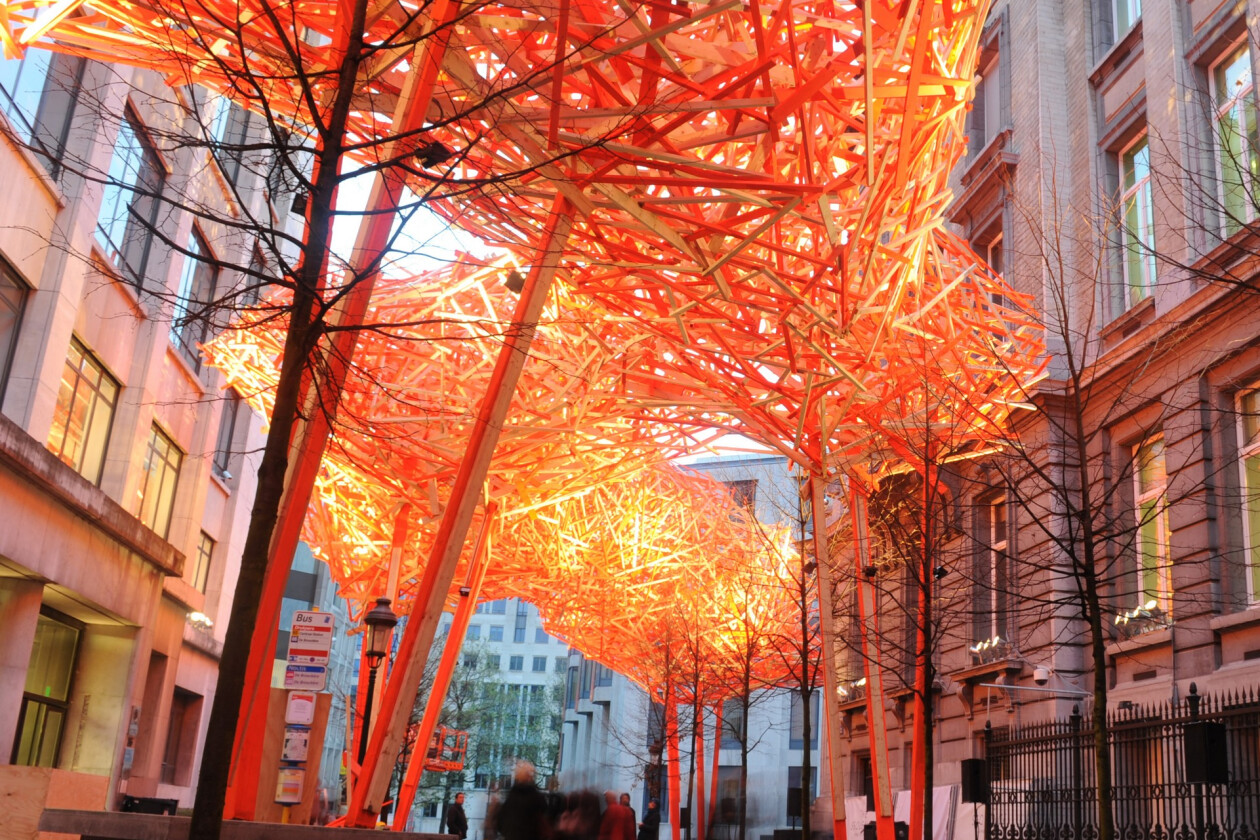
Quinze is best known for his monumental public installations: the wooden-plank chaos of Uchronia (2006) at Burning Man in Nevada, which burned as part of the festival’s ritual; Aurora (2023) at the pyramids in Giza; and Red Beacon (2010) in Shanghai. Closer to home, he built the skeletal, twisted ribbons of The Sequence (2008) at the Flemish Parliament in Brussels, the dented red-steel structure Rock Strangers (2012) on Ostend’s seafront, and the wooden The Passenger (2015) in Mons.
Arne Quinze installation
Newer gallery works like Chroma Lupine (2024) and Yielding Glauca (2025) reveal an artist still innovating, shifting from giants in the streets to oil paintings and smaller sculptures that refine his visual grammar.
Yet in recent years, Belgium has seen fewer of his high-profile outdoor commissions. When asked why, he does not blame the lack of demand but rather a shift in focus. “Today, I am mainly working on fountain installations. I want to bring more life to the city. Where there is no water, we bring fountains,” he says. Projects are underway in São Paulo (where he also has a home); discussions continue in New York, Egypt, Riyadh and Istanbul. The world is his workshop.
His ambition is huge. He wants to change how city planning, architecture and public art intersect: to make cities more habitable, more human, more rooted in the rhythms of nature, rather than just traffic and commerce. His early career as a graffiti artist taught him that art in the city cannot be passive – it must provoke, invite dialogue, disrupt patterns. “As an artist, you’re not there to please everyone. You’re there to make something happen, to spark dialogue.”
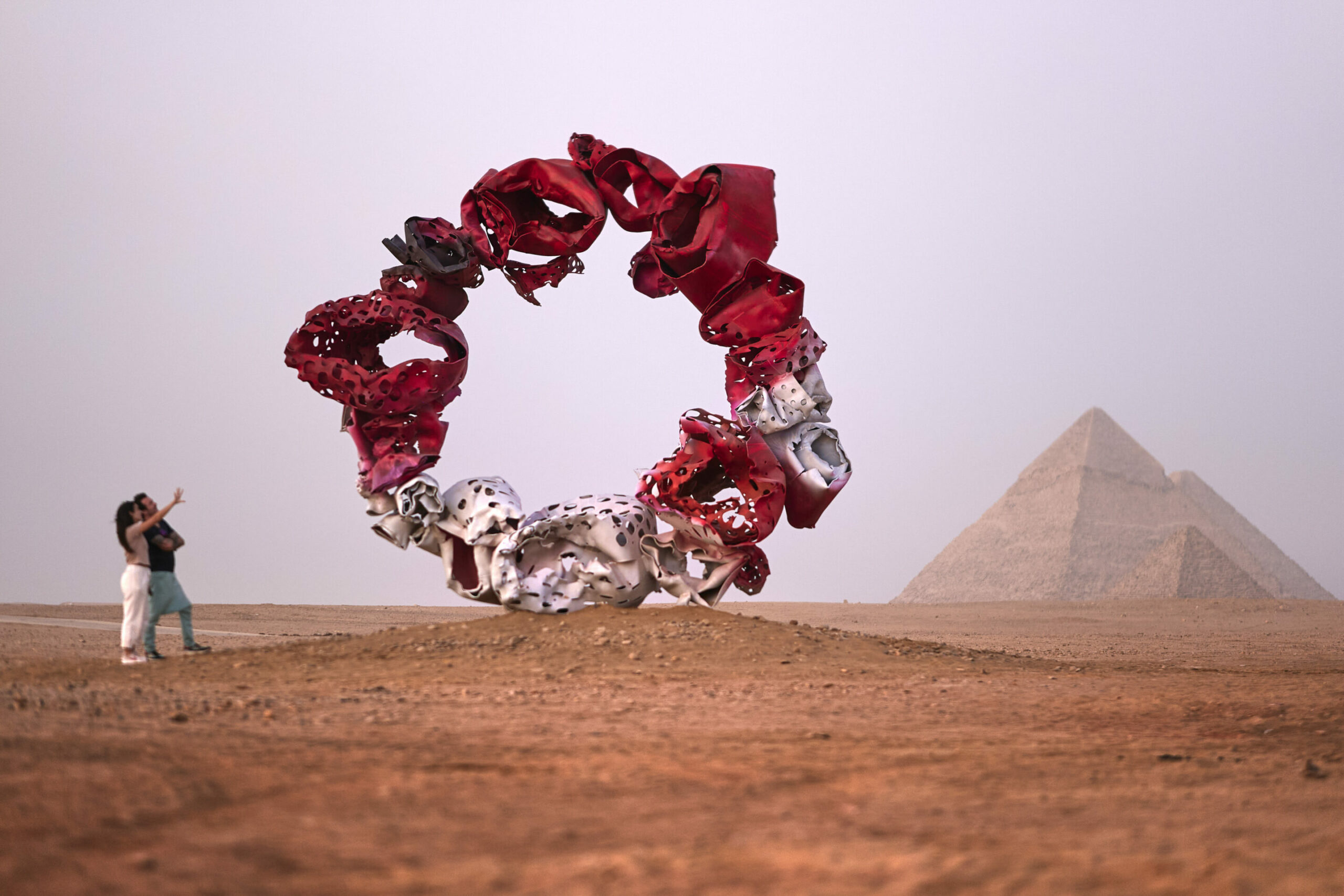
Arne Quinze installation in Giza, Egypt
For all his international scope, Quinze’s inspiration remains rooted at home. “You don’t need the Amazon to discover nature,” he says. “The garden is my muse. All my work begins there, where I study thousands of plants and flowers through the seasons. The beauty and splendour I see is what I translate into art. I study nature’s complex dynamics and integrate them into my pieces. I want to reawaken our sense of wonder.”
Quinze claims a kinship with Claude Monet – both the impressionist’s canvases and his gardens at Giverny. In his own patch, Quinze grows a pink poppy. “It’s the same variety Monet once grew. We share a passion for studying impermanence in beauty.”
Between meadows and city blocks
Born in 1971, Quinze came of age in the small rural village of Driekapelle, near Diksmuide. “The village was tiny. Barely five houses,” he says. “Our garden merged into a meadow. For a child, nature felt endless. Today, many city kids have never seen a frog or butterfly except on a screen. I loved that environment. Even then, I was making small installations. I’d lie on my stomach, play, and get lost in it.”
Then, at the age of nine, he and his family moved to Brussels. The change, Quinze recalls, was jarring. “I thought, ‘Oh, I’m going to see Star Wars,’ but it was a shock. All that grey concrete. The walls closed in.”
His teenage years in Laeken and Schaerbeek were marked by street crime, family conflict and a sense of dislocation. After his parents’ divorce, he wanted to live with his father, but the law then automatically placed children with their mothers.
At 15, he ran away, slept outdoors while clinging to school. “I slept outside – literally. On the grass, under a tree, in a shed. And still I went to school.”
Graffiti became an outlet. “I missed colour. I wanted to bring it back into the grey cityscape,” he says.
The impulse to transform urban monotony into vivid creative possibility – one that later defined his public sculpture work – took root here. With a sly smile, he recalls when a newly inaugurated metro train pulled in, freshly painted by him. Some thought it was part of the ceremony, others were outraged. “I loved those reactions. Supporters and opponents started talking to each other.”

Arne Quinze and artwork
What he does now, he insists, is not so different. From graffiti artist to globally commissioned sculptor, Quinze’s evolution has been unconventional and self-taught. “It’s logical to evolve from street art to public art.” He skipped formal art education, preferring the city walls and the open streets as the first canvas.
Criticism is inevitable. “Everyone has an opinion if you work in public spaces. There was criticism of the Eiffel Tower, too. Same with Rock Strangers,” Quinze says. “As an artist, you’re not here to please everyone – you’re here to spark dialogue. Rock Strangers is now a popular landmark. The harshest critics were fishermen: from the sea, the blocks were too small to see properly.”
He notes wryly that Belgium is more critical than abroad. “I don’t know why. Belgium is one of the best places to live, but people cling to what they have. They fear change. That attitude holds us back. Belgium is scared of ambition. We’re sometimes the opposite of chauvinists. But we need to dare to say, ‘Things must change.’”
Generational shift
Five years ago, Quinze lost his father, a man he describes as “my best friend… a very wise man.” It was after his troubled teenage years that his father stepped in to support his art dreams. “At 20, during a difficult time, he gave me a new lease on life. He showed me the way without ever imposing. He was my anchor. I could talk to him about anything; he never judged, only listened. He taught me about nature,” he says.
The bereavement changed Quinze. “Losing your father is a bit like losing the roof over your head. Now he is no longer there, I’ve become the roof myself.” In that sense, the male role of protector and creator merges in his art and life.
He is also a grandfather now, which adds a layer of continuity and urgency: for the world he leaves behind, for the public spaces he shapes, for the children who will inherit them. He still trains daily, still wakes at dawn, still believes art is as much about discipline as inspiration. “I’m 53, but I’ll keep going for another 47 years. And then I’ll rest for 20 years.” He laughs, but there is no hint of slowing down.
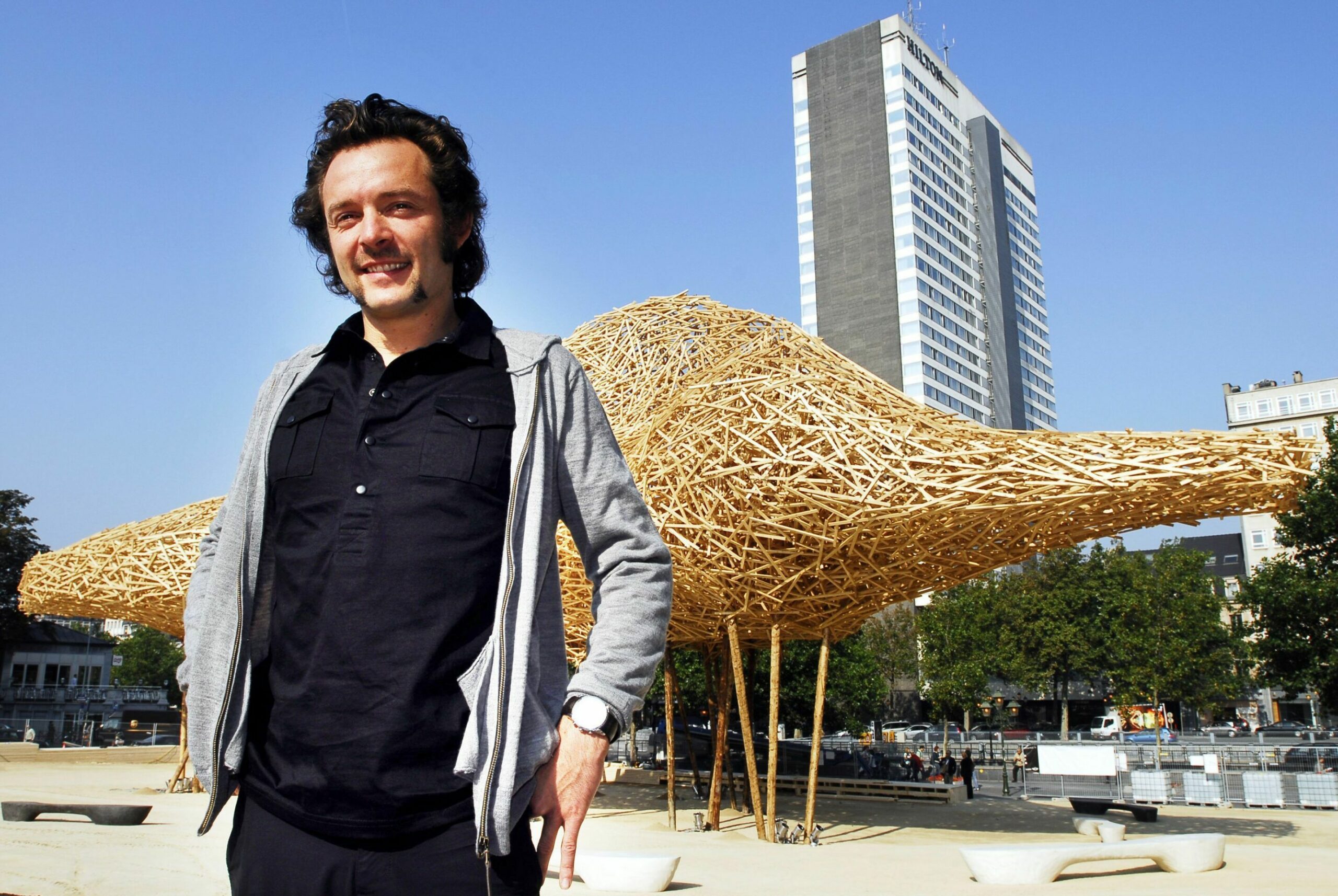
Belgian artist Arne Quinze pictured during the presentation of his project Cityscape, Friday 14 September 2007. Credit: Belga / Eric Vidal
He still lives and works in Sint-Martens-Latem, once a village famed for its impressionist painters (including Ensor, Permeke and De Smet), now a home base for an artist who does not do cliché. The connection to Flemish art history – of observational intensity, of nature and light – is present without being burdensome. The garden, the studio, the home all carry that legacy forward in new guises.
Quinze seldom visits Brussels now, though he admits it has changed. “For the better,” he says, noting the redevelopment of the canal and the new appreciation for water. “It’s crazy they once blocked it off. Brussels was the only capital where you barely saw water. The museums have improved too, lowering the threshold. Since the 1980s, it’s better, but there’s a long way to go. Still, when I see Zaventem airport every ten days: all that concrete, the underground car park, the taxis – that’s Belgium’s front door? It doesn’t have to be that way. Look at Singapore: a wild indoor garden and a waterfall in its airport.”
But Quinze’s main mission is public squares, not just in Belgium but around the world. “We must make them liveable again, with nature and art. Interaction is vital. My sculptures help revive neighbourhoods. They spark conversation; people take ownership of their surroundings. Crime disappears.”
The fountains, like his earlier wooden structures, are animated by aspiration, not decoration. His 2008 Cityscape at the Toison d’Or in Brussels was planned for one year but remained for five. For Quinze, they represent a moment when human interaction and natural movement converge.
“Before, the area was deserted, full of addicts,” he says. “We cleaned it up and added benches. The neighbourhood came back to life. People reconnected, cared for the area. The whole dynamic shifted. Fountains do the same: they attract people. Children play, parents talk. Yet convincing people to change remains hard. Some simply resist.”
