
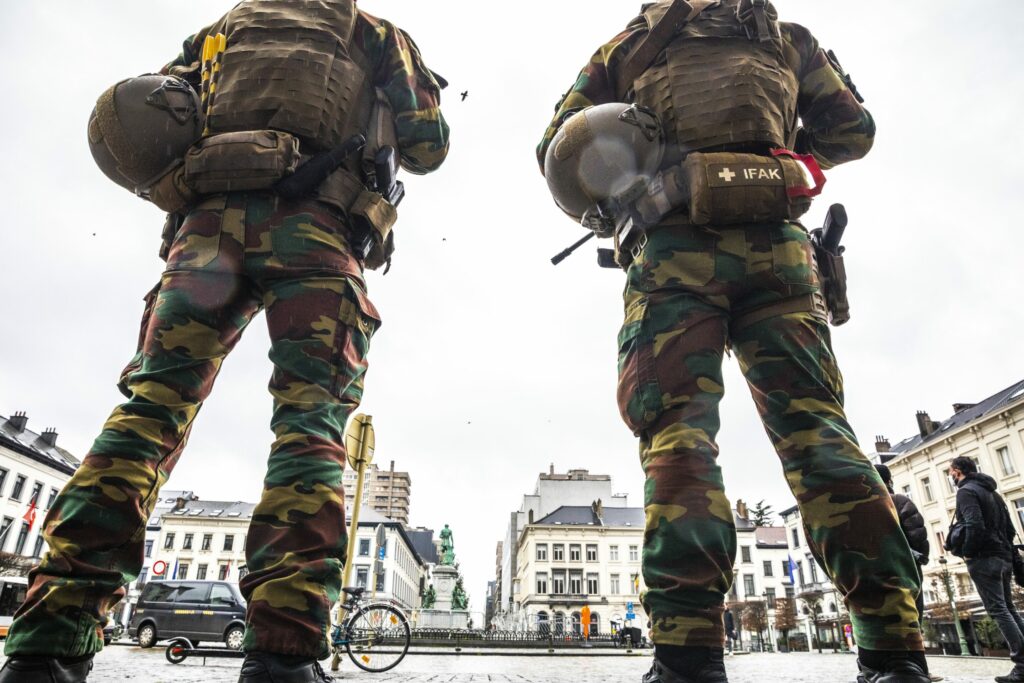
Earlier this year, Federal Interior Minister Bernard Quintin (MR) detailed his 'Big cities' plan that stipulated the deployment of troops in certain hotspots in Brussels by the end of the year. Now, that project is put to rest.
There will be no troops on the streets due to a disagreement between Quintin's liberal MR party and Flemish Christian Democrats CD&V: the issue has been absorbed into a standoff between the coalition partners over prison overcrowding and political messaging.
The deployment of troops in public spaces has long been advocated by MR and the Flemish nationalist N-VA as a way to reinforce police presence in areas affected by drug trafficking and related violence.
Defence Minister Theo Francken (N-VA) has repeatedly said the military is operationally ready, pending political approval.
Last Tuesday, discussions within the Federal Government failed to produce agreement, with CD&V refusing to give their backing to the measure without parallel measures to address prison overcrowding.
More than 670 detainees are currently reported to be sleeping on the floor, while over 3,200 convicted individuals are waiting at home for a place to become available.
Justice Minister Annelies Verlinden (CD&V) has proposed allowing certain prisoners to leave custody up to one year before the end of their sentence – an extension of the current six-month rule.
However, MR has rejected the idea outright, arguing that early release would undermine the party's political message about security.
As a result, two separate policy areas, public security in Brussels and prison management nationwide, have become politically inseparable.
Decisions affecting the capital's streets are a result of political bargaining on the federal level, with local authorities, including mayors who are legally responsible for public order, having had little visible influence on the outcome.
Under Belgian law, mayors can request military support only when police resources are insufficient and when there is an imminent threat to public order.
In practice, however, such requests depend on federal political approval and inter-ministerial agreements, placing final control firmly at the national level.
François De Smet, a federal MP for the Brussels regionalist DéFI party, has accused coalition parties of blocking each other's dossiers in a way that mirrors past political paralysis, despite promises of a new governing style.
Ce soir le #begov ne parvient pas à un accord pour lutter contre la surpopulation en prison parce que... il ne trouve pas d'accord non plus sur le déploiement de militaires en rue. CD&V et MR bloquent chacun le dossier de l'autre. Cette Arizona n'a rien à envier aux particraties…
— François De Smet (@francoisdesmet) December 23, 2025
When soldiers were deployed on Belgian streets following a series of terrorist attacks in 2016, the move had broad political consensus.
At the time, it was framed as an exceptional response to an immediate threat. Today, the security context is different, and the armed forces face competing priorities linked to international commitments and the war in Ukraine.
For now, there is no clear timeline for when, or even if, the military deployment proposal will return to the government's agenda.
Police forces remain responsible for managing drug-related violence, while structural issues in the prison system remain unresolved.
