
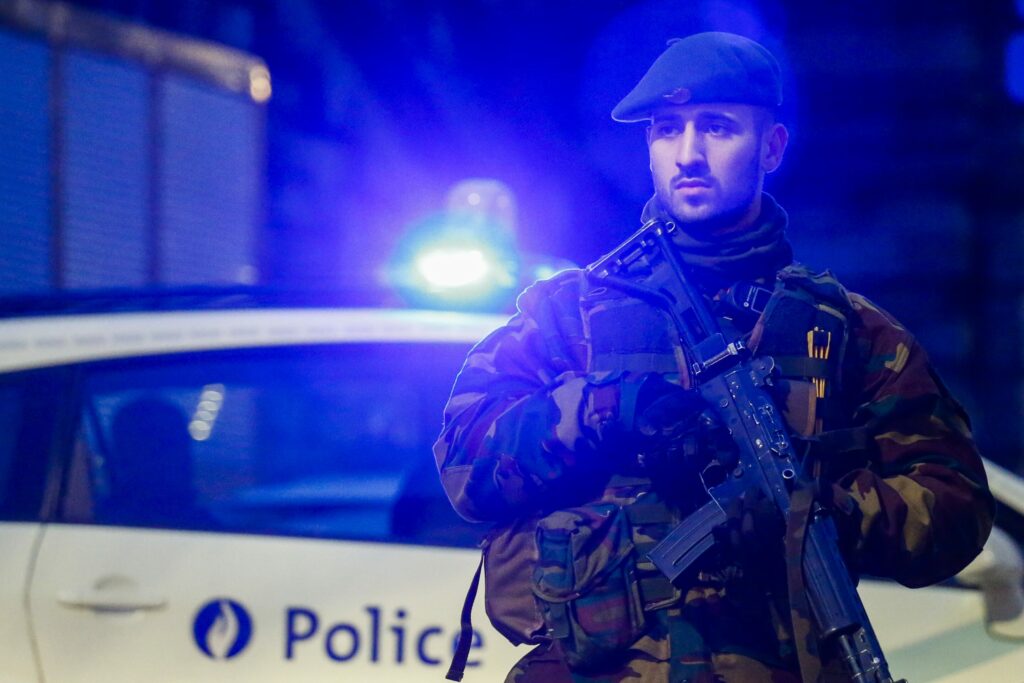
The federal government is taking a bold stance on the Brussels drug violence problem.
The 'Big cities' plan presented by the liberal party MR earlier this month and detailed by Interior Minister Bernard Quintin (MR) this weekend stipulated the deployment of troops in certain hotspots in Brussels.
'Mistakenly' labelled as rotten by the Brussels liaison to the EU institutions, Alain Hutchinson (PS), certain areas in Brussels are set to be patrolled by troops. These are the so-called 'Hotspots' where most of the drug trafficking and resulting violence takes place: the surroundings of Clemenceau metro station, Peterbos in Anderlecht, North station, Park Bonnevie in Molenbeek and Matonge, near the Toison d’Or avenue.
But can the troops really participate in securing public spaces in Belgium? Yes, but...
The framework
Legally speaking, the deployment of the military in the streets is the result of a protocol agreement between the Minister of Defence and the Minister of the Interior.
It theoretically allows mayors, who are the heads of the various local police zones, to request the support of the military in carrying out certain security functions within the municipal territory.
According to Article 43 of the 7 December 1998 law organising the integrated police service, the mayor may only request the intervention of the troops when neither the local police nor the federal police still have sufficient means to maintain or restore public order, and in events of calamities, disasters, accidents, riots, hostile gatherings or serious and imminent threats against public order.
There are therefore two conditions: imminent danger (imminence is defined by the Coordination Unit for Threat Analysis, CUTA, currently at a level 3), and the police services prove insufficient.
Si vis pacem para bellum
Theo Francken (N-VA), Minister of Defence, has been preparing a modern legal framework under the motto si vis pacem para bellum (if you want peace, prepare for war), which he names the Defence Codex, a coherent, comprehensive code that responds to new threats and the missions of the armed forces.
Its creation aims to consolidate and update the already existing legislation on defence.
In the case of troop deployment within the country, the Codex has been brewing and is almost ready to serve. It will provide clarity on the conditions of military engagement (with the police), particularly concerning the use of force outside traditional armed conflicts.
The protocol
Francken has approved the request of Quintin, and the process to have this draft law approved by the Council of Ministers will be initiated.
Once the Council of Ministers approves this draft law, it will go to Parliament, where it will also need to be discussed and, hopefully, approved.
The timeline
Once finalised at Defence, the draft goes to the Council of Ministers. This step can be quick if consensus exists, which in this case is likely, given the urgent situation.
Then the Council of State provides legal advice. This normally can take 30 days, but in urgent cases, this can be reduced.
After this begins the parliamentary process: the law is introduced in the Chamber of Representatives (and possibly the Senate if bicameral involvement is required).
The first parliamentary stage is the Committee stage, which is mainly detailed discussions, hearings, and amendments. This can take weeks to months, depending on the cadence of the debate.
Then follows the plenary session, which is the final debate and vote.
The King has to assent to and promulgate the law once adopted. The law is then signed by His Majesty and the competent ministers, and then published in the Belgian Official Gazette (Belgisch Staatsblad / Moniteur Belge).
In Summary
In short, constitutionally, there is no strict deadline. The duration depends on political will, parliamentary workload, and consensus.
The proposition of deploying the troops is on the table and seems to be moving forward, but in theory it could take anything from a few weeks to a few months or even more than 2 years to complete.
A normal process in Belgium for a law to be adopted is 6 months to a year from government approval to publication, and several years if the text is highly debated or controversial.
The timeline below is our prediction for when the troops might be seen on the streets.
Related News
- 'Rotten': How one word landed a Brussels' official in hot water
- Mayor ready to see soldiers on streets of Charleroi
- 'Bizarre and illogical': Military rejects call to deploy army in Brussels drug hotspots
- Military on the streets is 'admission of failure' say Brussels' socialists
- Police given full access to SNCB footage near stations
- Troops on the streets, cameras, police action: Interior minister's plan for Brussels and big cities
