
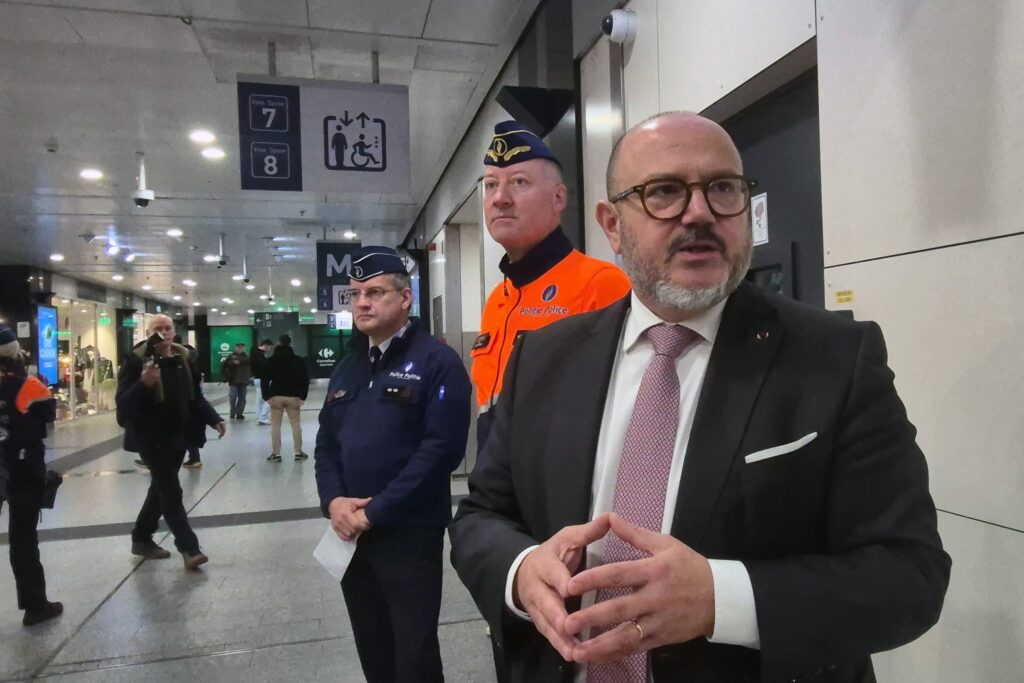
Belgium’s Minister of the Interior Bernard Quintin (MR) says he plans to reduce the number of local police zones from 176 to around 60.
Belgium has one federal police force to manage large-scale crime while 176 zones represent local policing. Six of these zones are spread across the 19 municipalities of Brussels.
In an interview with De Standaard and Het Laatste Nieuws, Quintin outlined the legislative proposal he will soon present to the Belgian Parliament, stating his intention to reform the nation’s security infrastructure. He argued that the current division into 176 zones undermines safety.
Police zone merger in Brussels
When asked when the long-anticipated merger of police zones in Brussels would happen, Quintin said he has "no deadlines" but argued that reform in the capital is "truly necessary for security".
In April, Quentin presented his plans to reduce the six zones to a single central command for the entire region, led by a single chief of police. That person will take operational decisions in consultation with a police college, which will include the 19 Brussels mayors and the Minister-President. The new structure should be fully operational by 2027.
The plans have been fiercely opposed by the mayors of Brussels. While zone mergers have occurred in other Belgian cities, all 19 Brussels mayors are "unanimous" in their opposition to the measure.
They argue that inter-police zone collaboration in Brussels already works well, the zones are at an optimal size and much bigger than in other Belgian cities. They shift attention to chronic underfunding that puts strain on both federal and local police forces.
“I would also have preferred to do this together, but with most mayors, we would never have reached an agreement," Quentin told De Standaard and Het Laatste Nieuws. "That is why we had to force it. And I say this as a former diplomat: consultation does not mean you have to be unanimous before you decide,” he said.
Quentin's plans for the rest of Belgium
Unlike the mandatory merger planned for Brussels, Quintin aims for voluntary consolidations in other regions, offering additional funding to incentivise cooperation.
The draft law will be discussed in parliament from 10 February. Quintin then plans to create the new police zones by royal decree. From then on, following a preparation period of 18 months, he plans on installing the zones with a second royal decree. That will happen before the end of 2027, Quintin said.
He denounced the fragmentation of the police force across the country as "not good for security."
"Police proximity must not be lost. The situation in the province of Luxembourg is not the same as in Flemish Brabant. I am aware of that. But can anyone explain to me why there are 23 police zones in Flemish Brabant for 1.2 million inhabitants — almost the same population as Brussels?” Quintin said.
The Belgian police union VSOA has supported Quintin's plan. Vincent Houssin, vice-president of VSOA Police, considers the reform necessary, describing the current system as "outdated" and "fragmented".
VSOA emphasised that Quintin's plan must be based on thorough research, to consider various parameters, such as population size, additional responsibilities at the national border or the presence of a prison in the region. Furthermore, the plan must make operations more efficient, without being a hidden cost-cutting exercise, concludes the union.
"Two plus two must equal five, not three. Such a plan must contribute to more police on the streets and greater safety for citizens," Houssin said. He therefore advocates minimum standards for each zone.
In parallel, the minister is developing a new funding model for local police forces, which is expected to benefit cities currently disadvantaged under the current system. The proposed mergers are intended to enhance efficiency without reducing the number of officers.
In the interview with HLN, Quentin also expressed concern over the lack of a Brussels government. "There is now talk of a caretaker government until 2029. I absolutely cannot and will not accept that. It is a total denial of democracy. Completely insane. We have had elections, but would then continue with the same policies for five years?”
"Voters did their job. They did not make it easy, that is true. But there has been a coalition since the end of 2024!" he added.
