
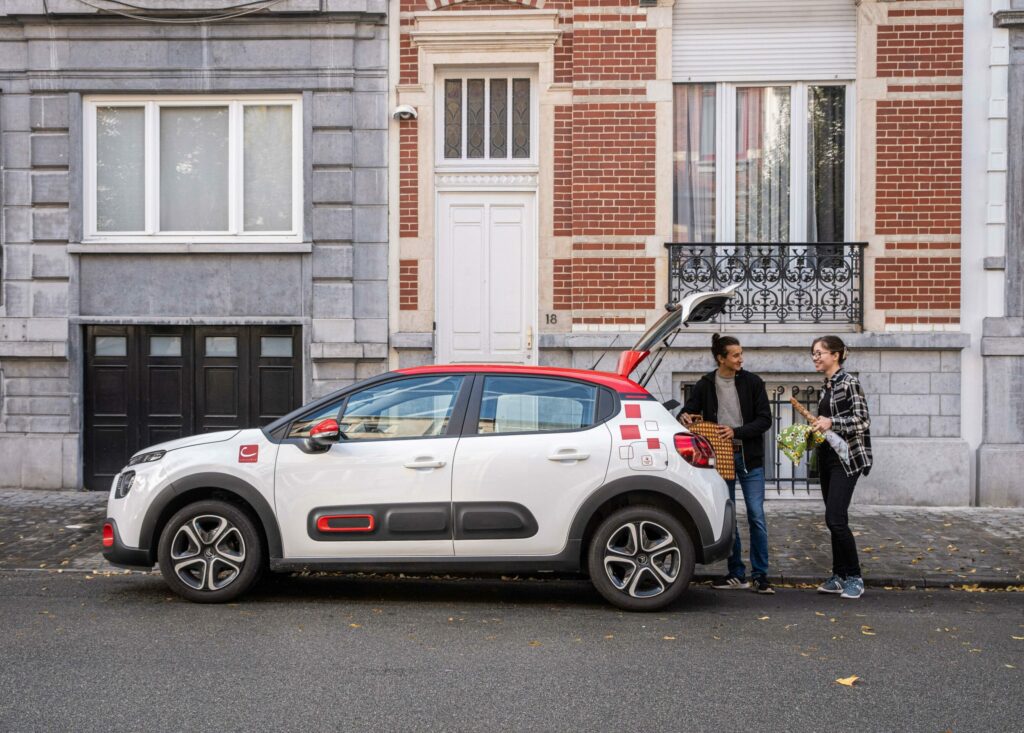
Six in ten Brussels residents have given up their private cars and switched to car-sharing services such as Cambio and Poppy, Brussels Mobility research has shown.
The study found that, without car-sharing services, 63% of Cambio users and 70% of Poppy users would purchase a private car. Brussels Mobility sees car-sharing as an increasingly essential tool to reduce the number of cars in the city.
The research surveyed over 2,200 Brussels residents who use Cambio and Poppy, revealing car-sharing as a flexible and cost-effective alternative to private car ownership. It also highlighted its potential to significantly reduce the total number of vehicles in the city.
Nearly 60% of Cambio users and 40% of Poppy users have reduced the number of cars in their households since joining car-sharing. Among those who use both services, car ownership dropped even further, with 64% reducing the number of cars they own, and almost six in ten households now owning no car at all.
Cambio and Poppy represent two distinct car-sharing models. Cambio offers cars at fixed locations, suitable for replacing family vehicles, while Poppy operates as a free-floating service aimed at younger users who might otherwise buy a car.
According to Brussels Mobility, combining both models is the most effective way to limit car ownership, as each service suits different purposes.
The study also highlighted that car-sharers often use a mix of transport options. Seven in ten Cambio users and 65% of Poppy users hold public transport subscriptions. Many report cycling more frequently, and over half say they use their own cars less often.
Families with children also benefit from car-sharing. The findings show that more than one-third of shared car users are families, disproving the notion that car-sharing is only for single urban dwellers.
Car sharers have suggested improvements such as diversifying vehicle options and increasing the availability of cars with larger capacities. Adding family-friendly features like child seats, trailers, and bike racks was also seen as a priority.
More residents might embrace car-sharing if the Mobib card - currently used for public transport access - could serve as a single entry system for both shared cars and public transport.
While integrating car-sharing into Mobib is not technically feasible, the services are already accessible via Floya, the Brussels-region multimodal transport app.
Brussels Mobility Minister Elke Van den Brandt(Groen) expressed strong support for car-sharing.
"Every shared car benefits Brussels. It reduces traffic congestion and frees up public space for everyone. I encourage residents to try shared cars - they’re good for the environment, your wallet, and now, with child seats available, they’re more practical for families too," she said.
