
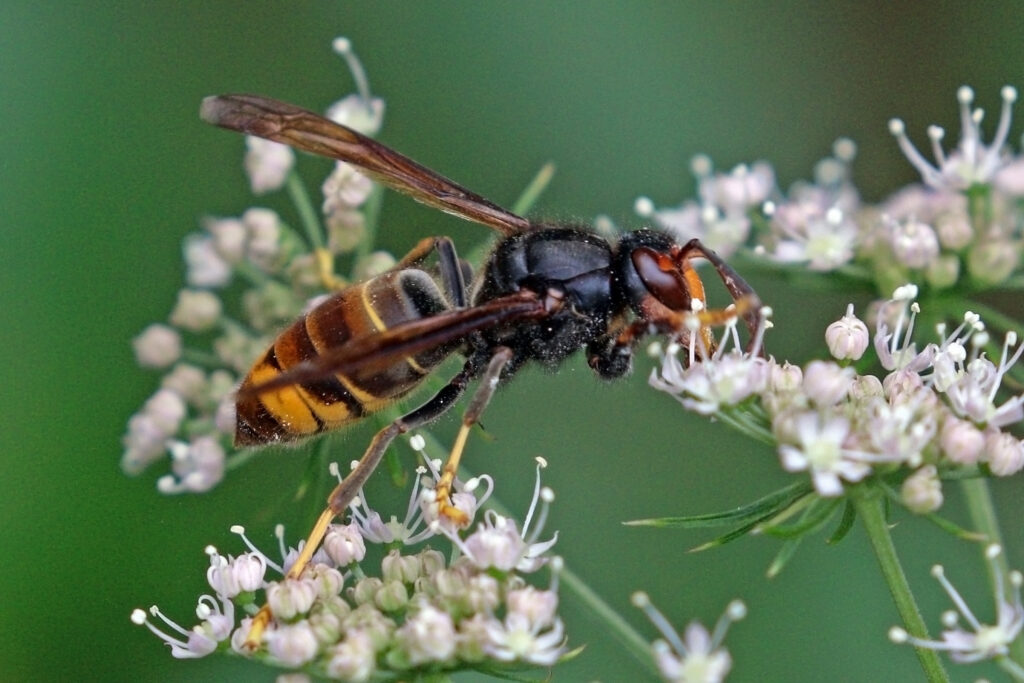
Brussels municipal authorities are raising the alarm amid an increase in the number of Asian hornets in Belgium in the springtime.
Present in Belgium since 2010, Asian Hornets (vespa velutina) drive high bee mortality and threaten biodiversity and public health.
During the spring season, Asian hornet queens build new nests, and from June onwards, worker bees hatch. "The coming weeks are decisive if we want to significantly reduce its spread this season," said Climate Councillor Valérie Libert (MR & Anders) of Ixelles.
The commune has also pointed out the impact the Asian hornets had on beehives installed at Ixelles Cemetery last year. "Every queen captured means one entire Asian hornet nest fewer - and therefore thousands of bees and other insects essential to our biodiversity protected," explained Ixelles's Animal Welfare Councillor, Nathalie Gilson (MR & Anders).
Last year, Asian hornet sightings in Belgian gardens nearly doubled compared to 2024, with close to 8,000 recorded by the Flemish observatory Waarnemingen.be.
Why is this important?
Originating from Southeast China, Asian hornets are spreading almost unchecked, while attacking honey bees and other native insects that pollinate flowers and plants. Belgium has no natural predators to limit their population.
Asian hornets usually hunt honeybees in groups at the entrance of beehives. About 18% of beekeepers in Belgium have reported seeing Asian hornets enter the beehives, while 9.2% reported having found empty bee colonies due to their attacks, according to the COLOSS survey.
In spring and early summer, Asian hornets build 'primary' nests at low altitudes. Those nests can contain hundreds of hornets, often hidden in thick hedges, low shrubs, or garden sheds.
Last year, the Brussels environmental and apiculture association, Apis Bruoc Sella, issued updated instructions for public park and garden workers on spotting Asian hornet nests hidden in hedges. They also advised on procedures upon detection, and offered strict safety guidelines.
On other occasions last year, several people were hospitalised after being stung by an Asian hornet.
Ixelles authorities are encouraging citizens to use special traps to contain them. At the initiative of First Councillor Gautier Calomne and Libert, Ixelles held a public meeting on Monday evening. Partnering with cleaning provider company Groupe F, Ixelles has distributed traps to residents for the purposes of catching the Asian hornet queens before they can start a new colony.
These traps are selective, meaning they capture Asian hornets alone, while other insects can escape. For example, the European hornet, which is native and highly beneficial to the local ecosystem, is larger than the Asian hornet and simply cannot enter the trap.
Similar initiatives have been organised across other municipalities in Brussels. The City of Brussels has held several public sessions earlier in February. Watermael-Boitsfort is also organising an information session on 16 March, followed by a distribution of traps for the spring trapping campaign.
It is still possible to contact your commune to collect a free trap. The trap distribution will continue throughout the season or while supplies last.
It is not advisable for the public to disrupt a nest themselves, as it can provoke hornet attacks. If you spot a nest, keep your distance and report it to Vespa-Watch (Flanders) or Vespa Alert (Wallonia). In case of a group attack, multiple stings, or an allergic reaction, you should call 112 immediately.
In Ixelles, residents can also report a nest directly to the commune or contact Groupe F directly via the dedicated Facebook group by posting a message.
