
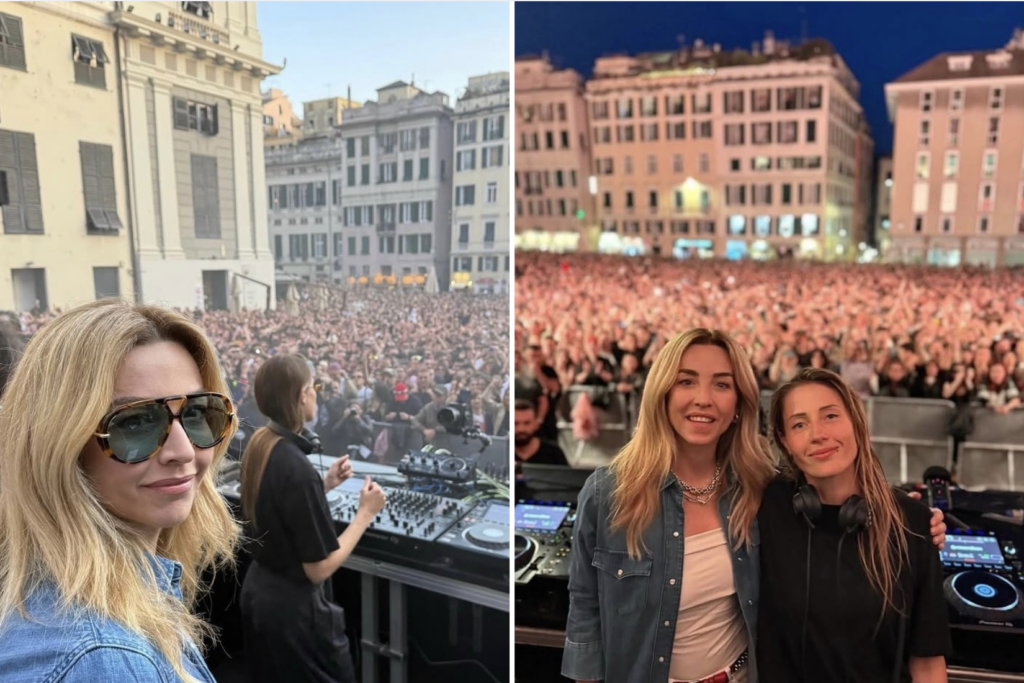
Genoa’s Piazza Matteotti in Italy was turned into an open-air rave when Belgian techno DJ Charlotte de Witte played a free set that drew more than 20,000 people on Saturday evening, quickly spreading across social media.
At the centre of the crowd was Genoa mayor Silvia Salis, the former Olympic hammer thrower who has, in less than a year in office, become one of the most closely watched new figures in Italian politics.
The event, organised by the city, saw thousands pack the square for the duration of the performance, with a continuous flow of spectators pushing total attendance well beyond 20,000. The crowd mixed club-goers with families, tourists and young people, before the programme continued with a set from local DJ Valentinø.
Following the event, de Witte posted on social media: "Genova, I have no words". By then, footage of the event was already circulating widely across Europe. De Witte, born in Ghent in 1992, is regarded as one of the leading figures in contemporary techno.
Elected mayor of Genoa in 2025 after ending years of centre-right control, Salis has been increasingly mentioned as a potential national figurehead for Italy’s fragmented opposition ahead of the 2027 elections.
Her path to politics is unusual in itself. Born in 1985, she competed at an international level in hammer throw, including at the Olympic Games, before moving into sports administration and then local government.
That background, combined with her visibility in office, has helped fuel speculation that she could become a bridge candidate for a divided centre-left camp struggling to define its leadership.
View this post on Instagram
The Genoa event has also fed into a wider Italian debate about how public space is used and what role culture should play in city politics.
Italian Prime Minister Giorgia Meloni has taken a markedly different approach. In 2022, her government introduced the "anti-rave decree", tightening rules around unauthorised gatherings and prompting criticism that the law risks capturing legitimate cultural events in its scope.
Salis, by contrast, has framed large free events as a tool of inclusion and urban renewal, particularly for younger residents and visitors.
"Our intention is clear: we want to bring this city to life and propose initiatives capable of generating real interest," she said. "We know we are among the European cities with the highest average age, and it is precisely for this reason that our commitment to new generations must be a priority. We need to attract them, engage them and offer them spaces where they can be protagonists."
Observers of urban policy say the contrast is increasingly political, with nightlife and public gatherings serving as proxies for broader debates about governance style, civic freedom and generational appeal.
Salis’ rising profile has not gone unnoticed in Rome, where she is increasingly cited as a possible unifying figure for a centre-left opposition that remains fragmented between the Democratic Party, Five Star Movement and smaller centrist and green forces.
