
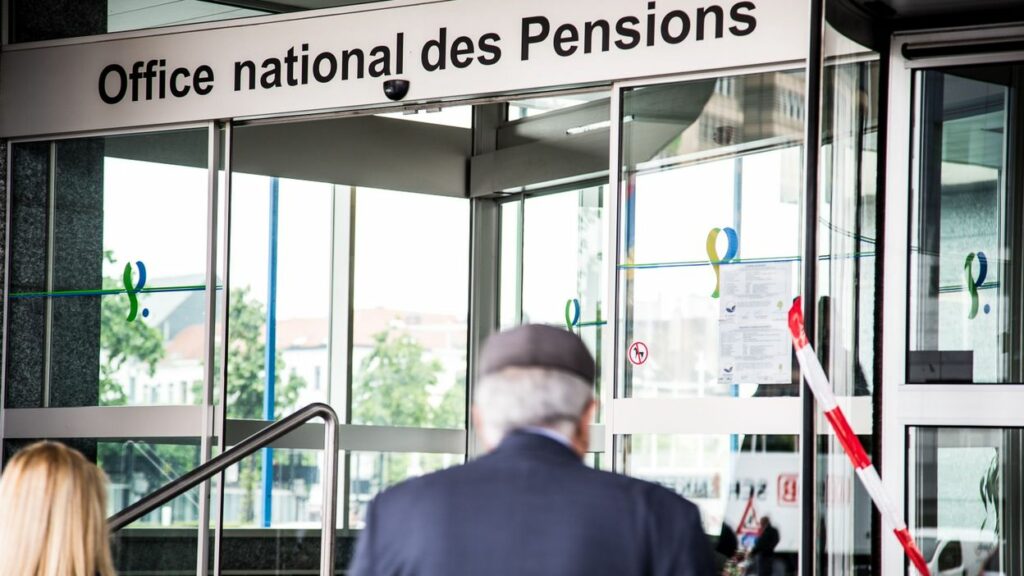
Despite numerous strikes, the Federal Government is still unwaveringly pushing through its much-contested pension reform. However, that will come at a high price, according to the Planning Bureau's detailed analysis.
Belgium's Prime Minister Bart De Wever (N-VA) and his 'Arizona' Government have long been pushing the upcoming pension reform as part of a budgetary effort to get the country's dire finances under control. Now, the Committee on Social Affairs has approved the reform.
"The pension reform will curb the rise in pension expenditure, one of the key components of the 'fiscal costs of an ageing population' in Belgium. On the other hand, the average pension following the reform will be lower than it would be without the reform. Inequality and the risk of poverty among pensioners will increase," summarised the Planning Bureau.
The long list of the Federal Government's pension reform measures can be divided into two main categories: changes that affect the (earliest possible) retirement age and changes that may affect the pension amount.
Now, the Planning Bureau has examined the impact of the pension reform – which is supposed to help them get a better grip on the costs of the ageing population – in two studies. They found that not only will average pensions fall, but inequality and the risk of poverty will also rise.
Good for the budget?
Importantly, this large-scale pension reform will indeed have a beneficial effect on the pension costs of an ageing population, according to a new report from the Planning Bureau.
By 2070, those costs should have fallen by 1.3 percentage points of gross domestic product (GDP) compared to a scenario without these measures – a third less than before the reform.
This decline is largely due to lower pension expenditure, but also to a slight increase in GDP (which is rising slightly because certain pension measures are leading to higher employment levels as a result of people postponing retirement).
The measures affecting civil servants (-0.7 percentage points of GDP) and employees (-0.6 percentage points) in particular have a significant impact on the budget, while those affecting the self-employed (-0.1) hardly make a dent.
Even a 0.1 percentage point increase in other social expenditure (healthcare, unemployment, etc.) would not significantly alter these positive effects.
However, that is as far as the positive aspect of the report goes.
As a result of the pension reform, the average gross pension of new pensioners will be lower than it would have been without the reform. As a result of that, the replacement rate (the ratio between the average pension of new pensioners and their final earned income) will also decrease.
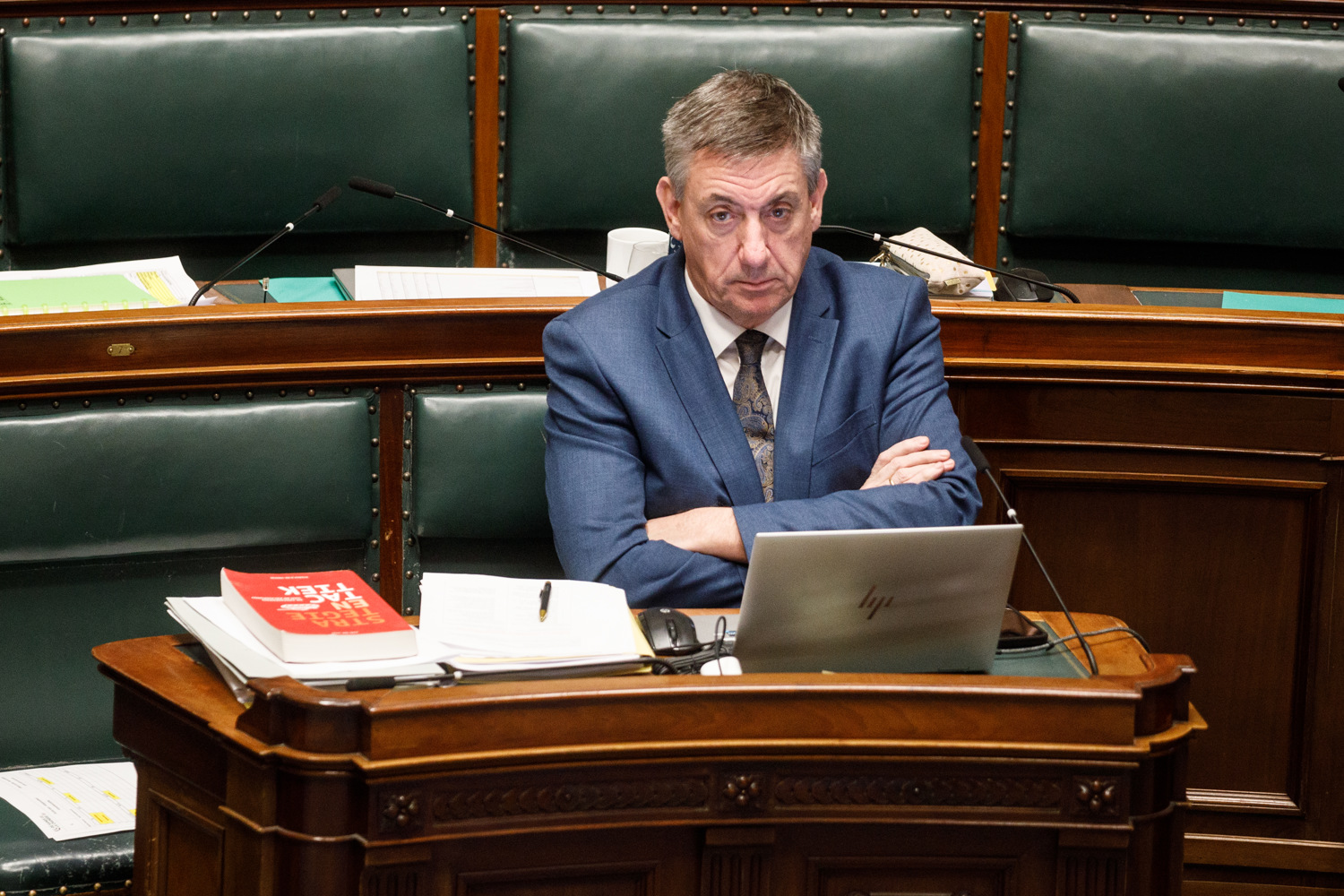
Minister of Finance and Pensions Jan Jambon (N-VA). Credit: Belga
For new pensioners, the average gross pension amount will fall by an average of 2.4% by the end of this Federal Government’s term.
Once all the measures are fully in place – for some this will happen quickly, for others it will take decades – the average gross pension will be as much as 5.6% lower.
This is largely due to the suspension of cost-of-living adjustments, but is also linked to the restriction of work-equivalent periods (times when someone is not working but which are still counted as worked for their pension) and the pension penalty.
Looking at the replacement rate (how high someone's pension is compared to their final salary), it is clear that the pension reform will hit civil servants hard. For them, that rate will fall by 15.2% by 2070. For employees, the fall is 7.2%, and for the self-employed, 3.2%.
The average pension for all pensioners combined would also fall compared to a scenario without reforms. The pattern is similar to that of the replacement rate, but less pronounced: -13.2% for civil servants, -6.2% for employees and -3.1% for the self-employed by 2070.
However, the average civil servant's gross pension (€3,589/month) is about twice as high as that of the average employee (€1,749/month), according to the 2025 figures.
Bad for (gender) equality
Another visible consequence of the reform is that pension inequality is set to increase.
By the end of the Federal Government's term (2029), the average gross pension amount for new pensioners on the lowest pensions will fall by 7.4%. For the highest pensions, the pension amount will actually rise by 1.1%.
Once all measures are fully implemented, the lowest pensions will fall by 12.1% and the highest by 5.7%.
Here too, the suspension of cost-of-living adjustments, the restriction on the duration of equivalent periods and the pension penalty play a significant role.
As critics had previously feared, the pension reform also increases inequality between men and women among new pensioners – the so-called "pension gap".
Credit: Belga
The impact of the reform also varies by gender.
While men will feel an impact due to the different calculation of work-equivalent periods, the impact on women will be significantly greater due to the suspension of prosperity adjustments, the restriction on the duration of work-equivalent periods and the pension penalty.
For employees, the average pension in 2070 will fall by 6.6% for women and 5.8% for men as a result of the measures. For the self-employed, the figures are 4.4% and 2.9% respectively.
However, the situation is reversed among civil servants. For them, the decline in the average pension in 2070 is greater for men (-13.8%) than for women (-12.8%) – meaning that the gender pension gap will be narrowing.
However, the Planning Bureau itself explains that this is due to the reform of favourable pension schemes, such as those for the military and SNCB/NMBS, where men are more strongly represented than women.
Still, across all systems in Belgium, the pension gap is likely to widen as a result of the reform.
Additionally, the risk of poverty is also rising for pensioners. For new pensioners, this risk climbs by 0.4 percentage points – from 5.9% to 6.3%. For all pensioners, the rise is even higher at 0.6 percentage points – from 5.5% to 6.1%.
For single, newly retired women, the risk of poverty also rises by 0.4 percentage points. For single, newly retired men, that risk remains stable.
Once the measures are fully implemented, the risk of poverty will rise even further, according to the Planning Bureau’s simulations.
The main reason for this is the suspension of cost-of-living adjustments, particularly those for minimum pensions.
'Negligibly small'
In a response, Federal Finance and Pensions Minister Jan Jambon (N-VA) pointed out that the budgetary impact of the pension reform is significant and that it also gradually harmonises the schemes for employees, the self-employed and civil servants.
"Measures that raise the earliest possible retirement age lead to a longer accumulation of pension rights and to a higher pension, and thus a higher standard of living for pensioners," his office said.
Additionally, the Federal Government emphasises that while the pension gap between men and women may widen among newly retired employees and the self-employed, it is actually narrowing among civil servants. It would also narrow among current pensioners.
According to Jambon's office, the impact on (gender) equality is moreover "negligibly small" when family composition and total household income are also taken into account.
The Planning Bureau calculates that inequality would then increase (depending on the coefficient used) by 1.1% to 1.5%.
Following the approval of the Committee on Social Affairs at first reading, a second reading will follow in the same committee. Afterwards, the full Parliament must still approve the bill. This is expected to happen before the summer.
