
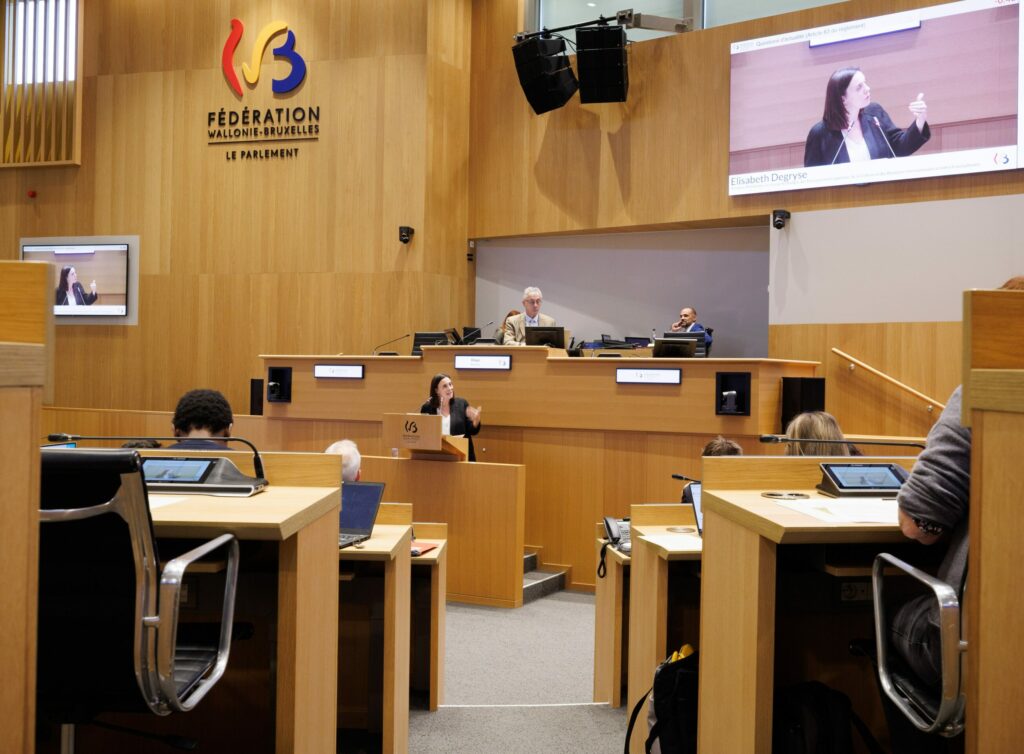
A large delegation consisting of members of the French-speaking community in Belgium arrived in Canada for a ministerial mission.
The Minister-President of the Federation Wallonia-Brussels (FWB), Elisabeth Degryse, and her Walloon counterpart, Adrien Dolimont, will lead the ministerial mission from 20 to 24 April, with stops in Montreal, Quebec, and Toronto.
The delegation includes over 140 representatives from businesses, academia, science, and culture, with nearly 100 of them coming from universities and colleges in francophone Belgium. Academic participation is especially notable this time, following minimal involvement in a previous economic mission to California last October.
Canada, particularly Quebec, is a key academic partner for the FWB, with long-standing ties between Belgian higher education institutions and Canadian counterparts. Currently, there are 202 cooperation agreements involving 26 Belgian institutions and 80 Canadian ones.
However, student mobility faces challenges due to Canada’s caps on new international students. This mission aims to explore ways to overcome such barriers and promote targeted mobility programmes, such as doctoral studies, post-docs, and long internships, instead of large-scale student exchanges.
Criticism & Academic focus
While the academic focus has seen broad support, the size of the delegation has drawn criticism. On Wednesday, Belgium’s PTB party called the delegation’s scale “incomprehensible” given the current budget restrictions imposed on FWB institutions.
When asked about the costs, Degryse refrained from providing a total figure. She clarified that institutions would receive fixed allowances for the trip: €2,500 for colleges and €3,500 for universities.
The mission, supported by Wallonie-Bruxelles International (WBI) and the Walloon Export and Foreign Investment Agency (AWEX), has been structured around four key areas summarised as IMPACT: Innovation, Partnerships in Academics, Culture, and Technology.
Academically, the focus will be on strengthening higher education and research ties while addressing structural obstacles to mobility for students, interns, and researchers.
Technological discussions will highlight Wallonia’s expertise in sustainable agribusiness, green biotech, biocontrol, biomass valorisation, and environmental technologies.
In aerospace, the delegation will visit companies such as Bombardier and Sonaca Montréal as well as Polytechnique Montréal. Quebec’s aerospace sector generated CAD 22.8 billion (€14.13 billion) in sales in 2024 and supported over 37,200 highly skilled jobs, demonstrating its exceptional capacity in manufacturing, simulation, and training.
Cultural representatives aim to develop new cross-residency programmes, partnerships in creative industries, and participation in the Franco-Quebecois strategy for managing cultural content.
"This diverse and dynamic delegation reflects the excellence of our ecosystems," said Degryse. She emphasised the mission’s ambition to strengthen existing collaborations and establish new agreements in critical areas such as culture and academia.
Dolimont added that the mission offers a unique opportunity to broaden cooperation in research, innovation, technology, and aerospace while advancing new joint projects. His government recently approved the second reading of a decree on CETA, the EU-Canada trade agreement.
The choice of Canada underscores strong historical links and shared priorities, backed by a solid economic partnership. Canada ranked as Wallonia’s 19th largest export market and 27th supplier in 2025 (€546 million exported, €117.9 million imported). Walloon exports to Canada have surged by 169.8% between 2024 and 2025, driven primarily by pharmaceuticals, which account for 76% of the total.
