

This week’s unusually low mid-May temperatures in Belgium saw the return of winter scarves and thick coats. But could a centuries-old religious myth be behind this week’s cold spell?
Indeed, Belgium and its neighbouring countries have been hit by polar winds coming from the Baltic Sea, bringing temperatures below 10°C, thunderstorms, wintery shows and even slush in the Ardennes this week.
For most of us city dwellers in need of some warmer air, it has been a difficult few days. And for centuries, gardeners in Northern Europe have dreaded the so-called curse of the Ice Saints.
Dating back to the Middle Ages, the Ice Saints folklore marks the feast days of three saints: Mamert (11/5), Pancras (12/5), and Servatius (13/5). In some cases, it also includes a fourth saint, Boniface (14/5), and ends with Sophia of Rome (15/5).
According to tradition, these dates mark the last possible frosts before the definitive arrival of warm weather. It is rooted in farmers historically noting a last cold winter spell halfway through the month of May.
"Don’t plant before the Ice Saints," went the well-known adage among farmers and gardeners for centuries. The expression is believed to have originated in Germany, where farmers would not plant their crops too early and risk losing their harvest to frost.
The trend was first noted by students of the legendary Italian astronomer Galileo Galilei, who observed a marked cold snap over the days of the Ice Saints between 1655 and 1670.
However, the head of the British Royal Meteorological Society, William Dines, in 1902, used more updated statistical techniques to prove this was, in fact, a myth driven by selective reporting.
Myth or science?
This year, Belgium’s cold spell has fallen over the exact days of the Ice Saints – 11 to 14 May.
Yet for Belgian meteorologist David Dehenauw from the Royal Meteorological Institute (IRM), a clear distinction must be made between tradition and scientific reality.
"The Ice Saints is a popular belief; people use this argument to explain why it’s colder at this time of year," he told SudInfo. "But if you analyse it, there are many more years when that’s not the case. For me, that’s not science," he says bluntly.
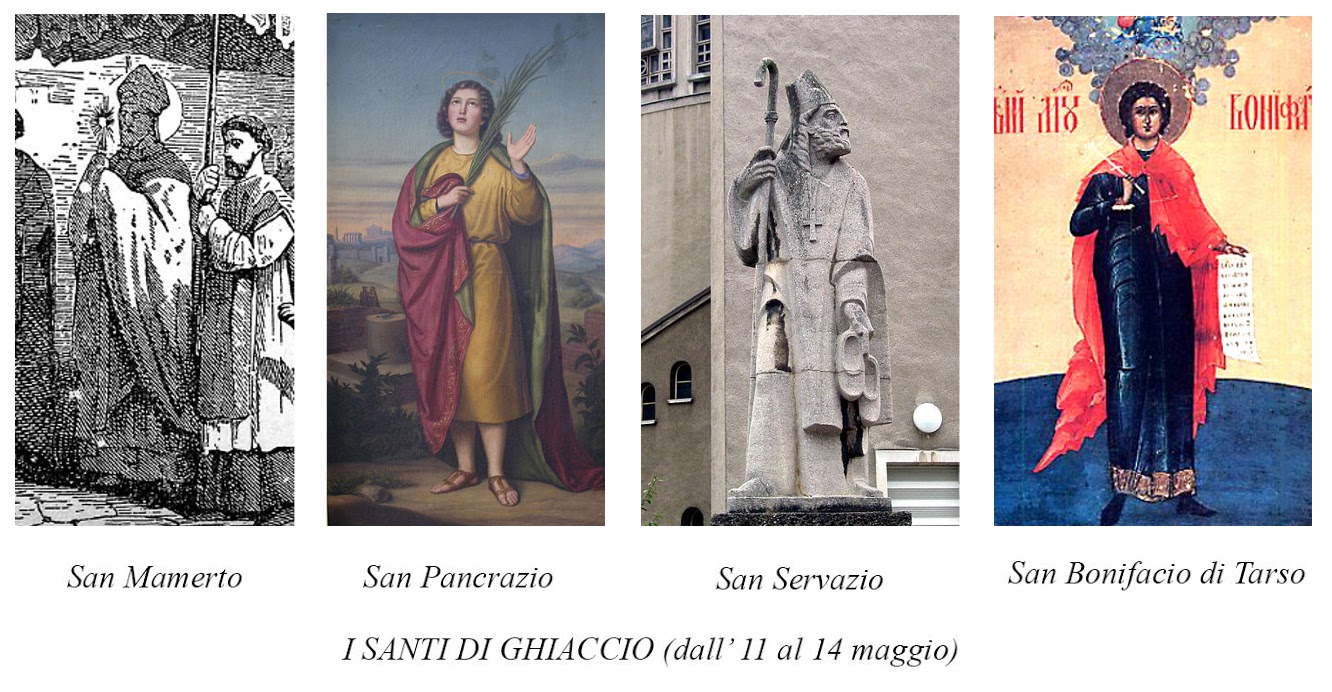
The Ice Saints (in Italian).
Indeed, the Ice Saints myth has been disproven scientifically. Yet, while the data presents more nuance, the general last cold snap of winter is still observed in and around this time of year.
For example, a review of weather data in London from 1941 to 1969 showed that 13 May was usually the warmest day of the month, but this was usually followed by a drop in temperature, according to the Guardian.
"Since 1991, the Ice Saints have no longer been observed," Sébastien Doutreloup, a climatologist at ULiège, told Le Vif.
According to his calculations, since the 1950s, the date of the last frost has, on average, moved up by a month, from the first half of May to the middle of April.
Doutreloup still cautioned against drawing hasty conclusions, as Belgium suffers considerable weather fluctuations – with the cold spell even arriving at the end of May in some years.

Illustration picture shows a couple watching the river La Meuse in Liege, Tuesday 07 May 2013. Credit: Belga
"The data fluctuates somewhat. So, to draw general conclusions from a climatic perspective, we need to calculate an average of the temperatures recorded in May over the past few years," he explained.
In other words, the cold has a much simpler explanation, and the saints have nothing to do with it – it all depends on the wind direction: "If it comes from the north or northwest, the weather is cooler. If it comes from the south, it’s warmer. It’s very simple," IRM's Dehenauw told Sudinfo.
While this may of course be true, it is much more entertaining to believe we are under the spell of the folkloric myth of the Ice Saints to explain these unseasonably cold temperatures.
The good news is, however, that the curse will be lifted by next week – with an expected return to (slightly) warmer climates.
