
Belgium had the sixth-highest average salaries among EU countries in the OECD in 2025, according to a report published by the intergovernmental organisation.
The recently-published Taxing Wages 2026 report takes a look at changes in taxation on employees and employers across the 38 member states of the OECD. It uses average gross wage figures collected from each of the countries, and focuses on changes between 2024 and 2025 as part of its analysis.
With an average wage of €62,348, Belgium sits in tenth place in the overall ranking of European countries within the OECD, which is topped by Switzerland and Iceland. Norway and the United Kingdom are the other non-EU countries ahead of Belgium, which is sandwiched between Ireland and Austria in the table.
Luxembourg had the highest average wage among European Union countries at €77,840, ahead of Denmark, the Netherlands, and Germany.
Other major EU countries are some way behind their northern neighbours, with France on €45,964, Italy on €36,594, and Spain at €32,678. Slovakia had the lowest average wage, with €19,590, while Hungary and Latvia were also below the €22,000 mark.
Wages stagnating in Belgium
As was the case elsewhere, Belgium saw an increase in the gross average salary of its workers compared to the previous year, having jumped from €60,370 in 2024 by nearly €2,000. However, this figure grew at a slower rate than in other countries.

Flags pictured at a special European Council summit to discuss continued support for Ukraine and European defence, Thursday 06 March 2025 in Brussels. Credit: Hatim Kaghat
Taking into account inflation (which averaged at 3% in Belgium across 2025), the previous twelve months will have seen the average salary before tax grew by only 0.3%. Only Austria saw a lower percentage increase in the EU, at 0.2%, while Greece, France, and Luxembourg were the other EU member countries where growth was lower than 1%.
The most dramatic increase was seen in Lithuania, which saw a 5.8% increase in wages, closely followed by Poland on 5.7% and Slovenia with 4.1%.
Gap narrowing between OECD members
As pointed out in a Euronews analysis of the report, the gap in average wages between OECD countries narrows once purchasing power is taken into account, compared to the nominal figures.
A separate ranking, measuring gross salaries in US dollars with equal purchasing power, sees Belgium move up to seventh place in the European rankings, with a gross average of $87,530. The country is notably ahead of the United Kingdom ($82 329), France ($67 273), and Italy ($60 503)
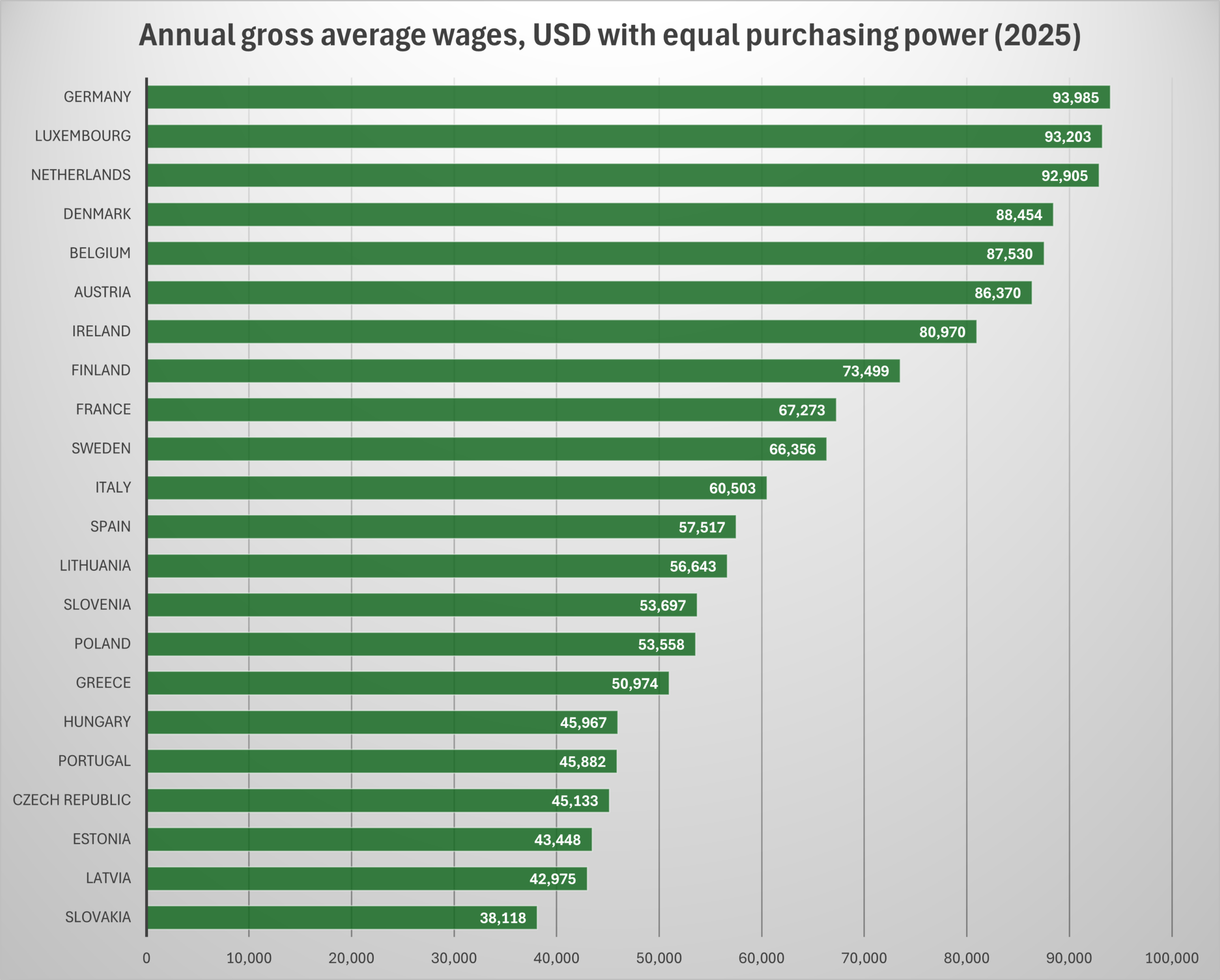
Credit: The Brussels Times / Taxing Wages 2026
Germany tops the list among EU countries, at $93,985, and is only behind Switzerland in the OECD-wide ranking.The lowest of the member countries, meanwhile, is Slovakia on $38,113, while the average among the EU countries that are members of the OECD is $64,771.
Belgium leads tax table
The report also found that Belgium had one of the highest average tax rates among OECD countries. For single workers with no children, the burden is nearly 40%, higher than for any other member.
The next-highest tax burdens were found in Lithuania, Germany, Slovenia, and Denmark, while the OECD average was around 25%.
Czechia had the lowest average tax rate, reaching around 21%, while among European countries as a whole, Switzerland's rate was the only one that fell below the 20% mark.
The OECD also analysed the differences in tax burdens for married couples, specifically those with one earner and one child. In these cases, Belgians pay only 19.9% on their income, a rate which places the country below the likes of Slovakia, Poland and Luxembourg.
