
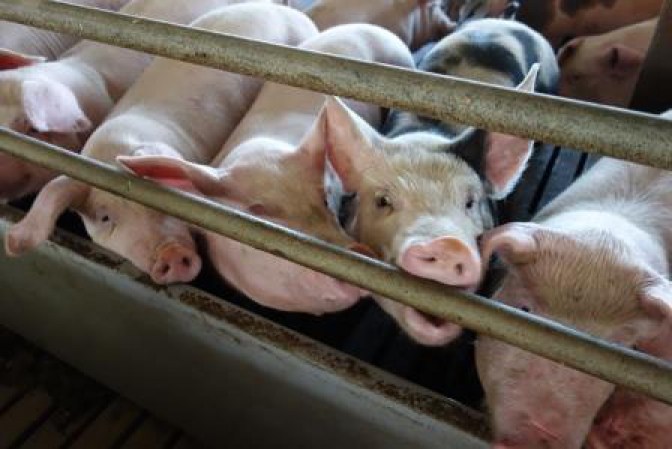
The European Commissioner for Health and Animal Welfare, Olivér Várhelyi, told recently animal welfare NGOs that the Commission does not intend to ban or phase out the use of high concentration carbon dioxide gas (CO2) for stunning of pigs at slaughterhouses in the EU.
As previously reported, the NGOs had sent letters to him on issues where no progress has been made so far on revising EU’s outdated animal welfare legislation. Last February, they contacted him about the stunning methods following the PigStun-project.
This project, initiated and financed by the Commission, tested and compared different methods with the objective of encouraging EU pig slaughterhouses to adopt more animal-friendly methods using non-aversive stunning. In his reply last week, seen by The Brussels Times, the Commissioner referred in positive terms to the PigStun project.
He also mentioned that the European Food Safety Authority (EFSA) has concluded that exposure to CO2 at high concentrations is highly aversive and causes pain, fear, and respiratory distress. “Therefore, EFSA recommends that this exposure is replaced by exposure to other gas mixtures.”
The NGOs had written that urgent action is needed by the Commission and called for the removal of high concentrations of CO2 from the list of permitted stunning methods for pigs. In the reply, the Commissioner repeated the Commission’s previous reasoning that the regulation already permits the use of the non-aversive alternatives identified in the PigStun project.
“This means operators can already adopt them without requiring regulatory changes,” the Commissioner wrote, without addressing the point in the letter that “pig slaughterhouses are unlikely to switch to more humane alternatives as long as EU law allows them to continue to use high concentrations of CO2”.
The Commissioner added: “It should be considered that while these alternatives present a balance of welfare, economic, and practical considerations (e.g. cost, ease of implementation), they also involve challenges for their commercial implementation (e.g. lower throughput rates, installation of stunning equipment) that could affect their application."
“We are deeply concerned that, once again, the Commission appears more focused on prioritizing economic arguments framed around ‘competitiveness’ and ‘resilience’ than on responding to citizens’ expectations and clear scientific evidence on animal welfare,” commented Olga Kikou, Director of Animal Advocacy & Food Transition, already in February.
The last deliverable in the PigStun project last year provided insights from stakeholders on the proposed alternatives, to reach general recommendations and facilitate a change away from conventional high concentration CO2 stunning of pigs.
While the project team found the alternatives have the potential to increase animal welfare, they also acknowledged that most of the ideas in the project have not yet been developed to commercial high-throughput scale (except for electrical stunning). For the gas stunning alternatives, no studies have yet been done at commercial scale to mitigate the reduced capacities that were observed.
Belgium is among the major producers in the EU pork market (after Spain, Germany, France, Poland, Denmark and the Netherlands). High-concentration carbon dioxide is still the most dominant stunning method for pigs in the EU, used to stun an estimated two thirds of all pigs slaughtered. In some countries the figure is over 80 – 90 %.
There are 17 pig slaughterhouses operating in Flanders. Asked about the situation in Flanders, a spokesperson of Ben Weyts (N-VA), the minister who is also responsible for animal welfare, replied that there is one large pig slaughterhouse in Flanders that uses electrical stunning. The other large slaughterhouses use CO₂ stunning. A number of smaller slaughterhouses also apply electrical stunning.
“At present, there are no plans in the pipeline to phase out CO₂ stunning, but we continue to monitor all developments in the field.”
