
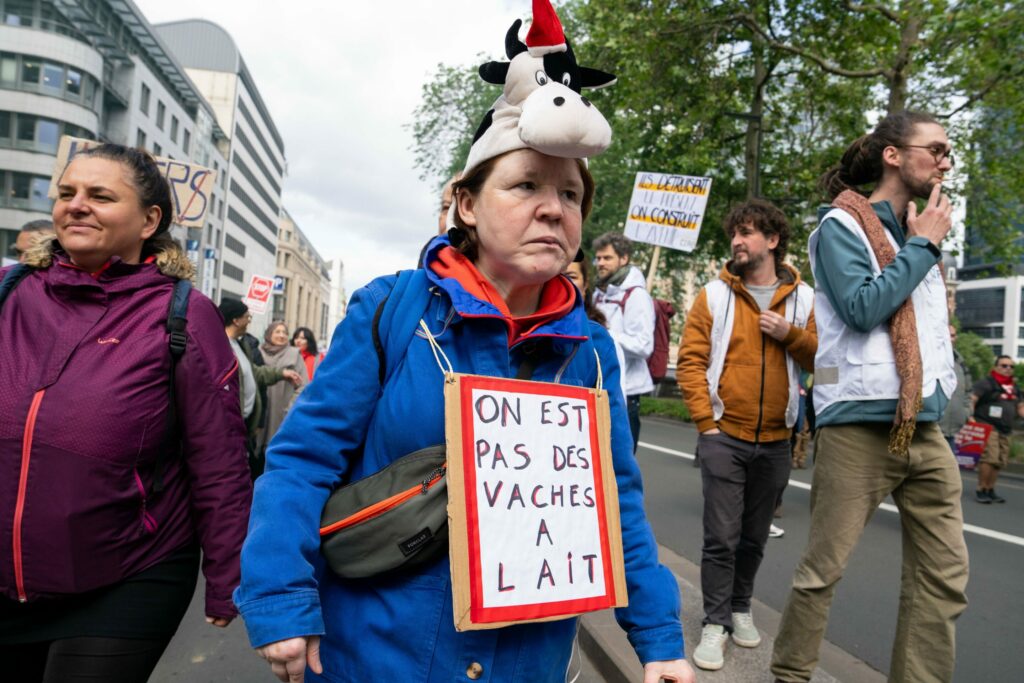
Belgium has historically been one of the most strike-prone nations, but as cost-of-living pressures grow, workers in other countries are taking to the streets more often than Belgians, according to analysis seen by Euronews.
Between 2020 and 2023, Belgium lost an average of 93.9 days to strike action, the second highest in Europe (where data is available) after Finland, according to the European Trade Union Institute (ETUI). But in the first quarter of this year, Portugal, Italy, Spain and France had the highest number of strikes across the EU.
Over 234 strikes were recorded in Portugal according to Euronews analysis of data from Strike Tracker, an AI tool that monitors strike action across Europe, alongside verified information from some national agencies.
According to the same source, Belgium had 43 strike days over the same period, which included a major public-sector day of action in February, shutting down activity across the country. Despite the low number, Strike Tracker cautions that Belgium's "centralised union structure means that when strikes happen, they tend to be large scale."
High union membership
Trade union membership, at 50%, is high in Belgium compared to other countries across the EU, giving it this highly centralised union structure. This figure places Belgium among the top countries for membership alongside Nordic countries.
In previous analysis, the ETUI explained that "unemployment and other social benefits are normally paid out through the union" which makes union membership pivotal.
Unions in Belgium also play an important role in collective bargaining agreements and negotiations. Noah Vangeel, affiliated with the Labour, Organisation and Social Dialogue research group at HIVA (KULeuven) previously highlighted to The Brussels Times that 96% of employees in Belgium are covered by such agreements.
Since the Federal Government introduced reforms to pensions and other working conditions, alongside recent strikes opposing cuts to the French community education system, Belgium has seen a wave of strikes.
However, when compared to other countries' recent figures, Belgium is actually less likely to strike.
Julie Macq, an advisor at ACV-CSC trade union, told The Brussels Times that the comparisons were "surprising".
She attributes it in part to the use of alternative action, such as the 'chalk revolution' used in the recent French community education strikes. Under this approach, the union encouraged supporters to leave messages in public places to raise awareness.
Cost of living crisis as a driver of strikes
According to Euronews, strikes across the EU have primarily focused on wages, with the cost-of-living crisis being a key driver of trade union action in recent years.
Francine Bolle, lecturer at the French-speaking Free University of Brussels (ULB) and director of the Centre for History and Sociology of the Left, previously explained to The Brussels Times that trade unions in Belgium play a balancing role, having both "the mobilising power of Southern Europe and the negotiation culture of the North.”
One of the outcomes of this structural role is automatic wage indexing. Belgium has a highly comprehensive system, which is rare across Europe and helps to keep wages in line with inflation. This in part explains why workers in other countries are striking at higher rates than Belgians.
However, just last month, the Federal Parliament voted to cap the level of automatic indexation for some workers and pensioners. Under the new rules, future index-linked pay rises will be fully applied only to the first €4,000 of a gross monthly salary. For pensions and benefits, the limit is €2,000 gross per month.
Both unions and employers urged the Federal Government to postpone the vote, and unions held a national strike to oppose the measure.
The government hopes the reform will slow the growth of labour costs, but business groups such as VBO and Unizo opposed it, alongside unions, describing it as a hidden tax increase and accusing the government of ignoring alternative proposals from employers and unions.
