
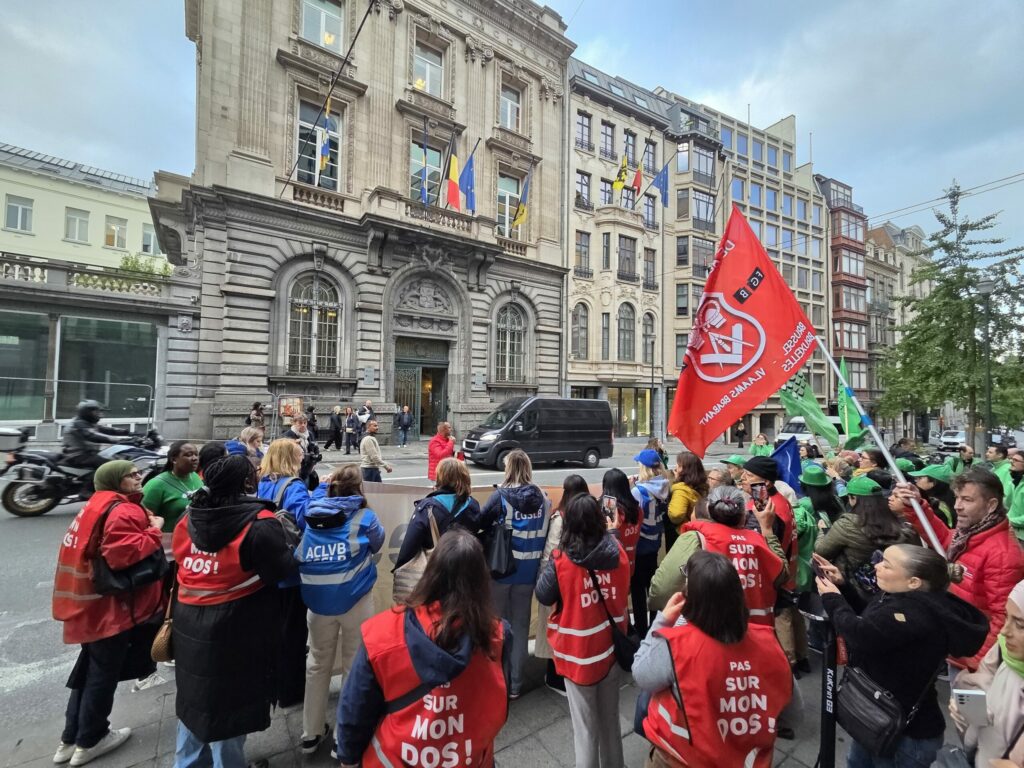
Belgium remains one of Europe’s most unionised countries, with around half of all employees still affiliated with a trade union - far above the European average.
Ahead of today's nationwide strike, we examine the significant role unions continue to play in Belgium's national life and how they developed into the powerful bodies they are today.
The 'pillarisation' system
According to historian Francine Bolle, lecturer at the Université libre de Bruxelles and director of the Center for History and Sociology of the Left, the so-called 'pillarisation' of Belgian society dates back to the end of the 19th century and helps explain how unions developed in the way they did.
“The working class was organised into major pillars: socialist, Christian, and liberal, each framing the worker’s life from cradle to grave,” Bolle told The Brussels Times. These pillars weren’t just political affiliations, they were entire social ecosystems. Workers chose unions, health funds, cooperatives, youth groups, and even holiday homes aligned with their ideological community.
The socialist pillar, represented today by the FGTB, maintained close ties with the Socialist Party and health insurers like Solidaris. The Christian pillar, led by the CSC, aligned historically with the Catholic Party and later with Christian democracy. The smaller liberal pillar, through the CGSLB, represented a vision of individual autonomy and economic liberalism.
Over time, these links loosened. As Bolle notes, “There has been, since at least the 1970s, a general trend toward union independence from political parties.” The FGTB declared its autonomy as early as 1945, and the Christian movement followed a similar path decades later.
But while formal ties have been severed, affinities remain. “Depending on who is in government, unions may find themselves closer to or further from their traditional political counterparts,” she says. “Today, there’s probably more distance between the Christian labour movement and Les Engagés than between the socialist unions and the Socialist Party.”
Social consultation
Despite this evolution, unions remain central to Belgium’s political fabric thanks to its model of social consultation - a structured dialogue between unions, employers, and the state. Within bodies like the National Labour Council and the Central Economic Council, these social partners negotiate wages, working conditions, and labour policy. “Belgian trade unionism is integrated in an extremely developed system of consultation and dialogue,” says Bolle. “It’s institutionalised.”
'Belgium has the mobilising power of Southern Europe and the negotiation culture of the North'
Compared with its neighbours, Belgium stands out for the strength and legitimacy of its unions. In France, for example, unions are politically loud but represent a small fraction of workers, “Belgian unions occupy an intermediary space,” says Bolle.
“They have the mobilising power of Southern Europe and the negotiation culture of the North.” She notes that the system of social consultation gives unions a structural role that few countries maintain. “In Scandinavian countries, social dialogue is also institutionalised, but it relies more on trust between partners,” she adds. “In Belgium, it’s formalised through a dense network of councils and joint committees, a framework that gives stability but can sometimes slow change.”
Benefits of union membership
Beyond collective bargaining, belonging to a union in Belgium comes with tangible benefits. Members can rely on unions not only for workplace disputes but also for social protection. “Unions here play a direct role in administering unemployment benefits,” Bolle explains. “That makes them unique in Europe, they’re not just advocates, they’re part of the welfare state.”
Legal assistance, professional training, and help navigating the complex rules of the labour market are part of the package. This practical support reinforces membership and ensures that unions remain close to workers’ everyday realities, rather than distant political actors.
For Bolle, the fact that so many Belgian workers continue to join unions reflects a deeply ingrained social habit: “Belgium has escaped the haemorrhage in trade unionism that affected much of Europe from the 1980s, we really had joint management between employer and trade union organisations."
That partnership, she says, “has resisted much more than in countries like England, where social security was dismantled.” Despite global shifts, this shared history of organisation and negotiation means that in Belgium, unions remain not only a political force, but a social institution.
