

Brussels Economy Minister Laurent Hublet (Les Engagés) has confirmed to The Brussels Times that from early 2027, freelance work permit applications from non-EU citizens will move to the federal 'Working in Belgium' online portal and be subject to a legal maximum deadline.
The change will revamp the 'outdated' professional card application process used by non-EU freelancers who want to start an independent activity in Brussels, giving a new guarantee that applications will take a maximum of four months to be approved.
The process in Brussels has been criticised for poor transparency and delays, with some applications taking up to five months to be approved.
Upcoming changes to the system have been confirmed to The Brussels Times by Brussels Economy Minister Laurent Hublet, who said: "We are going to remove a number of obligations to make it easier, which are things that the other Belgian regions have already removed, we are going to simplify a number of requirements."
Long processing times in Brussels
Processing times for professional cards in Brussels have stretched from around two months to five months in recent years, and advisers say rejection rates are far higher than in Flanders or Wallonia. The reforms aim to cut those delays and give applicants clearer legal certainty.
One of the key changes in the reforms will be a shift from applications being submitted and vetted via 'enterprise counters', towards a direct application via the Working In Belgium portal. The move will centralise the approvals for work and residency in one place, similar to the system in Flanders.
According to Sergey Chernetskiy from Beroepskaart.be, which guides non-EU nationals through the application, the process of obtaining a professional card in Brussels is "a bit outdated, in terms of the application approach".
According to Chernetskiy, removing the use of enterprise counters in Brussels and moving to direct application will save between two to four weeks in application time for entrepreneurs.
Currently, applicants with legal residence in Belgium must await approval from the Brussels Region that their freelance activity has been approved. Once this approval is received, and the professional card issued via an enterprise counter, applicants then need to apply for a change of residency via their commune. Those applying from outside Brussels must apply via an embassy who handles the process. Once they are in Brussels, they must then apply to convert their visa to a residence permit.
Better legal certainty and clearer deadlines
Alongside the shift to the Working in Belgium portal, Hublet's office confirmed that applications will come with greater clarity around deadlines and processing times.
Chernetskiy echoes some of the frustration being felt by applicants. "Recently the processing times has been increased. Two to three years ago it was quite fast with processing times by the regional administration of two months on average, now it tends to be three to five months on average," he said.
However, he argues that these problems are linked to the fact that the system is often seen, inaccurately, as a cheap and quick way to gain residency in Brussels. Chernetskiy believes reforms are needed to only attract "seriously oriented applicants".
The cost of applying, which has remained at €140 for the last 10 years, could also be increased to give more resources to those processing applications. "It takes, I think, quite a lot of hours to analyse the business case, financial plan, all supporting documentation, and I don't believe that €140 can cover those internal costs of the government," said Chernetskiy.

Credit: Canva
Faster processing times
As part of the reforms to the professional card system, Brussels Economy will be required to issue a decision within "a maximum period of four months".
This would bring Brussels in line with Flanders, although it is not clear if applications would be automatically approved if this deadline is missed, as they are in Flanders.
For renewals to professional cards, similar deadlines will come into force to provide certainty for applicants. If a renewal application is submitted at least two months before expiry, the professional card will remain valid until the final decision on the renewal. If an applicant is denied a renewal but appeals, they can continue to perform their freelance activity while the case is reviewed.
Chernetskiy noted that he and his colleagues have been seeing longer processing times for renewals – even though these are generally straightforward to process. "Instead of two to three months, it could be five to six months," he said. (Hublet disputes this. "Actually, what I see at the moment is that the process is going quite fast," he told us.)
Digital nomads not welcome
Where both Chernetskiy and Hublet agree is on the need for greater clarity on the types of businesses Brussels wants.
Currently, applications are assessed on economic contribution to the region, which according to Chernetskiy usually comes down to tax contributions based on revenue projections. "In Belgium it's kind of the country of taxes, so if you highlight very well all kinds of taxes, even from quite modest businesses, if you can highlight that it will generate easily 50k per year or even more," he said.
He suggested that service businesses, such as IT and HR consultancy, seem to find greater success compared to physical businesses, but even with this "it's important that you should have the client base in Belgium and in Brussels. They still consider that it's important for the digital services like this to be anchored in Belgium."
"In simple phrasing, they still don't admit that digital nomads, some kind of lifestyle digital nomad business, exists."
According to Hublet, "making sure that the people who are here, they can fulfil the conditions to actually receive the card," is the most important factor for reform. "In particular, having a better view on what are the jobs for which there is an acute demand" would help to focus the system," he argues.
The minister's office indicated that the framework set out in the All.In economic roadmap will serve as one of the guiding documents for assessing an application for its contribution to the regional economy, or its social or ecological impact. Under the current system, all appeals to professional card rejections are decided by the minister.
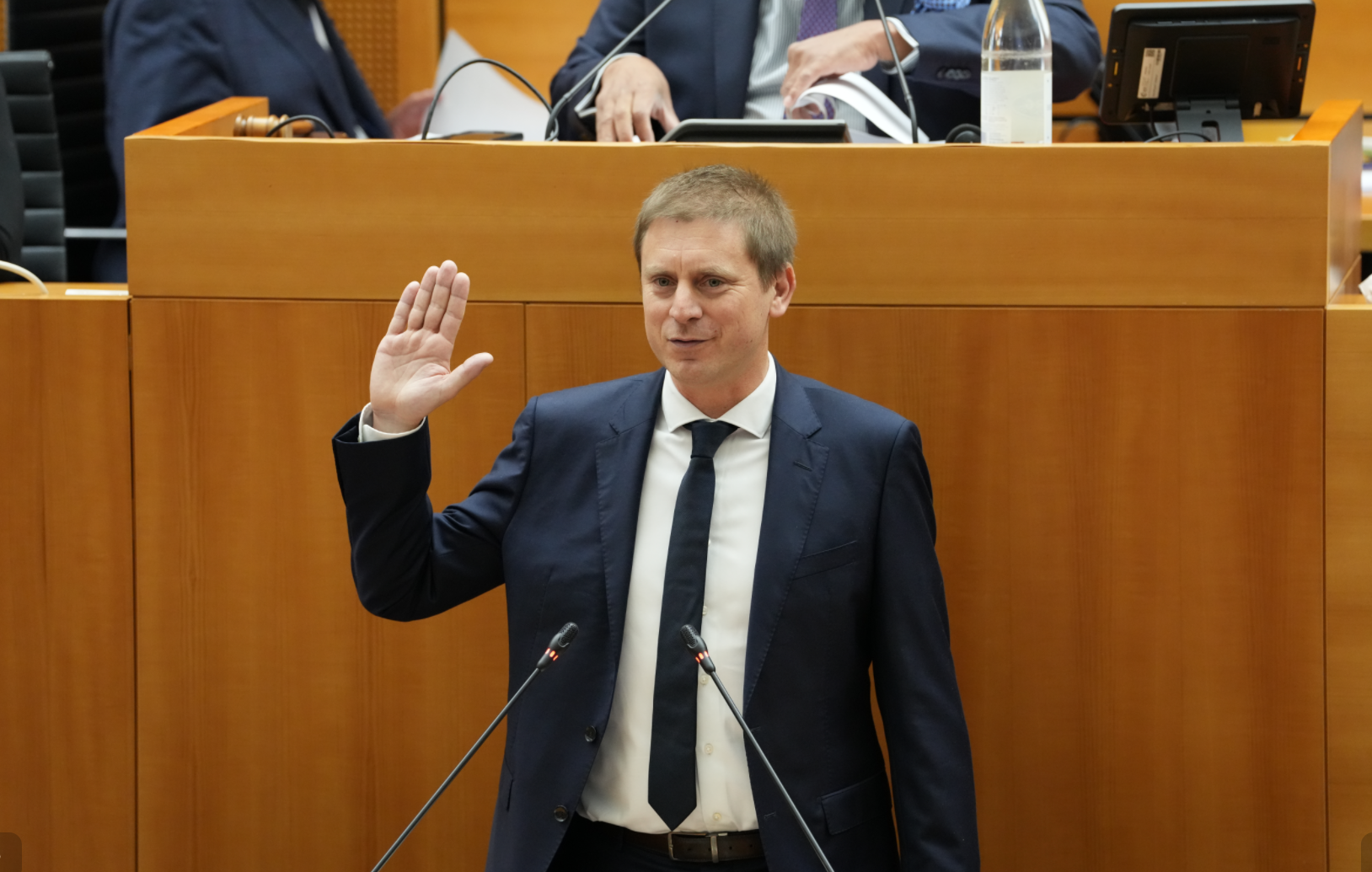
Brussels region Minister Laurent Hublet takes the oath during a plenary session of the Brussels parliament in Brussels, Saturday 14 February 2026. Credit Marius Burgelman/Belga
This economic roadmap also states that "for certain roles, and given demographic trends, it is necessary to attract highly specialised foreign professionals". Reform of the professional card application process seen as one way of attracting "promising young entrepreneurs".
Some argue Brussels is at risk of missing out on this specialised talent to other regions of Belgium. Chernetskiy noted the low success rate in the Belgian capital: "I would say in Brussels, we have higher rejection rates compared to Flanders and Wallonia. In Flanders our agency, we have quite high, let's say, success rate, roughly 90% but in Brussels, lately it was kind of more roughly 50 or 60%."
Explaining the reasons behind this difference he hinted at 'secret' rules behind applications. "We prepare with the same type of quality the materials like business plans, financial plans, and dossier overall, but they tend to be more rejected in Brussels than in Flanders, and lately we started to advise that if you have the choice to apply from from Brussels or from Flanders or from Wallonia, maybe to skip Brussels for now, because you just limit your chances just based on our latest experience."
Whether the reforms will reduce the application failure rate in Brussels is unclear. Brussels has not confirmed if applications will be automatically approved if they go past the four-month window, as they are in Flanders.
