
Belgian researchers of the Leuven university hospital (UZ Leuven) have discovered a way to detect autoimmune illnesses in pregnant women using the combined non-invasive prenatal test (NIPT).
By studying the DNA fragments counted in a NIPT, researchers found a way to predict whether pregnant women would develop illnesses like Lupus. While a NIPT, which also reveals the baby's sex, is not mandatory, it is very common among pregnant women in Belgium.
"The objective of a NIPT test is to determine fetal chromosomal abnormalities. In particular, trisomy 21, which everyone knows as Down syndrome. The intention is to detect that abnormality," Joris Vermeesch of the Department of Human Genetics of the University of Leuven, the team behind the discovery, told The Brussels Times.
This, he explained, is done by counting DNA fragments: if there are more than there should be, there is an abnormality in the fetus. "The test is very sensitive and specific, and that is why it has also been generally introduced in Belgium as a non-invasive prenatal screening test."
Using data that is already there
The newly developed method uses the data collected by a NIPT and studies the fragments. "We look at the distribution across the entire genome, but also at the type and nature of the fragments," said Vermeesch.
"Are they smaller or larger? What are the end motifs, and how are they distributed across the genome? We call that fragmentomics. That is data that is already present in the NIPT but that we have not used until now," he said.
In the case of autoimmune illnesses, the body attacks its own cells. These cell deaths leave a specific pattern in the DNA fragments, allowing researchers to predict pregnancy complications.
"Some people know that they have an immune disease. They enter a pregnancy with a certain prior knowledge," Vermeesch explained. "But some diseases, such as Lupus, are introduced or intensified by pregnancy. We also have autoimmune diseases that manifest more strongly because of pregnancy."
Pregnant women often dismiss the early symptoms of autoimmune illnesses, such as fatigue or joint pain, as regular pregnancy symptoms. As a result, treatment is often started late, while early detection would allow patients to get treated preemptively.
The new method can detect these illnesses with a relatively high success rate: 80% to 90%, said Vermeesch. Still, the method is not yet conclusive.
"There is certainly room for improvement, and we already have ideas about how to that. But given the relatively high accuracy, we think it is realistic to give this a clinical consequence and to stratify pregnant women in the future for better follow-up," he said.

A woman holding a positive pregnancy test. Credit: Pexels/Tima Miroshnichenko
As the method will enter clinical trials next, Vermeesch believes it can become part of prenatal care in the near future.
"The nice thing about the method is that nothing extra is needed, apart from an analysis pipeline. We already have a bioinformatics analysis, which can run in parallel with the result of the NIPT," he said.
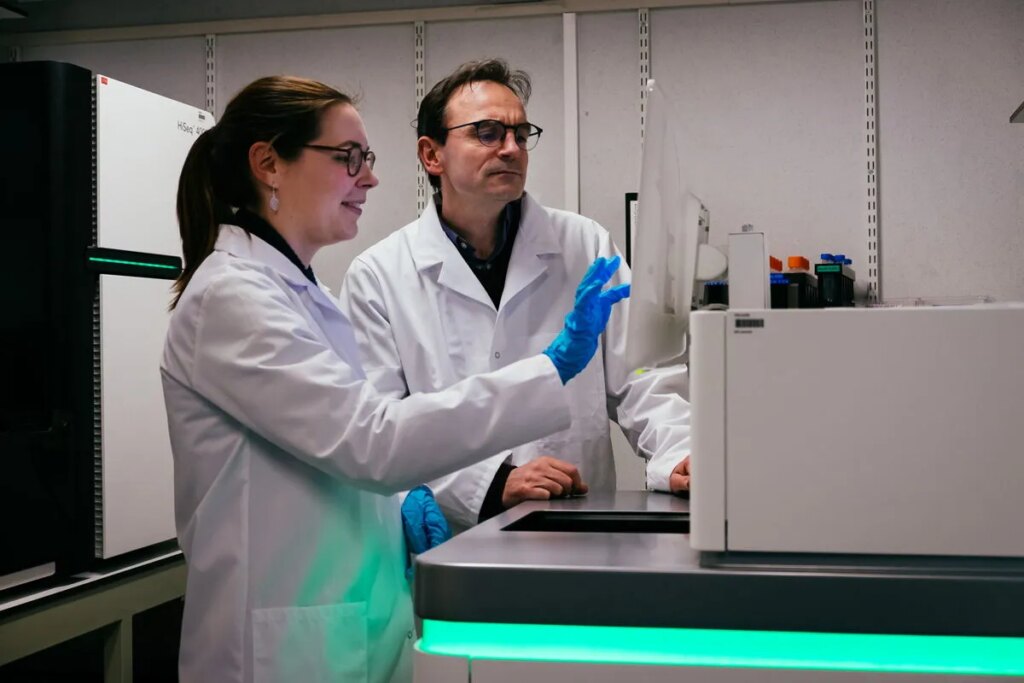
A blood sample will be sent to a lab, where the DNA is extracted and processing is carried out. This is put on a sequencer, and then the results are processed overnight. "In the morning, the analysts arrive, and the results are there. the results of the new method could form part of that, using the same data. There is hardly any additional cost, apart from a little computing."
Vermeesch and his team are the first to discover the method, and the only research team developing it.
"We validated the study with an external cohort from a group in Limburg. That allowed us to demonstrate that this works. But it is not a multicentre study. It is only being carried out at UZ Leuven. We are the first worldwide," he said. "But of course, we are looking at whether we can involve our colleagues in this."
